Sila Signs $1B Panasonic Supply Deal to Power Next-Gen Batteries
A landmark agreement between Sila and Panasonic Energy signals a pivotal shift toward domestic silicon-anode manufacturing amid geopolitical pressures.
EXECUTIVE BRIEF // KEY TAKEAWAYS
A landmark agreement between Sila and Panasonic Energy signals a pivotal shift toward domestic silicon-anode manufacturing amid geopolitical pressures.
MOSES LAKE, Wash. — Next-generation battery materials developer Sila Nanotechnologies has finalized a multi-year commercial offtake contract with global manufacturer Panasonic Energy to supply silicon-carbon anode materials, cementing a transaction the supplier indicates could exceed $1 billion in total value. The commercial pact marks one of the largest domestic commitments to alternative battery chemistries to date, injecting critical momentum into a nascent American supply chain that has weathered several years of retrenchment, corporate insolvencies, and cooling electric vehicle demand.
The agreement underscores a consequential evolution in how Western markets approach the clean energy transition. Beyond promising electric vehicles with higher energy density, longer operational ranges, and drastically compressed charging cycles, the commercial partnership highlights an overarching realignment of capital and industrial policy. As automotive original equipment manufacturers and battery producers race to derisk supply chains heavily dependent on East Asian processing, Sila’s commercial breakthrough signals that alternative anode chemistries are finally graduating from boutique pilot lines to high-volume automotive integration.
From Laboratory Chemistry to Commercial Scale
According to an analysis published by MIT Technology Review, the agreement represents a hard-won victory for an advanced battery sector battered by macroeconomic volatility. Over the past three years, several domestic battery developers struggled under the weight of capital-intensive scale-up timelines and softening vehicle adoption curves, with high-profile entities facing deep structural headwinds. Sila’s ability to secure a multi-billion-dollar commercial pipeline provides rare validation that synthetic silicon anodes can clear rigorous tier-one automotive qualification standards.
"After a tough few years littered with some high-profile failures, there’s some positive news for next-generation batteries in the US," reported MIT Technology Review, highlighting Sila’s milestone as an essential turning point for domestic advanced manufacturing.
Founded by former Tesla battery engineers, Sila has spent more than a decade engineering its proprietary Titan Silicon composite to replace conventional graphite. While silicon has long been recognized for its theoretical capacity to store up to ten times more lithium ions than standard synthetic or natural graphite, legacy attempts to deploy pure silicon suffered from severe volumetric expansion, where particles swelled by up to 300 percent during charge cycles, fracturing electrodes and prematurely degrading cell life. Sila overcame this barrier by encapsulating nano-sized silicon within a porous, micrometric carbon matrix that absorbs expansion internally.
Operational Expansion and Technological Architecture
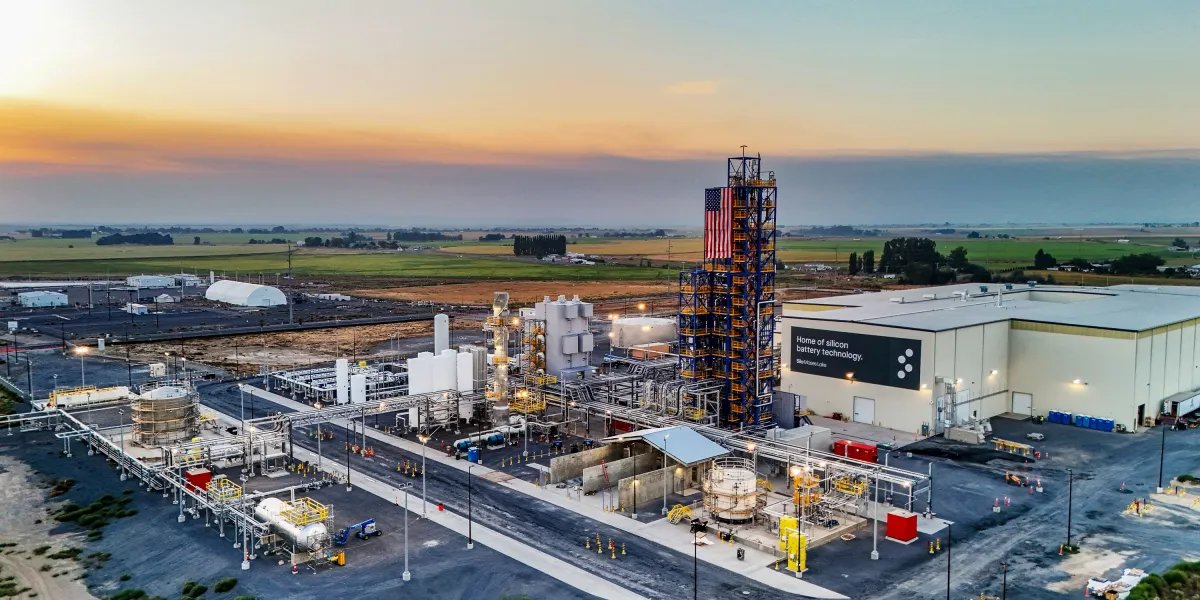
Under the terms of the multi-year offtake arrangement, Sila will manufacture the silicon-carbon material at its commercial facility in Moses Lake, Washington, shipping offtake directly to Panasonic Energy’s battery cell manufacturing plants across North America. To fulfill the volume requirements dictated by the multi-year timeline, Sila is executing an extensive expansion of its Moses Lake footprint, a capital program projected to create approximately 500 manufacturing and construction jobs while dramatically multiplying its annual metric tonnage.
For Panasonic Energy, an anchor battery supplier to major global automakers, the integration of Titan Silicon into its commercial cell architecture provides an immediate path toward boosting volumetric energy density by an estimated 20 percent, with an ultimate developmental roadmap targeting gains of up to 40 percent. In real-world automotive applications, these technical improvements allow vehicle designers to either extend driving ranges by hundreds of miles without adding physical pack mass or reduce pack weight and volume to manufacture lower-cost vehicles with comparable performance profiles. Furthermore, the anode chemistry significantly mitigates lithium plating during rapid replenishment, expediting charging cycles down toward 10 to 15 minutes.
Geopolitical Tailwinds and the Outlook for Industrial Sovereignty
The strategic imperative behind the transaction extends far beyond vehicle specifications. China currently controls more than 90 percent of global battery-grade graphite extraction and refining capacity, a monopolistic choke point that prompted Beijing to impose export controls on key anode materials in late 2023. Western automakers and cell manufacturers have consequently faced urgent pressure to diversify raw material sourcing and localize production within allied trade jurisdictions.
This vulnerability has catalyzed aggressive federal intervention. While earlier advanced energy ventures leaned almost exclusively on private venture capital and Department of Energy grants, Sila’s Moses Lake development has been bolstered by extraordinary state backing, including a $1.4 billion loan commitment from the U.S. Department of Defense under the Defense Production Act. The defense apparatus’s direct capital intervention demonstrates that battery production is no longer evaluated solely through the prism of climate decarbonization, but rather as an indispensable pillar of national defense, technological sovereignty, and economic security.
Moving forward, the primary test for Sila and Panasonic Energy will center on execution speed and yield economics. Transitioning from metric-ton pilot quantities to tens of thousands of metric tons per year requires unprecedented chemical precision and stringent cost controls. If the Moses Lake site meets its production and qualification milestones, the Sila-Panasonic alliance could establish the definitive technical and commercial benchmark for non-graphite anode commercialization across North America, permanently altering the competitive balance of global battery manufacturing.