Sweden Tests Hydrogen Range Extender After Norway Proves Electric Plow
After a battery-electric Scania cleared Norwegian mountain roads, a Swedish project adds hydrogen fuel-cell tanks to a battery truck in search of viability.
EXECUTIVE BRIEF // KEY TAKEAWAYS
After a battery-electric Scania cleared Norwegian mountain roads, a Swedish project adds hydrogen fuel-cell tanks to a battery truck in search of viability.
Nordic winter road maintenance authorities and commercial vehicle operators are evaluating competing zero-emission architectures for heavy-duty snow removal after a Swedish initiative introduced a hydrogen fuel-cell range extender onto a battery-electric truck platform, according to a report published by CleanTechnica. The deployment comes after a purely battery-electric Scania snowplow already demonstrated operational capability clearing mountain roads in neighboring Norway, raising fundamental economic and engineering questions regarding the necessity of auxiliary hydrogen infrastructure for municipal and highway winter fleets.
The divergence between Norway's direct battery-electric execution and Sweden's hybrid battery-hydrogen approach highlights a broader capital allocation debate across the European heavy-duty transport and clean energy sectors. As logistics providers, municipal transit agencies, and infrastructure planners work to decarbonize the most energy-intensive vehicle classes, the addition of compressed hydrogen storage tanks and specialized refueling equipment to an existing battery-electric chassis must establish a clear commercial and operational business case to justify its added capital expenditure and mechanical complexity.
Nordic Heavy-Duty Decarbonization Diverges
Snowplowing across high-altitude Nordic corridors represents one of the most demanding operational profiles in commercial transportation, combining steep gradients, sub-zero ambient temperatures, heavy chassis loads, and continuous auxiliary power draw for plowing blades and salt spreaders. Historically, industry observers viewed these severe duty cycles as a primary justification for hydrogen fuel-cell technology over pure battery-electric drivetrains.
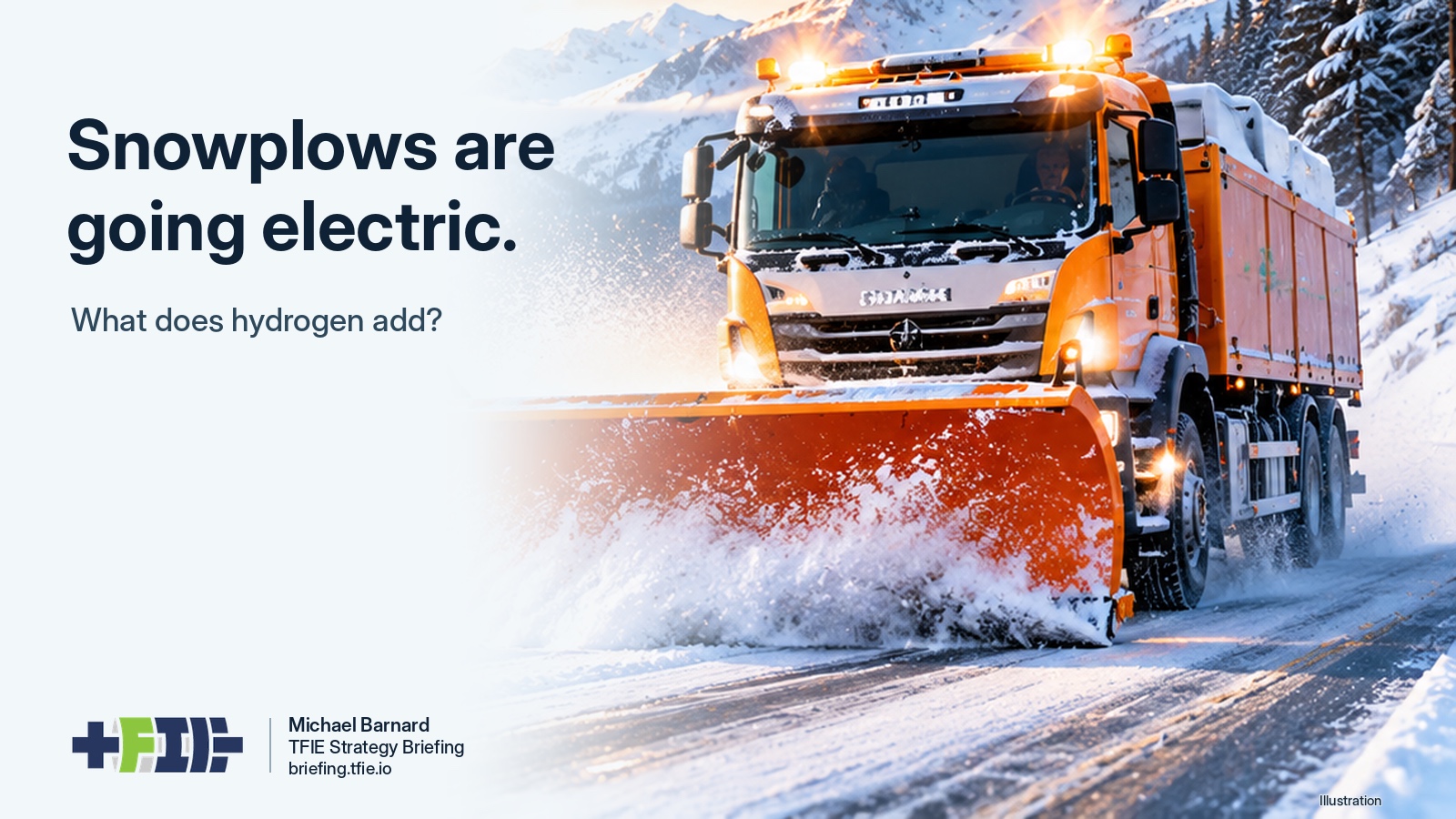
However, as reported by CleanTechnica, a Norwegian battery-electric Scania snowplow has already operated on mountain road routes, establishing an empirical baseline for pure battery propulsion under severe winter conditions. In contrast, the newly introduced Swedish configuration modifies a battery-electric truck by integrating a hydrogen fuel-cell range extender alongside dedicated hydrogen storage tanks and associated fueling hardware.
A Norwegian Scania has already plowed mountain roads. Sweden's new fuel-cell range extender adds tanks and fueling equipment to a battery truck and needs a business case.
Operational Complexity and Infrastructure Economics
From an engineering and fleet-management perspective, layering a hydrogen fuel-cell system onto a battery-electric truck introduces dual-powertrain maintenance requirements and distinct supply-chain dependencies. While a dedicated battery-electric snowplow relies strictly on high-capacity depot or route-based charging connected to the regional electrical grid, a fuel-cell range-extended vehicle requires both electrical charging apparatus and specialized high-pressure hydrogen dispensing infrastructure.
CleanTechnica notes that the Swedish project adds physical hydrogen tanks and dedicated fueling equipment to a truck that already carries a traction battery. For fleet procurement officers and municipal budget directors, this dual-system architecture alters the total cost of ownership calculation. Operators must weigh the capital cost of mobile or stationary hydrogen fueling equipment, the thermodynamic efficiency losses inherent in converting electricity to hydrogen and back into electrical power, and the physical payload or frame-rail space occupied by fuel tanks against the marginal operational range gained during extended snow-clearing shifts.
In regions such as Scandinavia, where hydroelectric and wind generation provide relatively low-cost grid electricity, direct battery charging enjoys a substantial operating-cost advantage over green hydrogen procurement. Consequently, any range-extender architecture must prove that its uptime or route-length benefits cannot be matched more economically by high-power megawatt charging or strategic battery capacity sizing.
Strategic Outlook for Municipal and Commercial Fleets
Looking ahead, the comparative performance of Sweden's fuel-cell range extender against Norway's proven battery-electric Scania operations will serve as a closely watched benchmark for European transport regulators and heavy-equipment manufacturers. As battery energy density continues to improve and high-output charging networks expand along Scandinavian freight corridors, the operational window in which hydrogen range extenders offer a distinct advantage faces increasing competitive pressure.
To secure long-term commercial adoption beyond pilot programs, the Swedish hydrogen-assisted configuration will need to demonstrate verifiable financial returns and operational resilience that clearly surpass standalone battery-electric trucks already in active mountain service.