NASA Studies Show How Gravitational Waves Can Reveal Exoplanets
Two studies led by NASA astrophysicists detail how the upcoming LISA space observatory could detect a unique population of exoplanets across our galaxy.
EXECUTIVE BRIEF // KEY TAKEAWAYS
Two studies led by NASA astrophysicists detail how the upcoming LISA space observatory could detect a unique population of exoplanets across our galaxy.
Two new studies led by NASA astrophysicists demonstrate in unprecedented detail how the upcoming Laser Interferometer Space Antenna (LISA) observatory could uncover a distinct and previously inaccessible population of exoplanets throughout the Milky Way by measuring gravitational waves—the subtle ripples in space-time generated by orbiting masses.
The findings represent a significant methodological expansion for planetary science and space instrumentation. While conventional exoplanet hunting relies heavily on electromagnetic observations, such as tracking the fractional dimming of starlight during planetary transits or measuring radial velocity shifts, gravitational wave astronomy bypasses optical limitations entirely. By leveraging space-time perturbations rather than light, the LISA mission—currently in active development—promises to map planetary architectures across galactic distances that remain obscured or unreachable by traditional space telescopes.
Expanding the Boundaries of Planetary Detection
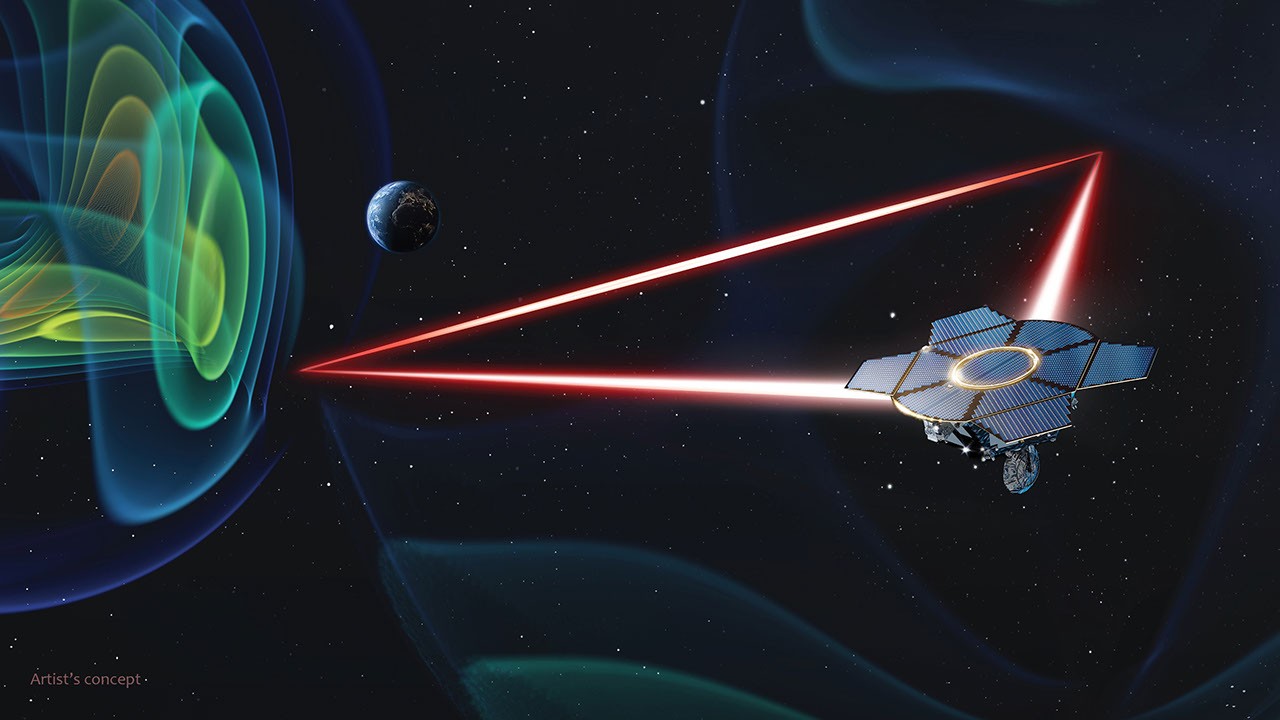
According to NASA News Releases, the LISA observatory is engineered to detect the minuscule distortions in the fabric of space-time caused when massive objects orbit one another. In the newly published research, NASA astrophysicists evaluated how this sensitivity can be applied to planetary systems beyond our solar system. Rather than observing light reflected or blocked by a distant world, researchers analyzed how a planet's gravitational pull alters the space-time signals emitted by its host system.
Traditional exoplanet detection surveys have cataloged thousands of worlds, yet those discoveries remain heavily concentrated within relatively nearby stellar neighborhoods due to the rapid attenuation of light and the obscuring effects of interstellar dust. Gravitational waves, by contrast, propagate across the galaxy virtually unimpeded by intervening matter. Because LISA operates in space rather than on Earth, it avoids terrestrial seismic noise and can monitor low-frequency gravitational wave signals over extended durations, allowing astrophysicists to probe dense galactic regions where optical instruments struggle to resolve individual targets.
Operational Capabilities and Galactic Reach
The two NASA-led investigations outline the specific physical mechanics that enable an interferometer in space to identify worlds beyond our solar system. As compact binary systems or other massive stellar remnants orbit each other, they emit continuous gravitational wave frequencies. When an exoplanet orbits such a system, its gravitational tug induces a measurable shift in the arrival times and frequency modulation of those space-time ripples—an effect analogous to the Doppler shift observed in electromagnetic spectra.
By modeling these subtle frequency modulations in detail, the NASA research teams demonstrated that LISA will possess the analytical resolution required to isolate planetary signatures embedded within galactic gravitational wave data. This capability opens a window into a unique population of exoplanets, particularly those orbiting evolved stellar systems that are rarely prioritized or easily analyzed in standard optical transit and radial velocity campaigns. Consequently, the mission's science yield will extend well beyond high-energy astrophysics and cosmology into comprehensive galactic planetary demographics.
Strategic Outlook for Space-Based Interferometry
As the LISA observatory advances through its development lifecycle, the dual studies provide actionable theoretical frameworks that mission planners and data analysis pipelines can integrate prior to launch. Establishing standardized algorithms to filter and identify planetary signals within complex gravitational wave backgrounds will be essential to maximizing the observatory's scientific return once operational operations commence.
Looking ahead, the convergence of gravitational wave astrophysics and exoplanet research marks a pivotal milestone for space science infrastructure. By proving that space-time ripples can serve as a reliable detection medium for distant worlds, NASA astrophysicists have broadened the operational scope of next-generation space observatories, laying the groundwork for a more complete census of planetary formation and survival across the entire galaxy.