NASA Launches $1M Student Design Challenge for Future Lunar Base
NASA opens a $1 million competition inviting U.S. high school and university teams to design critical infrastructure for sustained lunar habitation.
EXECUTIVE BRIEF // KEY TAKEAWAYS
NASA opens a $1 million competition inviting U.S. high school and university teams to design critical infrastructure for sustained lunar habitation.
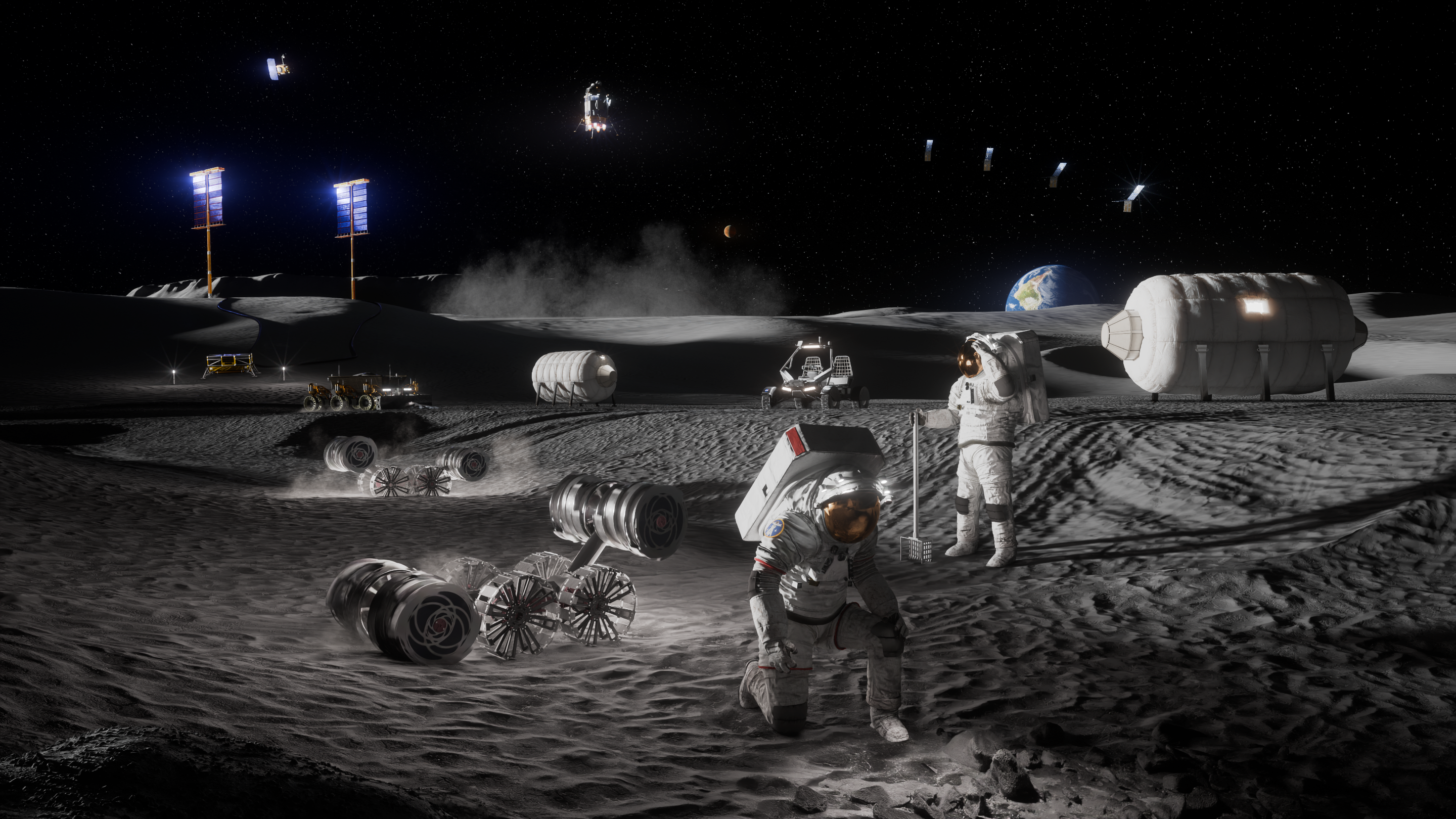
The National Aeronautics and Space Administration (NASA) announced on Sunday the formal opening of its $1 million Moon Base Student Challenge during a MAX POWER event hosted at the Kennedy Space Center Visitor Complex in Florida. Framed by the agency as a central initiative within what it terms a Golden Age of Science, the nationwide competition invites student teams from United States high schools and post-secondary educational institutions to submit engineering and architectural concepts for future lunar surface infrastructure. By tapping into emerging academic talent, the space agency aims to expand its pool of structural and operational designs required to transition lunar exploration from short-duration sorties into a permanent, sustainable presence on the Moon.
For the broader aerospace sector, defense contractors, and commercial space enterprises, the $1 million challenge signals an ongoing strategic emphasis on cultivating the domestic science, technology, engineering, and mathematics (STEM) workforce pipeline alongside long-term surface architecture development. As public and private capital increasingly converges on cislunar logistics, in-situ resource utilization, and autonomous habitat construction, early-stage academic competitions serve dual purposes: identifying novel systems-engineering approaches unconstrained by legacy aerospace paradigms and training the next generation of engineers needed by prime contractors and commercial lunar payload providers.
Academic Mobilization at Kennedy Space Center
According to NASA News Releases, the agency unveiled the competition parameters during the MAX POWER gathering in Florida, positioning student participation as a direct contribution to national space exploration objectives. By structuring the initiative across both secondary and post-secondary academic tiers, NASA creates parallel tracks that allow high school innovators and collegiate engineering departments to tackle distinct elements of lunar base design.
As part of a Golden Age of Science, the competition invites student teams at U.S. high schools and post-secondary schools to contribute designs for the Moon Base.
Historically, NASA has utilized prize-based university and student challenges to crowdsource solutions for complex environmental hurdles, ranging from regolith excavation and dust mitigation to closed-loop life support systems and radiation shielding. Engaging academic institutions directly at Kennedy Space Center underscores the operational link between launch infrastructure on Florida's Space Coast and the long-range mission planning required to support human crews working in deep space environments.
Economic Scope and Engineering Impact
The $1 million prize purse represents a targeted federal investment in decentralized research and development. While modest compared to multi-billion-dollar prime aerospace procurement contracts, challenge-based funding mechanisms consistently yield high returns on capital by incentivizing hundreds of multidisciplinary student teams to dedicate laboratory hours, computational modeling, and faculty mentorship toward solving specific agency problem statements.
Sustained lunar habitation presents formidable technical constraints that student design proposals must address. Any viable Moon Base architecture requires resilient power generation capable of surviving the two-week lunar night, thermal regulation across extreme temperature fluctuations, micrometeorite and cosmic radiation protection, and modular pressurized habitats that minimize launch mass and volume. By opening the design space to U.S. high schools and post-secondary schools, NASA encourages fresh trade-space analyses across materials science, robotics, power distribution, and human factors engineering. For aerospace employers and venture-backed space startups, these competitions also function as a proving ground where prospective engineering hires demonstrate practical systems integration and project management under strict programmatic criteria.
Strategic Outlook for Cislunar Infrastructure
Looking ahead, the designs generated through the Moon Base Student Challenge will feed into a broader ecosystem of lunar surface planning as the United States and its international partners work to establish foundational infrastructure on the Moon. While student conceptual designs undergo rigorous technical review before any sub-systems are considered for hardware prototyping or flight qualification, the ideas surfaced in academic challenges frequently highlight unconventional efficiencies in modular construction and resource management.
Over the coming months, participating U.S. academic institutions will organize faculty-led teams, refine technical specifications, and compete for shares of the $1 million award allocation. As commercial launch cadence accelerates and surface mission architectures mature, initiatives that bridge academic research and federal space agencies will remain vital to sustaining technical leadership and workforce readiness across the domestic aerospace industrial base.