NASA Highlights Rigel and the Witch Head Nebula in Deep-Space Feature
NASA's Astronomy Picture of the Day spotlights the interstellar reflection mechanics connecting supergiant star Rigel and the Witch Head Nebula.
EXECUTIVE BRIEF // KEY TAKEAWAYS
NASA's Astronomy Picture of the Day spotlights the interstellar reflection mechanics connecting supergiant star Rigel and the Witch Head Nebula.
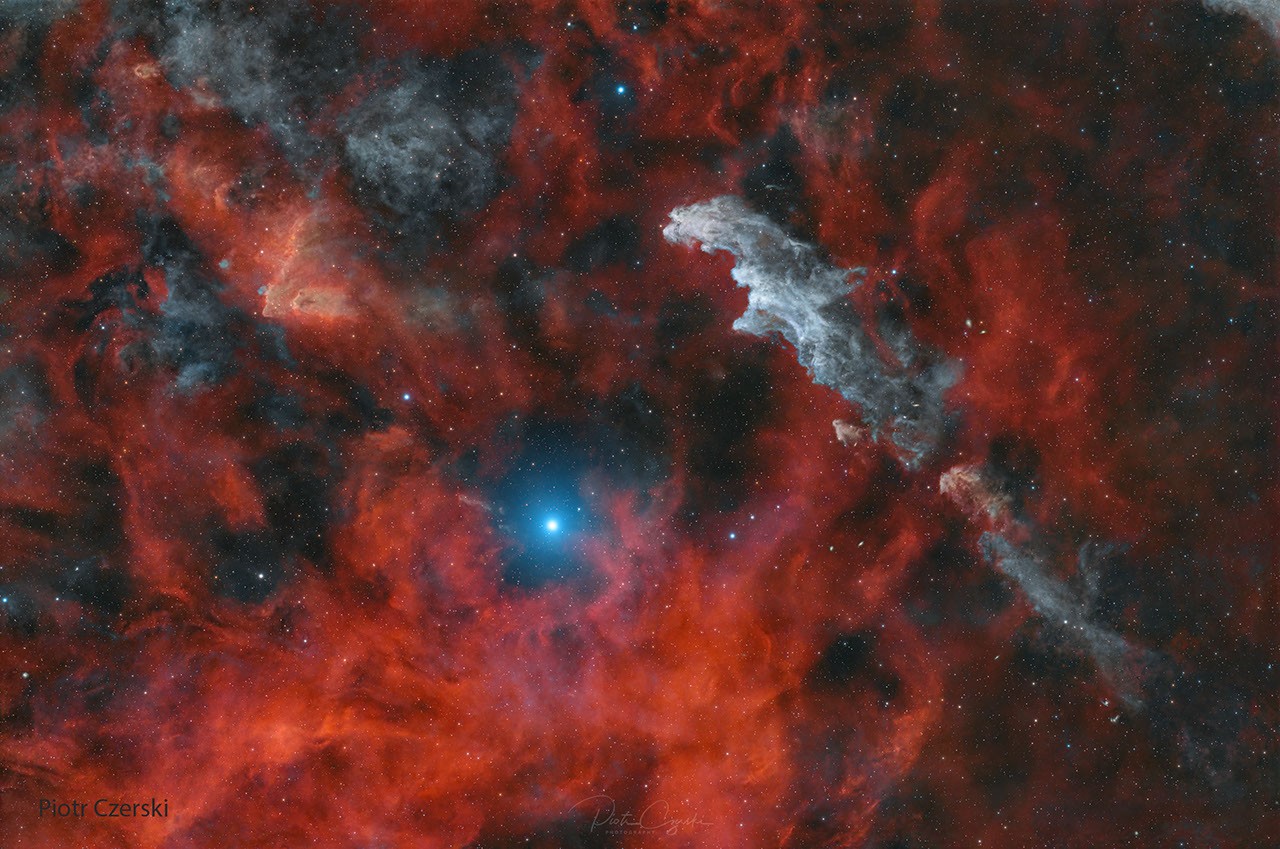
WASHINGTON — The National Aeronautics and Space Administration (NASA) featured the cosmic pairing of the blue supergiant star Rigel and the surrounding Witch Head Nebula in its Nov. 9 Astronomy Picture of the Day (APOD) release, illustrating the mechanics of interstellar light scattering and stellar radiation across deep-sky observation catalogs.
Published through NASA Science's daily astronomical archive and curated with commentary by professional astronomers, the release underscores the enduring role of high-resolution astrophotography and public-access observational datasets in documenting stellar evolution, interstellar dust composition, and radiative dynamics within the Milky Way galaxy.
Observational Context and the Astronomy Picture of the Day Archive
According to the NASA News Releases dispatch, the Nov. 9 installment continues the agency's long-running Astronomy Picture of the Day program, which presents a distinct astronomical image or photograph each day accompanied by a technical explanation authored by a professional astronomer. The program serves as a primary bridge between institutional astrophysical research, amateur and professional observatory networks, and global science education initiatives.
"Each day a different image or photograph of our fascinating universe is featured, along with a brief explanation written by a professional astronomer."
In the featured observation, the focus centers on Rigel, the brightest stellar system in the constellation Orion, alongside the delicate, billowing structures of the Witch Head Nebula. Officially cataloged in astronomical surveys as IC 2118, the Witch Head Nebula is a faint reflection nebula located inside the neighboring constellation Eridanus, positioned along the outer boundary of the Orion molecular cloud complex. Unlike emission nebulae that glow primarily from ionized gas excited by ultraviolet radiation, reflection nebulae become visible to optical instruments when fine interstellar dust grains scatter light emitted by a nearby luminous star.
Astrophysical Mechanics and Optical Scattering Dynamics
The physical relationship highlighted in NASA's feature demonstrates fundamental principles of radiative transfer and optical physics in the interstellar medium. Rigel, classified as a blue-white supergiant, emits intense radiation across the short-wavelength end of the visible spectrum. Furthermore, the carbon-rich and silicate-based microscopic dust grains distributed throughout the Witch Head Nebula scatter blue wavelengths of light far more efficiently than longer red wavelengths—a phenomenon analogous to the Rayleigh scattering that gives Earth's daytime sky its characteristic blue hue.
For observational astronomers and optical instrumentation engineers, capturing the interaction between an extraordinarily luminous stellar source like Rigel and a low-surface-brightness reflection nebula presents substantial technical challenges. Wide-field imaging systems must manage extreme dynamic range to prevent the glare of the primary star from saturating adjacent detector pixels while simultaneously integrating sufficient photon counts over extended exposure times to resolve the tenuous dust filaments of the nebula. These wide-field surveys provide essential empirical data on how massive stars shape their surrounding molecular clouds through radiation pressure and stellar winds, which can compress nearby gas regions and influence subsequent cycles of star formation.
Implications for Astronomical Cataloging and Public Science Portals
The continued operation and integration of the Astronomy Picture of the Day archive into NASA's modernized web infrastructure reflect a broader institutional commitment to open science and digital archive accessibility. By indexing daily visual telemetry alongside searchable archives, educational indices, and calendar registries, NASA Science maintains a standardized repository used by educators, planetary scientists, and commercial space imaging platforms worldwide.
As ground-based wide-field survey telescopes and space-based observatories continue to expand their multi-wavelength mapping of the Orion-Eridanus superbubble and surrounding stellar nurseries, comparative records curated through programs like APOD will remain vital for tracking calibration benchmarks, verifying wide-field astrophotography techniques, and advancing public engagement with deep-space exploration.