NASA Highlights Lunar Occultation of Saturn in Daily Astrophotography
NASA's Astronomy Picture of the Day features a celestial alignment showing Saturn passing behind the Moon, reinforcing public engagement in planetary science.
EXECUTIVE BRIEF // KEY TAKEAWAYS
NASA's Astronomy Picture of the Day features a celestial alignment showing Saturn passing behind the Moon, reinforcing public engagement in planetary science.
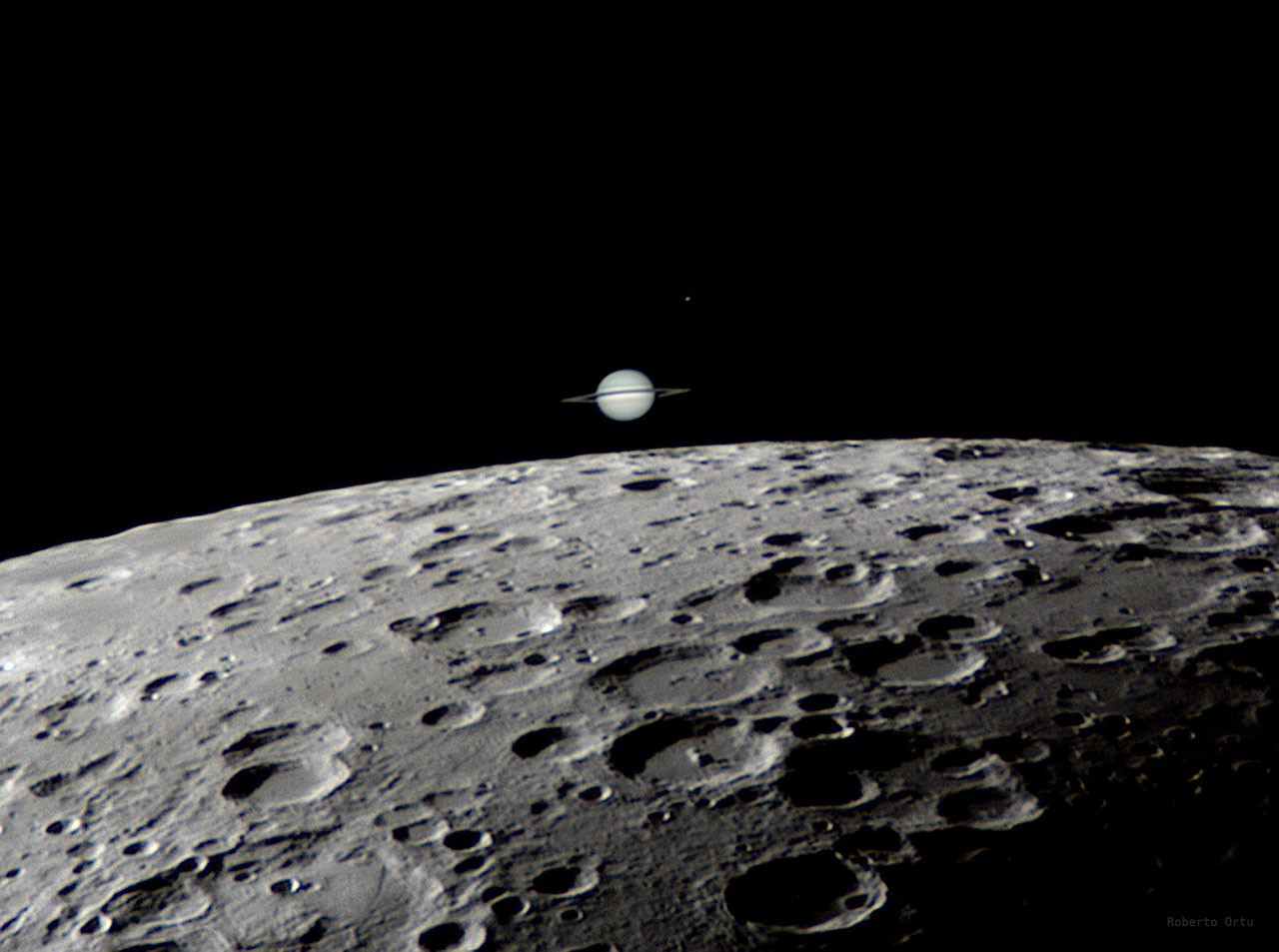
The National Aeronautics and Space Administration (NASA) has spotlighted a celestial alignment of Saturn passing behind the Moon in its November 10, 2026 edition of the Astronomy Picture of the Day (APOD), the agency disclosed in its science publication series. The featured observation, titled "Saturn Behind the Moon," documents a lunar occultation in which Earth's natural satellite crosses directly in front of the ringed gas giant along the line of sight from terrestrial observers. Curated alongside analytical explanations written by professional astronomers, the daily planetary imaging archive serves as a foundational bridge between high-precision observational astronomy and public science communication.
While primarily an educational and observational milestone, high-resolution planetary and lunar imaging plays an increasingly critical role in the broader space economy and frontier technology sector. As commercial lunar landers, cislunar space situational awareness networks, and deep-space optical navigation systems proliferate, precise astrometric tracking of celestial mechanics remains essential. Ground-based and orbital optical observations of planetary occultations provide vital calibration benchmarks for imaging sensors, atmospheric refraction modeling, and autonomous optical navigation algorithms deployed across commercial and governmental space missions.
Celestial Mechanics and the APOD Archival Mandate
According to NASA News Releases, the Astronomy Picture of the Day program operates on a continuous mandate to feature a distinct image or photograph of the universe each day, accompanied by technical context prepared by a professional astronomer. The November 10 feature capturing Saturn behind the Moon exemplifies the stark visual and physical contrast between two vastly different solar system bodies. During a lunar occultation of Saturn, the airless, cratered horizon of the Moon—located approximately 384,400 kilometers from Earth—passes across the visual plane of the outer solar system's second-largest planet, which orbits at a distance exceeding 1.2 billion kilometers.
Lunar occultations of bright planets occur periodically as the Moon travels along its inclined orbital path relative to the ecliptic plane. Because the Moon lacks a substantial atmosphere, planetary bodies disappear and reappear abruptly behind the lunar limb rather than fading gradually. For professional astronomers and astrophotographers alike, capturing the exact moments of ingress and egress requires sub-second timing accuracy, high-dynamic-range sensor calibration, and advanced atmospheric dispersion correction to resolve both the brightly illuminated lunar surface and the dimmer, distant disk and ring system of Saturn within a single composite or sequential exposure.
Technological and Observational Impact on Space Operations
Beyond their visual appeal in public outreach archives, optical alignments such as the Saturn occultation demonstrate the ongoing evolution of ground-based and amateur-professional astrophotography hardware. Modern complementary metal-oxide-semiconductor (CMOS) imaging sensors, high-speed lucky imaging techniques, and automated telescope mount tracking systems enable terrestrial observers to achieve angular resolutions that previously required dedicated institutional observatories. By stacking thousands of millisecond-level video frames, imaging pipelines effectively freeze atmospheric turbulence, separating the crisp geometric rings of Saturn from the rugged topography of the lunar limb.
In the operational aerospace domain, similar optical tracking methodologies underpin cislunar space domain awareness. As international space agencies and private aerospace contractors expand operations toward the lunar south pole and cislunar orbits, optical sensors must routinely distinguish faint distant objects—such as deep-space probes or orbital debris—against the high-albedo glare of the Moon. The dynamic range challenges inherent in photographing Saturn adjacent to the lunar horizon directly mirror the radiometric calibration hurdles faced by spacecraft star trackers and optical navigation cameras operating in the Earth-Moon system.
Strategic Outlook for Planetary Observation and Outreach
Looking ahead, NASA's sustained publication of daily astronomical imagery through the APOD platform continues to reinforce global STEM engagement and open-science data accessibility. By pairing citizen-science and institutional astrophotography with peer-grade astronomical commentary, the agency maintains one of its longest-running digital outreach infrastructures. As next-generation ground-based survey telescopes and cislunar orbital observatories come online over the coming decade, the integration of public astronomical archives with automated sky-monitoring networks will further deepen both scientific literacy and precise observational cataloging of solar system phenomena.