NASA Highlights Dwarf Galaxy NGC 4449 as a Cosmic Starburst Laboratory
Featured by NASA's Astronomy Picture of the Day, irregular dwarf galaxy NGC 4449 offers astronomers a nearby benchmark for intense galactic star formation.
EXECUTIVE BRIEF // KEY TAKEAWAYS
Featured by NASA's Astronomy Picture of the Day, irregular dwarf galaxy NGC 4449 offers astronomers a nearby benchmark for intense galactic star formation.
WASHINGTON — NASA News Releases featured the irregular dwarf galaxy NGC 4449 in its November 11, 2026, Astronomy Picture of the Day (APOD) dispatch, underscoring how compact galactic systems exert an outsized influence on modern astrophysical models of star formation and cosmic evolution. Cataloged under the headline "NGC 4449: Small Galaxy, Big Impact," the agency's daily astronomical briefing spotlights the dwarf galaxy alongside analytical context curated by professional astronomers to illustrate the turbulent dynamics governing smaller galaxies across the universe.
While massive spiral and elliptical galaxies frequently dominate observational surveys, dwarf systems like NGC 4449 serve as critical laboratories for space science agencies and observatory networks worldwide. Because smaller irregular galaxies possess lower gravitational binding energy and distinct chemical enrichment histories compared to massive spirals, tracking their star-forming episodes allows researchers to test how primordial galaxies assembled matter during the early epochs of the cosmos. For international space agencies managing multi-billion-dollar orbital assets, nearby irregular galaxies provide high-resolution benchmarks that calibrate deep-field observations from next-generation space telescopes.
Observational Context and the APOD Mandate
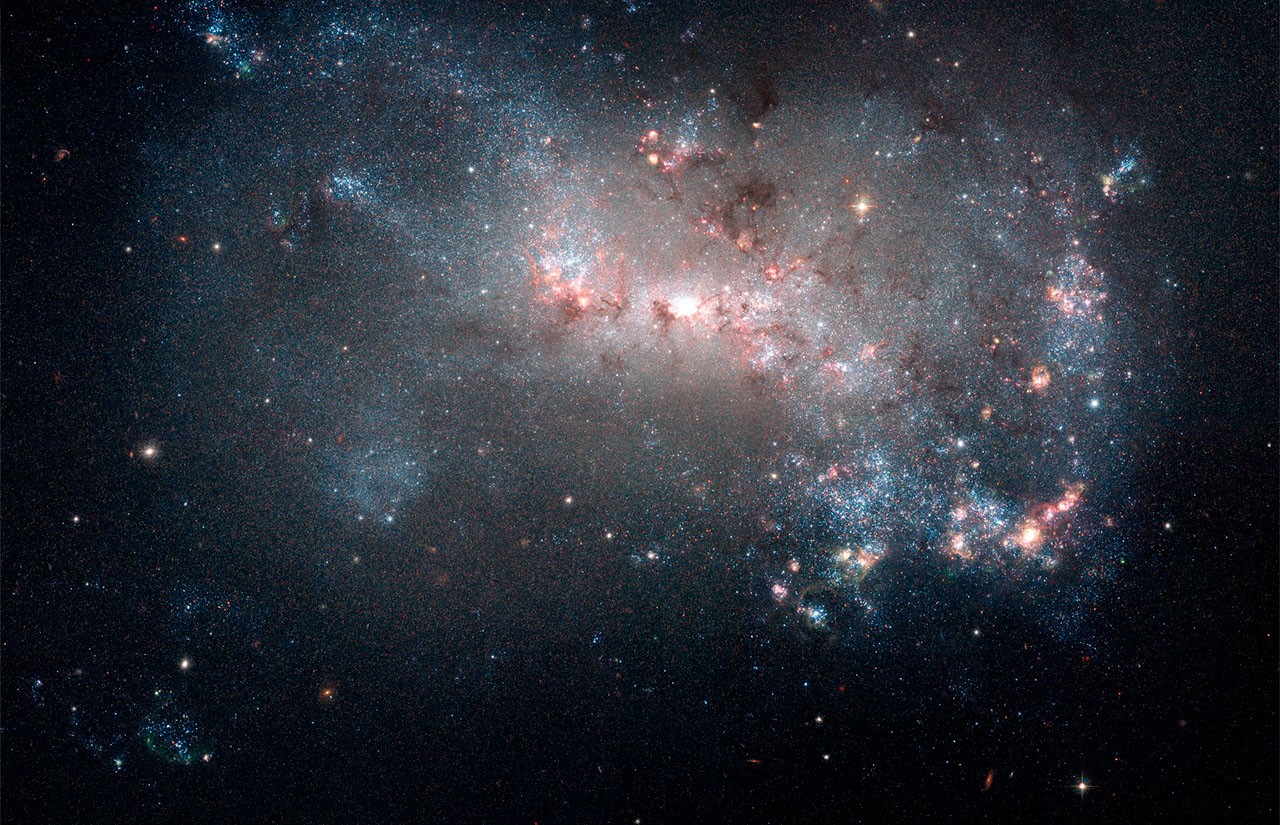
According to NASA News Releases, the Astronomy Picture of the Day program pairs daily cosmic imagery with technical explanations authored by professional astronomers to document notable celestial phenomena. In selecting NGC 4449 for its November 11 feature, the program directs attention to a well-studied member of the Canes Venatici constellation region, situated roughly 12 million light-years from Earth. Despite measuring less than 20,000 light-years across—comparable in scale to the Large Magellanic Cloud, a satellite galaxy of the Milky Way—NGC 4449 exhibits widespread, vigorous stellar birth across its entire disk rather than solely within defined spiral arms.
Astronomers classify NGC 4449 as a starburst galaxy because it converts interstellar gas clouds into new stars at a rate significantly higher than expected for its modest physical mass. Observational records maintained by NASA and partner astronomical institutions indicate that this intense activity is likely driven by past gravitational interactions or mergers with smaller companion galaxies. Glowing pink hydrogen gas clouds and clusters of young, massive blue stars permeate the galaxy's structure, offering spectroscopists a direct view of how stellar winds and supernova shockwaves redistribute heavy elements back into the interstellar medium.
Astrophysical Impact and Multi-Wavelength Calibration
The scientific significance of NGC 4449 extends across multiple wavelengths of the electromagnetic spectrum, making it a staple target for space-based observatories operating in optical, infrared, and ultraviolet bands. When massive stars ignite within a compact irregular galaxy, their intense radiation ionizes surrounding hydrogen reservoirs and clears out cavities in interstellar dust clouds. Studying these feedback loops in a relatively nearby system enables astrophysicists to measure star-formation efficiency at the individual cluster level—a granularity that remains impossible to achieve when observing distant galaxies billions of light-years away.
Furthermore, NGC 4449 was the first dwarf galaxy discovered to possess a tidal stellar stream, a faint halo trail of stars torn from an even smaller satellite system undergoing gravitational disruption. This structural evidence reinforces hierarchical galaxy formation models, which posit that even dwarf galaxies grow by accreting smaller neighbors. By comparing local starburst dwarfs against high-redshift galaxies captured in deep-space surveys, mission scientists can isolate how metallicity, gas density, and tidal forces regulate the lifecycle of galactic ecosystems.
Strategic Outlook for Deep-Space Astronomy
Looking ahead, continued high-resolution monitoring of benchmark targets such as NGC 4449 will remain central to the scientific return of orbital observatories and ground-based survey telescopes. As international space agencies allocate observation time across optical and infrared instruments, cross-referencing archival imagery with fresh spectroscopic data allows research teams to refine theoretical simulations of galactic feedback and dark matter distribution in low-mass halos.
Public dissemination initiatives like NASA's Astronomy Picture of the Day also fulfill a broader institutional mandate by bridging technical astronomical research and public scientific literacy. By highlighting how a relatively small irregular galaxy yields major insights into cosmic history, NASA's latest release reinforces the strategic value of sustained multi-wavelength sky surveys in decoding the origins of stellar populations across the universe.