Ex-Facebook Engineer Builds Autonomous Databases to Audit AI Outcomes
Dave Goldblatt has launched two automated platforms to separate artificial intelligence hype from documented real-world results and verify critic claims.
EXECUTIVE BRIEF // KEY TAKEAWAYS
Dave Goldblatt has launched two automated platforms to separate artificial intelligence hype from documented real-world results and verify critic claims.
Dave Goldblatt, a product engineer at Mission Control AI and former Facebook employee, has launched two autonomous research databases designed to evaluate the tangible real-world outcomes of artificial intelligence and fact-check prominent industry commentary, according to a report by Fast Company. Operating without external funding, Goldblatt created Because of AI to catalog documented instances where artificial intelligence has either succeeded or failed to deliver measurable benefits across sectors including medicine, education, transportation, and accessibility. Alongside a companion platform called Pundit Claims, the initiative seeks to establish an empirical baseline for technology evaluation at a time when public skepticism toward artificial intelligence is rising sharply across the United States.
The emergence of independent, automated verification platforms highlights a growing demand among enterprise decision-makers, investors, and the broader public for objective performance auditing in the artificial intelligence sector. As technology vendors commit billions of dollars to infrastructure expansion and model deployment, a widening gap between marketing narratives and operational reality has fueled public fatigue. By evaluating deployments strictly on evidentiary strength, direct attribution, and timeline of impact, Goldblatt's databases offer an analytical framework for distinguishing genuine technological utility from flawed execution and speculative hype.
Public Fatigue and the Push for Ground Truth
The launch of Because of AI arrives amid measurable American weariness regarding artificial intelligence proliferation and governance. According to a Talker Research survey cited by Fast Company, 54 percent of Americans report that they are tired of hearing about artificial intelligence. Public reservations extend equally to physical infrastructure and policy oversight. A poll conducted by the University of Massachusetts Amherst found that only one in nine Americans supports the construction of AI data centers in their local communities, while a Pew Research Center survey indicated that 67 percent of respondents hold little or no confidence in the federal government's capacity to regulate the technology effectively.
Goldblatt conceived Because of AI during a subscriber chat for The Exponential View, a newsletter published by British technology entrepreneur Azeem Azhar. After a fellow participant inquired whether any dashboard existed to track measurable improvements to human life directly attributable to artificial intelligence, Goldblatt used Anthropic's Claude assistant to compile an initial inventory. Encouraged by the community's response, he built and deployed the dedicated website in four hours on October 23.
"Everyone who is involved in tech and works in AI knows that it is tremendously powerful, and, of course, like anything that's tremendously powerful, it can be a great thing, or it could be a terrible thing. At the very least, we can establish some sort of a ground truth inasmuch as ground truth exists anymore."
Since its October debut, the platform has operated largely autonomously, relying on artificial intelligence tools to continuously monitor literature and update its records. Goldblatt told Fast Company that the site currently attracts between 200 and 300 daily visitors as its automated systems steadily expand the underlying repository.
Documented Successes, Clinical Shortfalls, and Critic Audits
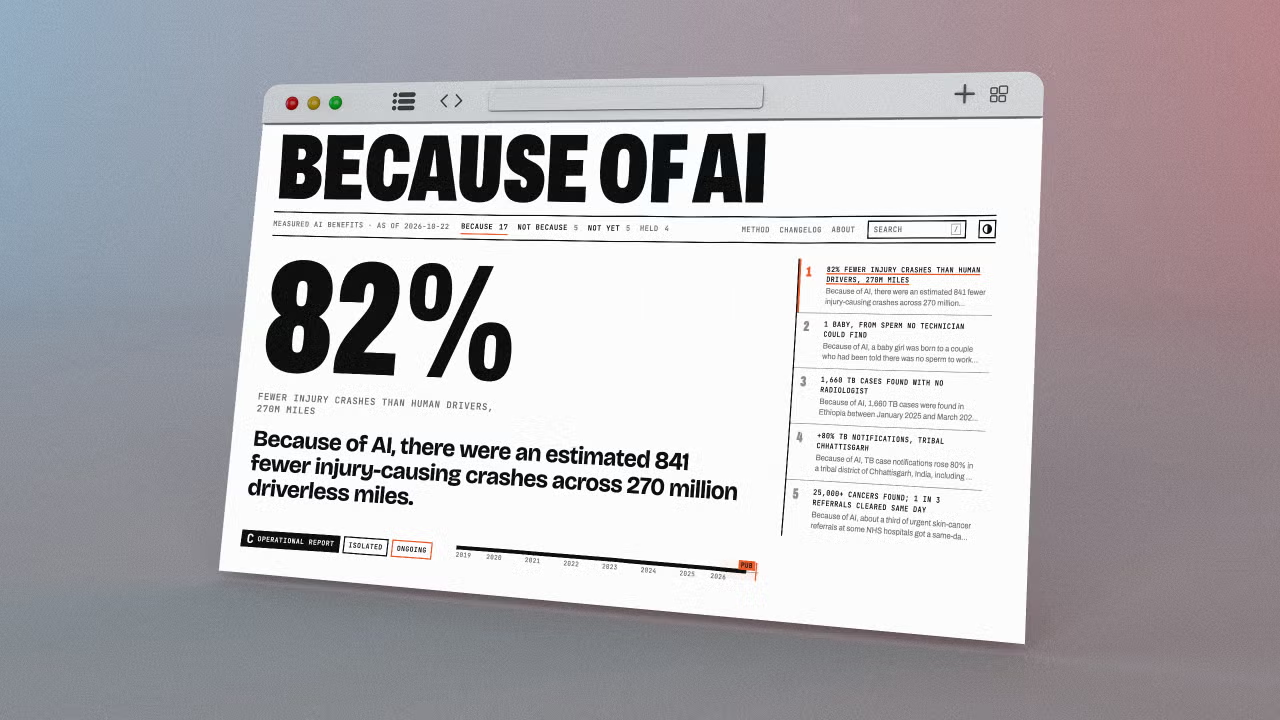
To provide structured analysis, Because of AI categorizes documented deployments into three distinct classifications: "Because of AI," "Not Because," and "Not Yet." Each entry is graded according to the rigor of the supporting evidence, how directly the outcome can be attributed to artificial intelligence systems, and when the documented impact took place.
Among the verified successes cataloged on the platform is an AI-assisted tuberculosis screening initiative in Ethiopia. Operating in clinical environments without radiologists available to interpret X-ray imagery, the system identified 1,660 tuberculosis cases between January 2025 and March 2026. Conversely, the database also tracks high-profile implementations that fell short of expectations. In the United Kingdom, an AI-enabled stethoscope deployed across 205 National Health Service general practices failed to produce a statistically significant improvement in heart failure detection after a 12-month period. However, the database notes that underwhelming field results do not automatically indict the underlying algorithms; poor deployment protocols, insufficient staff training, and workflow integration bottlenecks frequently undermine real-world performance.
Extending this evidentiary methodology to industry discourse, Goldblatt also developed Pundit Claims, a secondary platform that scrutinizes public assertions made by prominent artificial intelligence critics Gary Marcus and Ed Zitron. While Goldblatt defines the evaluation criteria, artificial intelligence models execute the initial drafting and fact-checking, followed by cross-verification from both OpenAI and Anthropic models before a final verdict is published. Goldblatt noted to Fast Company that both platforms share a unified mission: "Take claims about AI, and then check them against the record."
Strategic Implications for Enterprise and Capital Markets
As enterprise adoption transitions from experimental pilot programs to large-scale operational integration, empirical tracking mechanisms like Because of AI and Pundit Claims illustrate how automated verification can assist journalists, institutional investors, and corporate technologists. While Because of AI serves as a broad repository for evaluating the societal and clinical impact of large language models and specialized algorithms, Pundit Claims targets financial and media analysts seeking to weigh the validity of vocal industry skeptics against documented evidence.
Looking ahead, the reliance on multi-model verification—using competing systems from OpenAI and Anthropic to audit factual claims—presents an emerging paradigm for automated research governance. For enterprise leaders navigating public resistance to data center expansion and regulatory uncertainty, separating algorithmic capability from organizational implementation failures will remain a critical determinant in evaluating return on investment across the global technology landscape.