Dutch €231M Clean Shipping Fund Faces Shore Grid Gap
The Netherlands commits €231 million to cleaner inland vessel propulsion, yet the omission of shared shore infrastructure tests corridor viability.
EXECUTIVE BRIEF // KEY TAKEAWAYS
The Netherlands commits €231 million to cleaner inland vessel propulsion, yet the omission of shared shore infrastructure tests corridor viability.
The Netherlands has allocated 231 million euros in subsidy funding aimed at accelerating the adoption of cleaner propulsion systems across its inland shipping fleet, according to reporting by CleanTechnica. While the capital injection directly incentivizes vessel owners to transition away from conventional diesel engines, the program's design reveals a structural bottleneck: its principal cost denominator excludes the shared shore-side charging and power infrastructure required to integrate electric vessels into repeatable, high-frequency commercial freight services.
For European logistics operators, industrial shippers, and clean technology investors, the Dutch policy highlights a critical divergence between fleet-level subsidies and system-level decarbonization. Inland waterways represent a vital freight artery across the Rhine-Meuse-Scheldt delta and broader continental supply chains. However, subsidizing zero-emission propulsion on the water without parallel capital mechanisms for standardized port and corridor charging networks risks stranding electric vessels in localized operations rather than enabling scalable, cross-border freight corridors.
Policy Scope and the Infrastructure Denominator
As detailed by CleanTechnica, the 231 million euro subsidy framework is structured primarily around the capital differential of cleaner vessel propulsion technologies. By focusing financial support on onboard powertrains—such as battery-electric systems and alternative low-emission drives—the Dutch initiative addresses the high upfront capital expenditure that has historically deterred barge operators and independent fleet owners from retrofitting existing hulls or commissioning clean newbuilds.
Yet the exclusion of shared shore-side infrastructure from the subsidy's principal cost calculation introduces significant operational friction. Unlike conventional bunker fuel networks, which benefit from decades of amortized storage and distribution terminals, electric inland shipping relies on high-capacity grid connections, megawatt-scale shore charging stations, or standardized battery-swapping terminals positioned strategically along locks, inland ports, and cargo hubs.
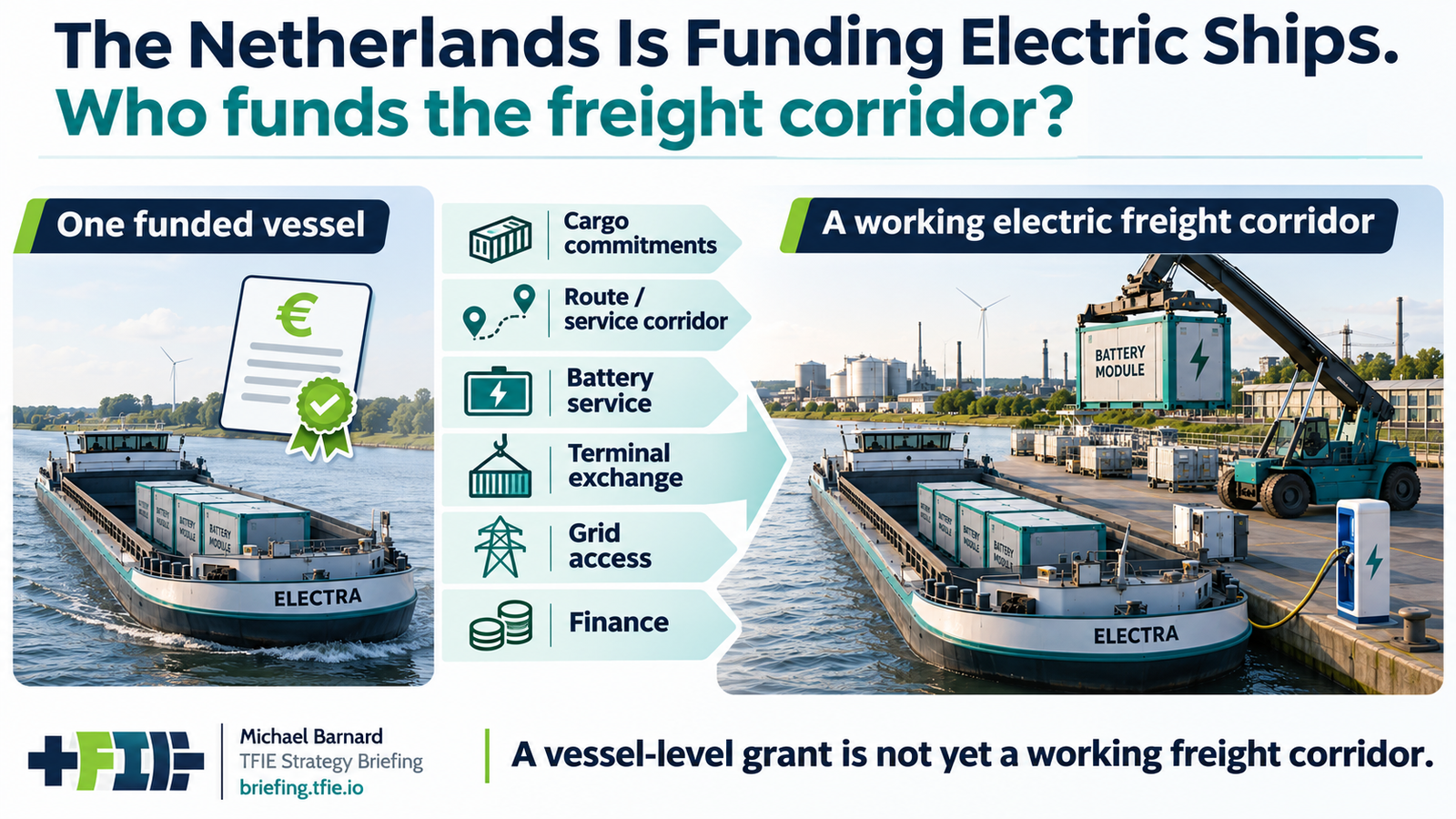
The Netherlands' new subsidy rewards cleaner vessel propulsion, but its principal cost denominator leaves out shared shore infrastructure that turns vessels into repeatable freight services.
Without co-funded terminal equipment and grid upgrades embedded in the same financial architecture, individual shipowners face a classic coordination dilemma. Vessel operators are reluctant to commit to electric propulsion even with generous onboard subsidies if guaranteed turnaround charging is unavailable along their primary commercial routes, while terminal operators hesitate to deploy capital-intensive shore power assets until a critical mass of electric barges guarantees sufficient utilization rates.
Operational Economics of Electric Freight Corridors
Transitioning inland vessels from isolated pilot projects into repeatable commercial freight services requires synchronization between vessel energy storage, cargo scheduling, and port dwell times. In commercial barge transport, profitability is governed by continuous asset utilization and predictable transit schedules. When a vessel's propulsion system is electrified, energy replenishment must align seamlessly with cargo loading, unloading, or lock queuing windows.
By leaving shared shore infrastructure outside the primary subsidy denominator, the 231 million euro allocation places the burden of corridor readiness on fragmented municipal ports, private terminal operators, and regional distribution system operators. In the Netherlands, where electricity grid congestion already constrains industrial connections in key logistics provinces, financing and permitting high-capacity shore power stations represents a major capital and regulatory hurdle independent of vessel acquisition costs.
Furthermore, repeatable freight services depend on interoperability and redundancy across multiple stopping points. A single point-to-point barge shuttle can occasionally manage with a bespoke private charger, but the broader inland shipping sector operates across dynamic, multi-stop logistics networks. Turning cleaner vessels into dependable commercial freight capacity requires shared, open-access charging corridors where multiple operators can amortize the fixed costs of transformers, switchgear, and grid reinforcement.
Strategic Outlook for European Maritime Decarbonization
Looking ahead, the effectiveness of the Netherlands' 231 million euro commitment will depend on how rapidly Dutch ministries, port authorities, and European Union infrastructure facilities bridge the gap between onboard propulsion grants and shore-side energy networks. Supply chain stakeholders and maritime financiers will closely monitor subscription rates for the vessel subsidy to assess whether fleet operators view the onboard funding as sufficient without bundled infrastructure guarantees.
For policymakers across Europe, the Dutch rollout serves as an instructive test case in industrial climate policy design. To convert subsidized clean vessels into durable, zero-emission freight corridors, subsequent regulatory phases and complementary public-private funding rounds will need to treat vessel powertrains and shared port charging networks as a single, integrated capital system.