World's Largest Wildlife Overpass Built Over Los Angeles Freeway
The Annenberg Wildlife Crossing over California's 101 freeway establishes a new engineering benchmark for ecological connectivity across major transit arteries.
EXECUTIVE BRIEF // KEY TAKEAWAYS
The Annenberg Wildlife Crossing over California's 101 freeway establishes a new engineering benchmark for ecological connectivity across major transit arteries.
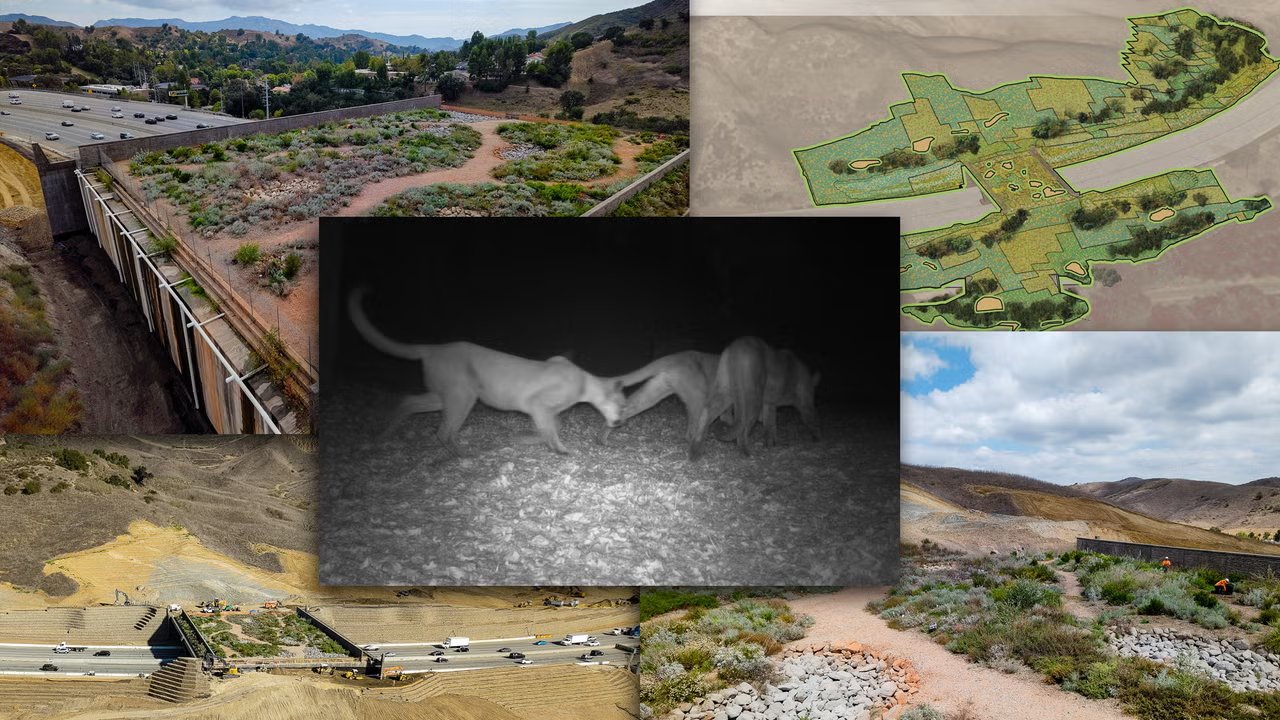
LOS ANGELES — The Annenberg Wildlife Crossing, spanning 10 lanes of the heavily congested 101 freeway northwest of Los Angeles, is scheduled to open officially on Dec. 2 as the largest structure of its kind in the world, marking a pivotal milestone in restorative civil infrastructure. Designed to stitch together an ecosystem severed for decades by suburban sprawl and highway corridors, the 250-foot-wide bridge represents a structural paradigm where civil engineering is subordinate to ecological function. Although habitat restoration and secondary construction will persist after the bridge opens, wildlife including coyotes, lizards, and Western bluebirds have already begun crossing the nascent corridor.
The landmark development underscores an accelerating global convergence between public infrastructure planning, civil technology, and environmental capital. As transport authorities worldwide confront the biodiversity impacts of transit networks, the Annenberg project demonstrates how advanced acoustic modeling, biological soil remediation, and architectural design can retrofit existing arterial systems without impeding economic transit corridors carrying approximately 300,000 vehicles per day. The initiative illustrates how state transport agencies and private conservation capital can collaborate to mitigate biological extinction risks through targeted, high-performance physical infrastructure.
Ecosystem Restoration and the Legacy of P-22
The crossing addresses severe ecological fragmentation between the Santa Monica Mountains to the south and protected open space to the north that indirectly connects to the Angeles National Forest. Movement data compiled before construction confirmed that most animals approaching the multi-lane freeway retreated rather than attempting to navigate the roadway. For apex predators, this barrier created severe genetic isolation; a 2016 scientific study cited by Fast Company determined that habitat fragmentation and extreme inbreeding placed the local mountain lion population under a 99.7% probability of extinction within 50 years.
Although conservation coalitions first proposed a crossing in the 1980s and the California Department of Transportation (Caltrans) began formal evaluations in 2003, the undertaking remained unfunded for years. Momentum shifted in 2013 after a male cougar designated P-22 successfully crossed the freeway into Griffith Park and was photographed beneath the Hollywood Sign. The viral image galvanized public interest, leading the National Wildlife Federation and the Santa Monica Mountains Fund to build a prominent funding campaign that moved the project into its final design phase by 2019.
“All of the infrastructure is there in service of this habitat connection,” said Robert Rock, chief executive of Rock Design Associates, the lead landscape architecture firm guiding the crossing.
Advanced Acoustic Engineering and Habitat Replication
Spanning 250 feet in width, the bridge substantially exceeds the U.S. Federal Highway Administration design baseline of 130 feet, drawing architectural precedents from crossings in Canada's Banff National Park that accommodate grizzly bears and elk. The structure incorporates an engineered “giant green roof” supporting native coastal sage scrub across the main crossing, a companion bridge over an adjacent roadway, and roughly 13 acres of contiguous habitat restoration.
The structural layout reflects rigorous interdisciplinary coordination to address varying species behaviors. Prey animals require dense foliage corridors to move under protective cover, while deer demand open sightlines. The design balances these demands by integrating aggregate pathways that halt plant encroachment while preserving open fields of view. Severe ecological degradation from a massive 2018 wildfire presented additional hurdles, as extreme thermal exposure destroyed microscopic fungal and biological activity across the top 14 inches of soil. To reconstruct the microbiome, Rock's team harvested more than 1 million seeds from regional wildlands, cultivated them in an exclusive nursery, and blended healthy regional soil samples to act as a biological inoculant comparable to a sourdough starter.
“We have ambient sound levels that are the equivalent of a rock concert on the north side and maybe a folk concert on the south side,” Rock said. “We needed to find a way to create additional quiet space and additional dark spaces along the freeway.”
Mitigating urban noise and light pollution required dedicated acoustic simulation software. Engineers incorporated terraced subterranean embankments beneath the structure to deflect low-frequency tire rumblings and fitted the span with sloped planter walls. This configuration dampens sound by 20 decibels, outpacing the 5- to 10-decibel suppression of typical highway soundwalls. To eliminate urban sky glow that disorients wildlife, builders cast the span in dusty brown concrete rather than reflective white or gray mixes and coordinated with Caltrans to replace standard white LED highway lighting with warm yellow luminaires.
Infrastructure Milestones and Ecological Outlook
With an estimated 450 native species inhabiting the adjacent open ranges, long-term monitoring will determine how frequently key wildlife corridors are established across the bridge. Biologists reported an early operational success during the structural construction phase, observing a barn owl hunting across the darkened aerial strip above the traffic lanes.
As ongoing replanting and secondary construction continue past the Dec. 2 opening, the crossing will be protected against future wildfires through recycled-water irrigation networks and curated fire-tolerant plantings. For regional mountain lions, conservation biologists emphasize that even occasional annual crossings by dispersing males will sufficiently diversify the gene pool to avert local extinction, offering global infrastructure planners an empirical case study in multi-species civil engineering.


