NASA Revisits Voyager 2 Neptune Data as Probe Traverses Deep Space
A retrospective composite highlights Voyager 2's landmark 1989 Neptune flyby as the sole ice giant probe continues operations in interstellar space in 2026.
EXECUTIVE BRIEF // KEY TAKEAWAYS
A retrospective composite highlights Voyager 2's landmark 1989 Neptune flyby as the sole ice giant probe continues operations in interstellar space in 2026.
WASHINGTON — Decades after conducting humanity's singular close-range reconnaissance of the solar system's outermost giant planet, the Voyager 2 spacecraft remains an active operational asset while providing foundational baseline data for outer planetary science, according to a technical retrospective released by the National Aeronautics and Space Administration.
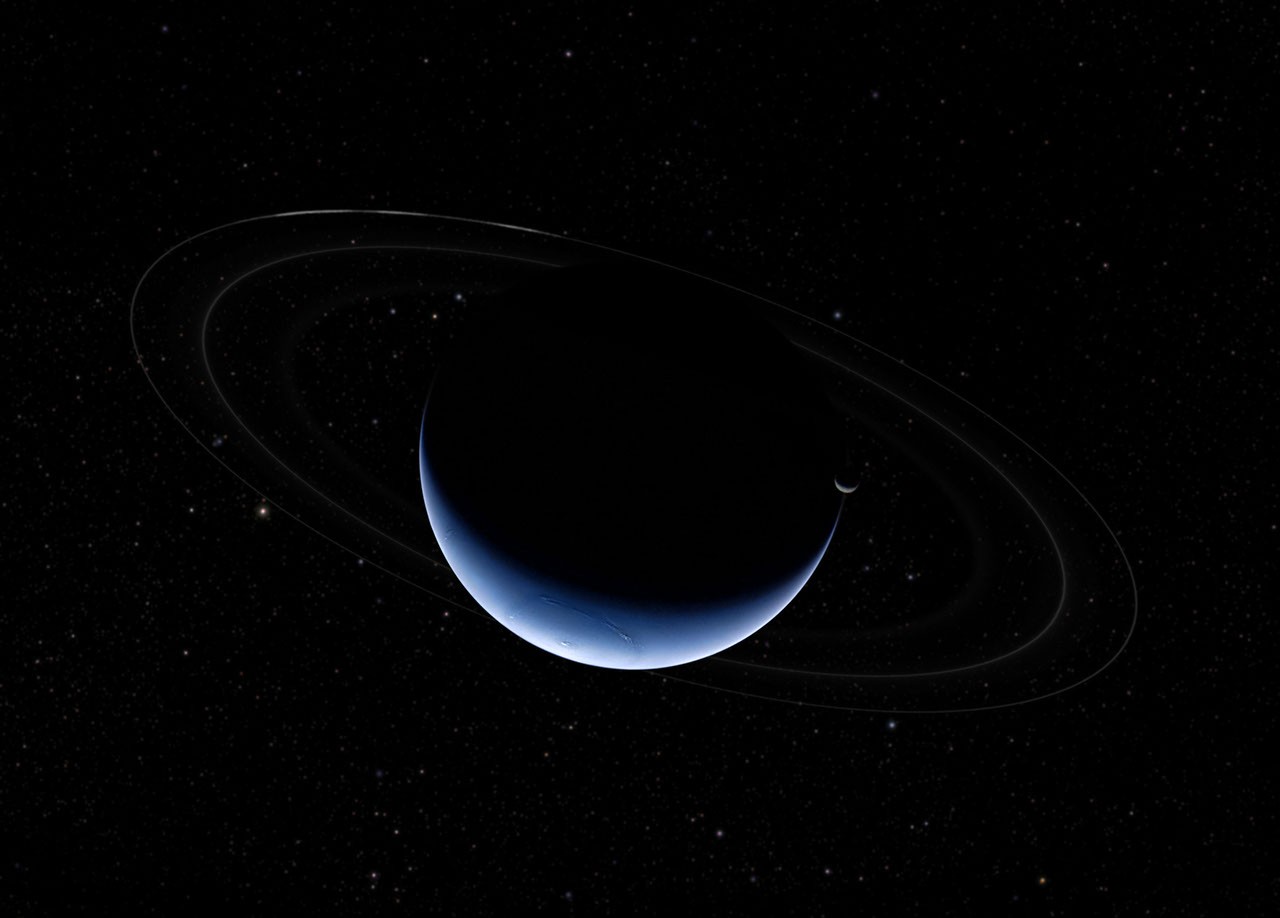
The agency highlighted an inspired composite visual analysis synthesizing data collected during Voyager 2's historic flyby of Neptune on August 25, 1989. As commercial aerospace entities and national space agencies increasingly assess long-duration deep-space instrumentation and outer-planet mission architectures, the enduring viability and scientific yields of the Voyager platform continue to shape engineering protocols for extreme-environment hardware operating far beyond the inner solar system.
Archival Reconstruction and Systemic Planetary Dynamics
Voyager 2 holds the unique operational distinction of being the only spacecraft ever to visit Neptune, the most distant ice giant in the solar system. The newly issued scene documents the planetary system from an interplanetary perspective just beyond Neptune's orbit, oriented back toward the Sun. In this geometry, both the dim outer planet and its largest moon, Triton, appear as slender, sunlit crescents against the deep-space void.
Scientific imaging captured during the 1989 encounter cataloged key atmospheric and structural phenomena, including high-altitude cirrus clouds, a distinct dark band encircling Neptune's south polar region, and a persistent cloudy vortex positioned directly above the planetary pole. During the approach and subsequent departure, the spacecraft also secured the initial direct images of Neptune's faint ring system, identifying three prominent, concentrated ring arcs. While the faintest segments of the ring network in the retrospective visualization are computationally modeled, the framework remains anchored to the empirical measurements recorded during the close encounter.
“NASA explores the unknown in air and space, innovates for the benefit of humanity, and inspires the world through discovery,” the agency noted in its official mission release.
The composite framing integrates an outbound field of view spanning 7.5 degrees, referencing astronomical sky survey data centered on the constellation Camelopardalis to replicate the precise celestial backdrop observed by Voyager 2 as it charted its trajectory away from the planetary system.
Operational Metrics and Deep-Space Telemetry Legacies
From an aerospace systems perspective, the Voyager 2 mission exemplifies long-lifecycle payload engineering. Launched in 1977 on an initial four-planet reconnaissance trajectory, the probe executed its Neptune flyby at an orbital distance of approximately 4.5 billion kilometers from Earth, managing extreme signal latency and faint illumination levels that measured roughly 0.1 percent of terrestrial solar irradiance.
The structural measurements returned by the spacecraft's primary imaging and radiometric subsystems required unprecedented radio tracking precision from NASA's Deep Space Network. The optical detection of Triton's retrograde orbit, complex cryovolcanic surface terrains, and tenuous atmosphere fundamentally altered planetary accretion models. Moreover, the verification of dynamic ring arcs demonstrated that outer-planet dust distribution and gravitational resonant confinement mechanisms were far more complex than classic Newtonian orbital models had previously projected.
The longevity of the spacecraft's radioisotope thermoelectric generators and fault-tolerant analog-digital computing systems has provided global aerospace contractors with critical durability metrics. The mission proved that micro-thruster propellant budgeting, autonomous star-tracker orientation, and long-range telecommunications links could survive decades of cosmic radiation bombardment and severe thermal gradients without catastrophic subsystem degradation.
Interstellar Trajectory and Future Outer-Planet Horizons
Now operating well into 2026, Voyager 2 has crossed the heliopause and continues to cruise through interstellar space. The probe transmits data regarding the boundary region where the solar wind gives way to the interstellar medium, maintaining its role as an active deep-space communications node despite severely degraded electrical power reserves and thermal margins.
The technological gap left by Voyager 2's departure underscores an ongoing operational void in frontier planetary science. Despite proposed flagship mission concepts targeting the ice giants, neither NASA nor its international partners have executed a dedicated orbital insertion or follow-up flyby mission to Neptune or Uranus since the 1989 encounter. Consequently, modern space agencies, academic consortia, and propulsion technology incubators continue to rely on Voyager 2's archival telemetry to validate remote spectroscopic observations executed by space-based observatories such as the James Webb Space Telescope.
As space exploration budgets face rigorous prioritization hurdles across legislative and executive committees, the technical durability of the Voyager program serves as both a design benchmark and an argument for durable, multi-generational mission design. The path charted by Voyager 2 beyond Neptune establishes the operational baseline against which the next generation of deep-space exploration probes will ultimately be measured.


