Voyager 1 Crosses One Light-Day Threshold as NASA Marks Milestone
As Voyager 1 crosses one light-day from Earth, the milestone spotlights the technical longevity and deep-space communications architecture of the 1977 mission.
EXECUTIVE BRIEF // KEY TAKEAWAYS
As Voyager 1 crosses one light-day from Earth, the milestone spotlights the technical longevity and deep-space communications architecture of the 1977 mission.
PASADENA, Calif. — Nearly half a century after leaving Earth, NASA’s Voyager 1 spacecraft has crossed an unprecedented frontier in deep-space exploration, officially reaching a distance of one light-day from its home planet on Nov. 18, 2026. The milestone, commemorated Friday by the space agency’s Astronomy Picture of the Day service under the designation "V-G-R," marks the first time a human-made vehicle has traveled far enough that a radio signal traveling at the speed of light requires a full 24 hours to bridge the distance one way.
For aerospace defense contractors, deep-space telecommunications networks, and commercial satellite operators, Voyager 1’s enduring operational lifespan provides critical empirical benchmarks for hardware longevity, radiation resilience, and long-range protocol engineering. The benchmark underscores the immense logistical constraints facing future interstellar communication architectures, while validating decades of precision orbital mechanics and telemetry retrieval managed through NASA's Deep Space Network.
Contextual Background and the "V-G-R" Signal
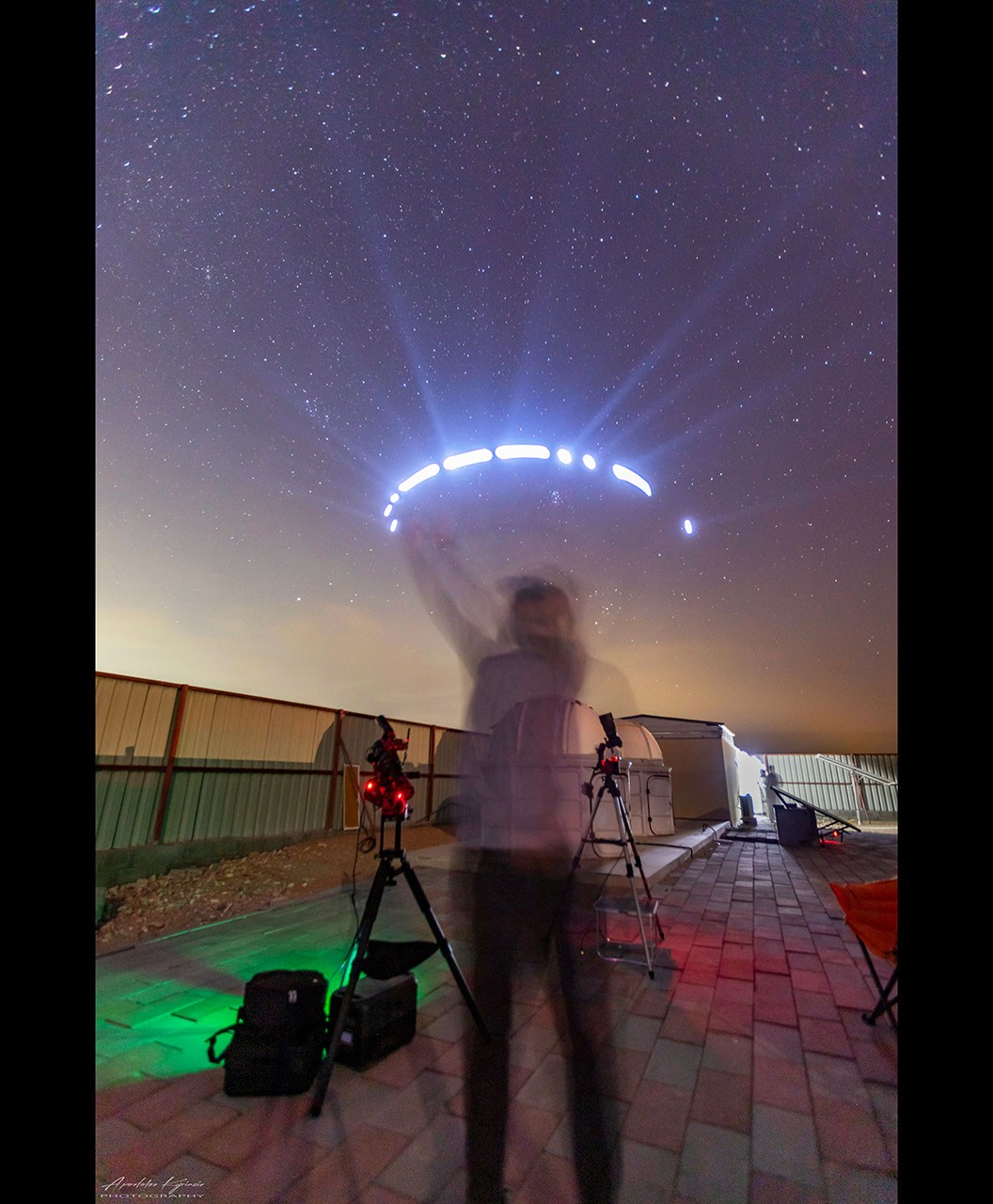
The milestone was recognized in an Astronomy Picture of the Day release showcasing an image captured by astrophotographer Apostolos Kyriazis at the Emirates Astronomical Observatory. The time-exposure photograph documented skyward light transmissions tracing "V-G-R"—Voyager 1's historical Morse code call sign—following a coordinated global initiative on Nov. 17 where observers pointed light sources toward the spacecraft's celestial coordinates.
According to NASA's mission briefing, the crossing at 10:16:07 UTC placed the probe roughly 16.1 billion miles (25.9 billion kilometers) from Earth. In its official description, NASA emphasized the immense scale of the achievement:
"Travelling at a speed of one light-day per 50 years, Voyager 1 will take roughly 18,250 years to reach its next major distance milestone of one light-year."
Launched in September 1977 aboard a Titan IIIE-Centaur rocket, Voyager 1 completed primary flybys of Jupiter and Saturn before crossing the heliopause into interstellar space in August 2012. Despite operating on degraded systems, the spacecraft continues to collect in situ plasma data from the local interstellar medium, relaying telemetry through dwindling power margins.
Engineering Economics and Infrastructure Strain
Maintaining contact across 26 billion kilometers imposes steep technical and financial demands on ground-segment infrastructure. NASA’s Deep Space Network—administered by the Jet Propulsion Laboratory—must direct high-power 70-meter parabolic antennas, such as Deep Space Station 14 at Goldstone, California, and Deep Space Station 43 in Canberra, Australia, to resolve signals broadcasting at less than 23 watts, comparable to the wattage of a residential refrigerator light bulb.
Because radio waves take 24 hours to reach the spacecraft and another 24 hours to return, flight engineers confront a 48-hour round-trip latency loop. This extreme delay eliminates the possibility of real-time intervention during telemetry anomalies or subsystem faults. The economic footprint of maintaining legacy assembly language decoders and specialized telecommunications infrastructure has driven ongoing budget debates within NASA's Planetary Science Division. However, aerospace engineers note that the telemetry received offers unique baseline data regarding cosmic ray shielding and material degradation that cannot be replicated in terrestrial simulation chambers.
Strategic Trajectory and Future Milestones
The strategic trajectory for Voyager 1 now centers on power budget management as its radioisotope thermoelectric generators experience relentless radioactive decay. The spacecraft loses an estimated four watts of electrical output annually, forcing flight directors to systematically turn off non-essential instruments and internal thermal heaters to conserve baseline power for the central transmitter and attitude-control thrusters.
Mission managers project that the final scientific instruments will succumb to power starvation before the end of the decade, converting Voyager 1 into an inert, silent emissary drifting along its hyperbolic escape trajectory toward the constellation Ophiuchus. While private space enterprises pursue laser communications and micro-probe architectures under initiatives like Breakthrough Starshot, Voyager 1 remains the sole physical benchmark for active deep-space telemetry. As the probe continues into the galactic plane, its 18,250-year journey toward one light-year highlights both the profound physical barriers of interstellar distance and the enduring standard of 20th-century systems engineering.


