US Solar Onshoring Surges in Modules but Lacks Precursors
Data from the Clean Investment Monitor highlights strong domestic module production while upstream polysilicon and wafer manufacturing lag behind.
EXECUTIVE BRIEF // KEY TAKEAWAYS
Data from the Clean Investment Monitor highlights strong domestic module production while upstream polysilicon and wafer manufacturing lag behind.
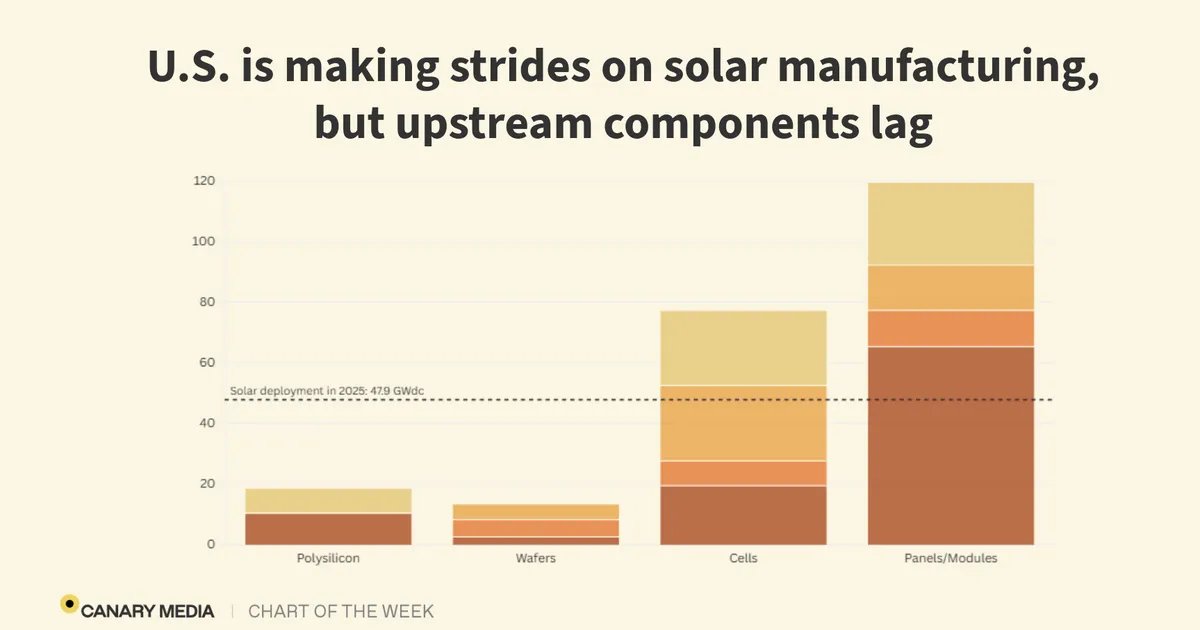
WASHINGTON — As solar energy solidifies its position as the primary choice for new power plants across the United States, a comprehensive review of the domestic clean technology sector reveals a rapidly expanding manufacturing base constrained by significant upstream vulnerabilities. According to data from the latest Clean Investment Monitor analyzed and reported by Canary Media, American factories currently possess the capacity to produce more than enough finished solar panels to satisfy national annual installations, which reached 47.9 gigawatts of direct current capacity last year. This manufacturing resurgence represents a profound turnaround for an industrial sector that had nearly vanished, driven forward by targeted federal incentives and stricter tariffs levied against imported components.
However, beneath the headline-grabbing figures of finished photovoltaic module production lies an uneven industrial ecosystem. While the assembly of final panels has blossomed, the upstream components required to build them—specifically photovoltaic cells, silicon wafers, and processed polysilicon—face distinct capital and operational hurdles. According to the reporting by Canary Media senior reporter Julian Spector, bridging this upstream gap remains the definitive test for whether the United States can secure a truly independent, localized solar supply chain capable of withstanding global market volatility and geopolitical friction.
The Module Expansion and Cell Production Milestone
The acceleration of domestic module production marks a historic shift in America's industrial landscape. Data indicates that if all current manufacturing projects undergoing construction and commissioning come to fruition, domestic module production could surge by approximately 83 percent. This localized manufacturing capacity easily dwarfs historical domestic output, positioning the nation to internally supply its immediate deployment demands.
Upstream progress has been similarly notable in photovoltaic cell manufacturing, which represents the next critical tier of the supply chain. Following several new factory openings this year, domestic facilities can now generate up to 19.5 gigawatts of cells annually. If projects currently wrapping up construction phase-in successfully, domestic output will scale sufficiently to match projected 2025 installation deployments. Yet, industry analysts caution that module and cell assembly represent only the middle and final tiers of a deeply complex chemical and material manufacturing process.
Upstream Bottlenecks in Wafers and Polysilicon
Despite successes in cell and module assembly, the foundational segments of the supply chain—capital-intensive polysilicon processing and silicon wafer production—continue to lag behind. These foundational elements require massive upfront capital investments and complex industrial processes that are not currently tracking the same expansion trajectories as downstream modules and cells.
This structural imbalance exposes vulnerabilities in the broader clean energy transition. Without an equivalent domestic scaling of wafers and polysilicon, American solar manufacturers remain tethered to foreign material inputs, undermining the strategic objective of complete supply chain autonomy. Financing these high-barrier facilities requires long-term visibility into market demand, a metric complicated by shifting political landscapes and regulatory uncertainty.
Strategic Outlook and Long-Term Market Viability
Looking toward the post-2030 era, the long-term viability of the domestic solar manufacturing sector faces a complex demand equation. According to modeling conducted by the Rhodium Group regarding the post-incentive landscape, once lucrative federal tax credits expire, the U.S. could experience a wide divergence in annual installations, ranging anywhere from 8 to 52 gigawatts of direct current capacity.
This massive projected variance presents a distinct strategic dilemma for capital allocators and enterprise leaders. If the domestic solar market experiences a downturn, current manufacturing capacity could prove self-sufficient. Conversely, if installations continue their upward trajectory, the lack of domestic polysilicon and wafer production will leave the country scrambling for essential inputs. Ultimately, as Canary Media highlights, successfully building these factories is merely the initial phase; American solar manufacturers must now prove their capability to operate sustainably and competitively over the long haul.


