US Seabed Lease Near American Samoa Faces Steep Economic Hurdles
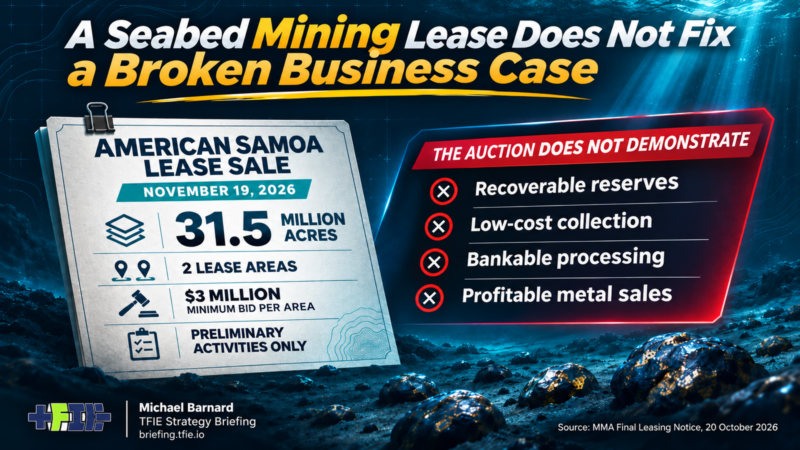
A $3 million mineral lease bid near American Samoa advances US deep-sea ambitions, yet the business case for seabed mining remains deeply unfavorable.
EXECUTIVE BRIEF // KEY TAKEAWAYS
A $3 million mineral lease bid near American Samoa advances US deep-sea ambitions, yet the business case for seabed mining remains deeply unfavorable.
The United States is moving forward with an auction of seabed mineral leases in federal waters near American Samoa, drawing a reported $3 million bid that underscores growing federal interest in offshore critical mineral reserves. However, according to an analysis published by CleanTechnica, securing an initial exploration or leasing right is far removed from financing and constructing a commercially viable deep-sea mining operation.
The development comes as global energy and manufacturing sectors evaluate long-term supply chains for battery metals and critical minerals required for grid storage and electrified transport. While federal seabed leasing signals policy willingness to explore domestic and territorial marine resources, capital markets and industrial operators face a sharp divide between nominal lease acquisition costs and the multi-billion-dollar capital expenditures required to extract, process, and refine polymetallic nodules at commercial scale.
Federal Leasing Advances Amid Commercial Skepticism
As reported by CleanTechnica, the American Samoa seabed auction represents a formal step in advancing marine mineral leasing under U.S. jurisdiction. Proponents of deep-sea extraction have long argued that ocean floor deposits could supplement terrestrial mining for essential transition metals. Yet the CleanTechnica assessment emphasizes that a $3 million lease commitment does not establish a functional mine or resolve the underlying structural deficits of the sector.
In the broader natural resources industry, upfront lease bids frequently represent speculative option value rather than confirmed project finance. Moving from an offshore lease award to active extraction requires exhaustive baseline environmental surveys, specialized deep-water vessel engineering, and dedicated metallurgical processing infrastructure on land—none of which are guaranteed by the auction process itself.
Technical and Economic Headwinds Weigh on Viability
The CleanTechnica report notes that both the technical and economic cases for a profitable seabed mining industry remain highly unfavorable. Operating miles beneath the ocean surface introduces extreme mechanical pressures, corrosion risks, and complex slurry-lift requirements that have never been proven at sustained commercial volumes. Unlike established offshore oil and gas production, deep-sea mineral harvesting relies on continuous robotic seabed collection systems that face high maintenance overhead and uncertain operational uptime.
On the financial side, marine mineral ventures must compete directly against terrestrial mining expansions, battery chemistries that reduce reliance on scarce metals, and rapidly scaling battery recycling networks. When battery manufacturers shift toward iron-phosphate chemistries or secure lower-cost terrestre supply agreements, the projected margins for high-cost deep-sea extraction narrow considerably. CleanTechnica highlights that these converging technical risks and market dynamics leave the commercial thesis for marine mining on fragile ground, regardless of how low initial lease auction prices may appear.
Strategic Outlook and Regulatory Hurdles Ahead
Looking ahead, the advancement of seabed leasing near American Samoa will test the intersection of federal resource policy, territorial governance, and institutional investor appetite. Any prospective operator attempting to transition a lease into an active project will confront stringent environmental review frameworks, potential opposition from regional stakeholders concerned about marine ecosystems, and rigorous scrutiny from project finance lenders.
For energy transition analysts and industrial procurement leaders, the American Samoa auction serves as a reminder to separate policy milestones from bankable supply additions. Until deep-sea mining developers can demonstrate reliable subsea engineering and cost structures capable of competing with terrestrial alternatives, nominal lease auctions are unlikely to alter the global critical minerals balance.