Tesla Winds Down Cybertruck Production After Steep Sales Collapse
Elon Musk confirms Gigafactory Texas will halt Cybertruck assembly mid-next year after annual deliveries hit just 8% of initial volume targets.
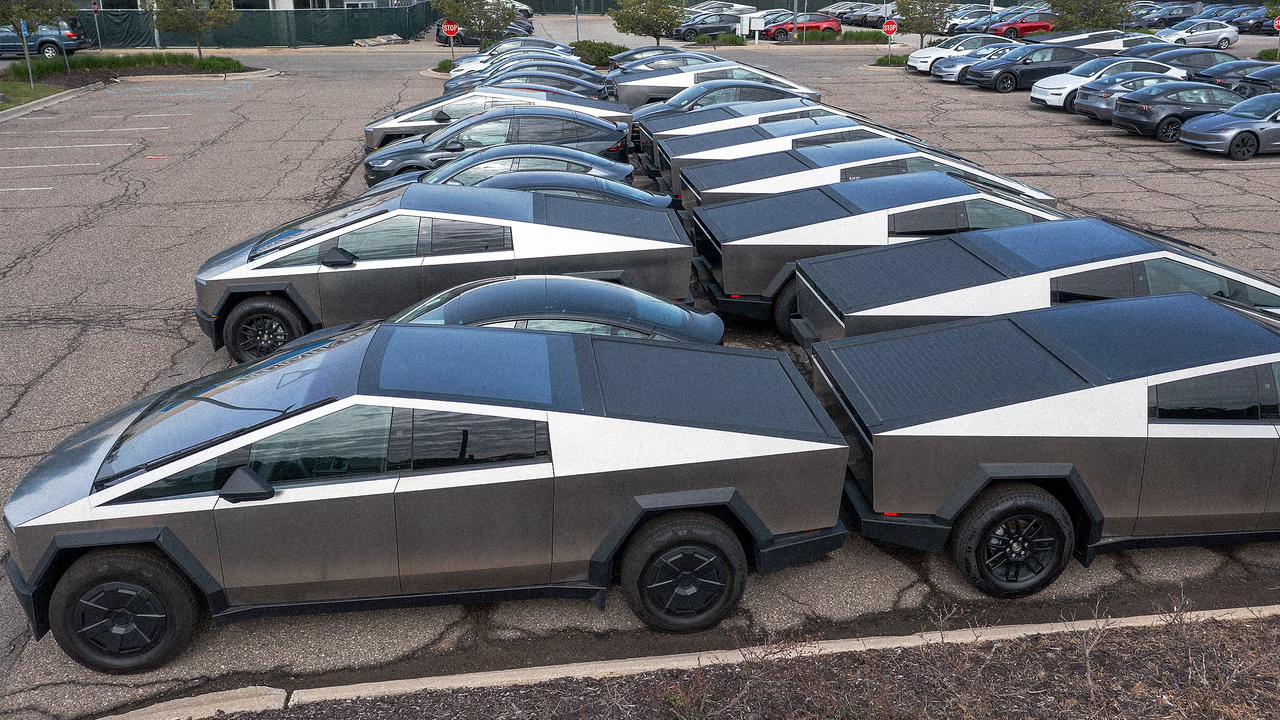
Tesla Chief Executive Elon Musk announced on social platform X that the automaker will wind down production of its polygonal Cybertruck pickup at Gigafactory Texas around the middle of next year, bringing a formal close to one of the automotive sector's most polarizing and manufacturing-challenged vehicle programs. According to a report by Fast Company, the decision follows a steep contraction in buyer demand, persistent structural defects, and a series of high-volume federal safety recalls that eroded the vehicle's commercial viability after less than three years on the market.
For global automotive manufacturers, industrial designers, and capital markets, the premature termination of the Cybertruck program serves as a stark case study in the limits of unconventional hardware engineering. While bespoke, angular stainless-steel styling generated massive early reservation interest, translating non-standard tolerances onto a high-volume assembly line proved economically and operationally unsustainable, leaving annual sales at barely 8 percent of management's projected capacity and recording the steepest electric vehicle sales decline in United States history.
From Unconventional Unveiling to Manufacturing Bottlenecks
First unveiled in Los Angeles on November 21, 2019, the Cybertruck was originally marketed with an entry price of $39,900 and a projected 2021 delivery schedule. Despite a high-profile demonstration mishap in which two of its purportedly shatterproof glass windows fractured on stage, the pickup's wedge-shaped exterior drew substantial early deposits from retail enthusiasts. However, moving the prototype from concept to mass production at Gigafactory Texas—the sole facility configured to build the model—exposed severe industrial engineering hurdles.
Automotive designers noted as early as January 2023 that the vehicle's flat, polygonal stainless-steel exoskeleton could not be mass-produced reliably using conventional stamping and assembly infrastructure. Musk himself acknowledged the tolerances required in a leaked internal communication, stating that "due to the nature of Cybertruck, which is made of bright metal with mostly straight edges, any dimensional variation shows up like a sore thumb." Achieving the sub-10-micron, interlocking precision demanded by the exterior geometry proved virtually impossible in a modern automotive plant.
When customer deliveries finally began in late 2023, the starting price had risen more than 50 percent to $60,990, and early production units exhibited visible panel misalignments and unit-to-unit dimensional inconsistencies. Veteran automotive designer Adrian Clarke summarized industry skepticism toward the program's execution, characterizing the pickup in remarks cited by Fast Company as "a low-polygon joke that only exists in the fever dreams of Tesla fans."
Operational Recalls and Collapsing Registration Volumes
Throughout its production run, the Cybertruck encountered a wide range of mechanical, software, and material quality issues that triggered repeated regulatory interventions. Reported field problems included chronic exterior panel misalignment, detaching trim pieces, front trunk closures capable of pinching digits, hail-vulnerable windshields, surface corrosion on the stainless-steel body, and promised features—such as a locking differential—that remained indefinitely delayed.
"Tesla will be winding down production of the Cybertruck at Gigafactory Texas around the middle of next year." — Elon Musk, Chief Executive Officer, Tesla
Those hardware vulnerabilities translated into a steady cadence of safety recalls. In addition to an over-the-air software correction addressing warning-light font sizes and a service campaign covering glued-on auxiliary light bars, Tesla was forced to recall 3,878 pickups after discovering that soap used as an assembly lubricant caused accelerator pedals to dislodge and jam. Subsequent physical recalls included a March 2025 action covering 46,096 vehicles whose exterior trim panels could detach at highway speeds, followed by a May 2026 recall of 173 units due to wheel assembly defects capable of causing wheels to separate from the vehicle.
Compounding the operational cost of warranty repairs, consumer demand deteriorated rapidly once early reservation holders took delivery or canceled orders. Monthly U.S. registrations peaked at 5,175 units in July 2024 before sliding to 2,000 units by April 2025. Full-year registrations totaled roughly 20,237 vehicles—a figure that Fast Company noted included internal fleet transfers to another Musk-controlled enterprise. That annual volume represented roughly 8 percent of the 250,000 units per year Musk had previously forecast. Promotional discounting failed to reverse the trajectory, leaving an estimated fleet of approximately 40,000 Cybertrucks on the road as the model registered the sharpest sales drop ever recorded for an American electric vehicle.
Strategic Implications for Capital Markets and Product Roadmaps
The decision to wind down Cybertruck assembly by mid-next year forces a strategic reassessment of how capital-intensive hardware manufacturers balance executive-driven industrial design against established manufacturing physics. Decommissioning or repurposing dedicated Cybertruck tooling at Gigafactory Texas will require Tesla to reallocate factory floor space and capital expenditure toward higher-volume models or next-generation vehicle platforms.
For institutional investors and industry analysts, the pickup's trajectory—coupled with ongoing delays surrounding other long-promised hardware such as the second-generation Tesla Roadster—intensifies scrutiny on corporate governance, realistic volume forecasting, and product validation cycles. Meanwhile, the roughly 40,000 current Cybertruck owners face an uncertain secondary market and long-term parts support outlook once Gigafactory Texas permanently halts production next year.