Tesla Rolls Out FSD v15 as Musk Claims Superhuman Safety Benchmark
Tesla has begun deploying FSD v15 with claims of superhuman safety, but lack of empirical validation keeps scrutiny on its Level 2 driver-assist platform.
EXECUTIVE BRIEF // KEY TAKEAWAYS
Tesla has begun deploying FSD v15 with claims of superhuman safety, but lack of empirical validation keeps scrutiny on its Level 2 driver-assist platform.
Tesla Inc. has commenced the initial rollout of Full Self-Driving Version 15 to select vehicle owners, with Chief Executive Elon Musk asserting the system achieves performance superior to human drivers, according to reporting by Fast Company. Despite Musk heralding the software update as a breakthrough built on an advanced architecture, the platform remains classified strictly as a Level 2 driver-assistance system that legally mandates continuous human oversight and immediate physical intervention.
The release arrives at a pivotal moment for automotive markets and enterprise robotics, as capital valuations increasingly hinge on whether consumer automakers can bridge the gap between driver-assist conveniences and commercially viable, unsupervised autonomy. While competitors in the commercial robotaxi sector rely on published safety metrics and third-party validation, Tesla continues to market high-multiplier safety improvements directly to consumers while keeping its core operational liability firmly on the driver.
Unsubstantiated Metrics and the Level 2 Disconnect
Musk promoted the update on social platform X, declaring Version 15 features a "completely new architecture that deserves being called 'super' intelligence, as it drives better than human intelligence." The proclamation closely mirrors previous projections delivered without independent verification. In November 2023, Musk asserted that "Version 12 (end-to-end neural nets) will far exceed human safety even when unsupervised," followed by remarks in August 2025 predicting that "v14 will be better than human for sure, but I don’t know if it will be 10X. Maybe 2X to 3X. v15 has a shot at 10X." As Fast Company noted, neither milestone was accompanied by third-party research or verifiable fleet data.
Tesla’s official promotional material for Version 15 claims "25x better handling of safety critical cases." Addressing public confusion regarding the magnitude of the improvement, Musk stated on X:
"Some people thought we meant 25% improvement, no we mean 25 times!"
Phil Duan, who leads self-driving development at Tesla, reinforced the claim on X, writing that "v15 is 25x safer than v14 across the fleet." However, industry analysts and electric mobility outlet Electrek highlighted that without published data or peer-reviewed literature—such as comparative studies demonstrating Waymo’s 85 percent reduction in injury-causing crashes—Tesla's assertion of a 25-fold safety multiplier cannot be independently substantiated. Furthermore, Tesla’s own customer support documentation maintains that the software "does not make the vehicle autonomous" and must be used "only with a fully attentive driver," establishing that any collision averted during operation may be attributable to human takeover rather than algorithmic execution.
Shared Vision Encoders and Operational Upgrades
Underpinning the software upgrade is a unified vision encoder responsible for translating raw camera feeds into real-time navigational inputs. Tesla disclosed that the neural network was trained on millions of internet videos and is now shared across its consumer FSD fleet, dedicated Robotaxi program, and Optimus humanoid robotics platform. According to Tesla's engineering group, this cross-platform architecture drives the reported 25-fold reduction in critical human intervention rates.
Functionally, Tesla stated that Version 15 introduces more refined velocity adjustments through school zones and inclement weather, actively avoids standing surface water, and accelerates reaction times to potholes, road debris, small animals, chains, and traffic signage. The platform also adjusts deceleration behavior around speed enforcement cameras, learning to bypass automated braking at specific coordinates if the driver manually overrides deceleration on two consecutive occasions. Inside the cabin, Tesla reported enhancements to its driver-monitoring camera, improving gaze-tracking reliability when occupants wear hats or sunglasses.
Interface Redesign and Hardware Constraints
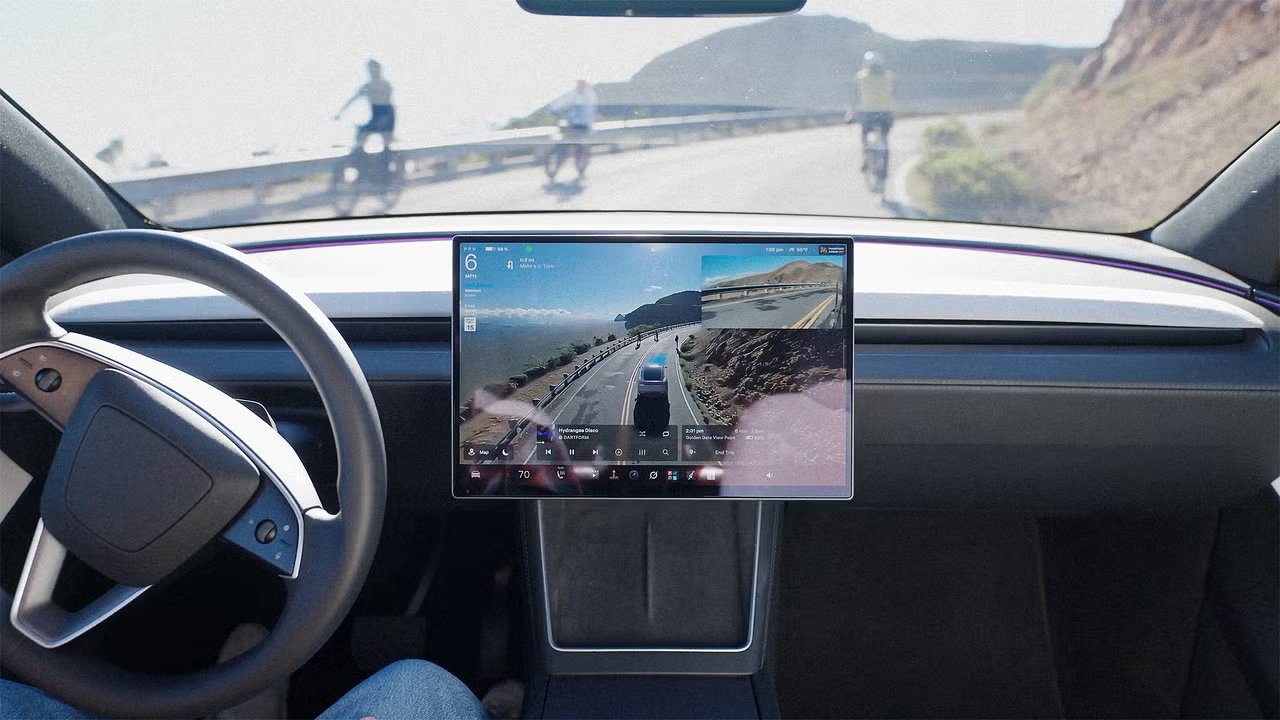
Alongside autonomous driving refinements, Version 15 overhauls the in-cabin user experience via an updated Tesla Reality View. Replacing its legacy high-contrast, schematic 3D display, the interface renders a hyperrealistic, 45-degree third-person representation of the surrounding streetscape, complete with textured architecture and animated ambient lighting reminiscent of high-end video games. The interface overlays navigational intent using overhead turn chevrons, a corrective blue route trajectory, and designated parking availability markers at target destinations. Musk claimed that drivers "can tap any point on the reality revisualizer to make your car go there."
However, the real-time graphics introduce localized hardware bottlenecks. The system renders eight-frame bursts at 36 frames per second using half of a single accelerator chip within Tesla’s AI4 vehicular computer. Musk acknowledged that visual latency on the screen is currently "a bit high due to compute constraints," though he maintained that upcoming software optimizations will reduce latency by roughly 35 percent.
A broader commercial release across the global fleet is slated for December. The operational reliability of Version 15 under diverse road conditions will serve as a definitive benchmark for Tesla’s claims heading into 2027, determining whether its camera-only neural network paradigm can withstand regulatory scrutiny and deliver verifiable enterprise-grade autonomy.


