Tennessee Solar Project Pioneers Commercial Cattle Agrivoltaics
A utility-scale solar developer in Tennessee proves cattle and photovoltaic panels can successfully coexist, offering a roadmap for rural clean energy expansion.
EXECUTIVE BRIEF // KEY TAKEAWAYS
A utility-scale solar developer in Tennessee proves cattle and photovoltaic panels can successfully coexist, offering a roadmap for rural clean energy expansion.
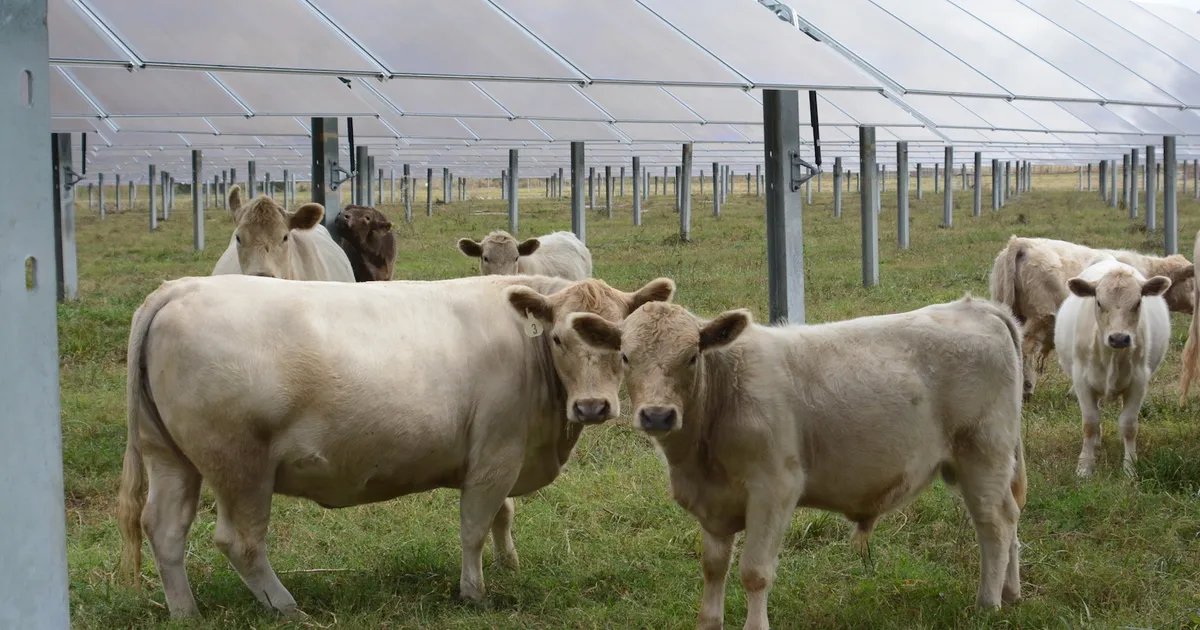
CHRISTIANA, Tenn. — Amid a shifting landscape of rural opposition and surging national demand for carbon-free power, a commercial breakthrough in Middle Tennessee is bridging the often-contentious divide between large-scale renewable energy infrastructure and traditional agriculture. According to reporting from Canary Media, Tennessee-based solar developer Silicon Ranch has successfully deployed a 3.25-megawatt solar project that integrates cattle ranching directly beneath photovoltaic arrays, establishing what industry observers identify as the first commercially viable utility-scale project of its kind in the United States.
As the United States constructs more solar installations than any other form of power plant, the industry's rapid expansion faces mounting resistance from rural communities resistant to losing agricultural land to industrial energy footprints. By combining electricity generation with active livestock grazing—a practice increasingly known as agrivoltaics—developers can preserve local farming economies, mitigate land-use conflicts, and streamline regulatory and community approvals. This dual-use model addresses a critical bottleneck for capital markets and utility providers seeking to scale renewable generation without alienating agrarian stakeholders.
Overcoming Engineering and Livestock Hurdles
Historically, integrating cattle into solar installations has been avoided by major developers due to the inherent risks posed by heavy, unpredictable livestock to sensitive electrical infrastructure. While the solar industry has successfully embraced sheep grazing for vegetation management, sheep are significantly lighter and less disruptive than full-grown cattle. Rambunctious bovines have long been suspected of damaging low-lying panels, exposed wiring, and mounting structures, creating prohibitive financial risks for risk-averse utilities.
To overcome these engineering obstacles, Silicon Ranch adapted its infrastructure design at the Christiana site. The facility utilizes higher-than-usual steel piles to elevate the photovoltaic arrays, providing adequate clearance and protection against livestock interference. A 15-member cattle herd rotates systematically among 15 paddocks demarcated by simple electrical wire, foraging on lush Bermuda grass thriving in the shade cast by the panels.
Terry Jennings, principal team leader for renewable energy at the Electric Power Research Institute (EPRI), a nonprofit research organization studying the electricity sector, noted the distinct engineering challenges involved in designing facilities suitable for cattle grazing.
“If you’re designing a solar facility that is suitable for cattle grazing, it generally requires more specific and unique design,” said Terry Jennings, principal team leader for renewable energy at the Electric Power Research Institute. That “adds cost to the overall project, which is challenging for utilities or electric power companies.”
Despite the initial cost premiums associated with modified steel piles and specialized paddock fencing, early operational observations indicate that conventional anxieties regarding cattle behavior inside solar fields may be exaggerated. Executives at Silicon Ranch reported that the operational performance of the Christiana project has exceeded initial projections, proving that livestock management can be successfully harmonized with high-density energy production.
Economic and Strategic Implications for Capital Markets
The successful commercialization of cattle-friendly solar installations carries significant economic implications for rural landowners and utility-scale developers. By stacking revenues from both electricity generation and livestock production, farmers can diversify their income streams while retaining agricultural productivity on the exact same acreage. This dual-revenue model directly counters local pushback against land conversion, facilitating smoother project permitting and accelerating deployment timelines.
Furthermore, the approach addresses operational maintenance expenditures at utility-scale sites. Traditional vegetation management requires regular mechanical mowing or herbicide application, both of which incur recurring operational expenses and carbon overheads. Utilizing livestock for natural grazing reduces maintenance costs while simultaneously supporting regional agricultural supply chains, such as the market for sustainably raised domestic meat.
As clean energy developers navigate tightening interconnection queues and escalating land acquisition costs, innovative agrivoltaic designs present a scalable pathway to optimize land-use efficiency. The proof-of-concept demonstrated in Christiana establishes a foundational framework that could soon be replicated across larger installations throughout the United States, transforming rural land-use paradigms.
Outlook and Regulatory Horizons
Looking ahead, the broader adoption of cattle agrivoltaics will depend heavily on empirical data gathered from early pioneers like Silicon Ranch and analytical insights from institutions like EPRI. As researchers continue to monitor long-term ecological impacts—including soil health, moisture retention, and forage yield under photovoltaic shade—utility companies will evaluate whether the upfront capital expenditures for reinforced racking systems yield acceptable long-term returns on investment.
Regulatory frameworks at the state and federal levels are also beginning to evolve, with various jurisdictions exploring incentives for dual-use solar projects that protect prime agricultural soils. If subsequent commercial deployments validate the financial viability of cattle-voltaics, the model could unlock vast tracts of rural land previously deemed off-limits by local zoning boards, ultimately accelerating the nation's transition toward a resilient, decarbonized electrical grid.


