Solar Poised to Leapfrog Hydropower as China's No. 2 Power Source
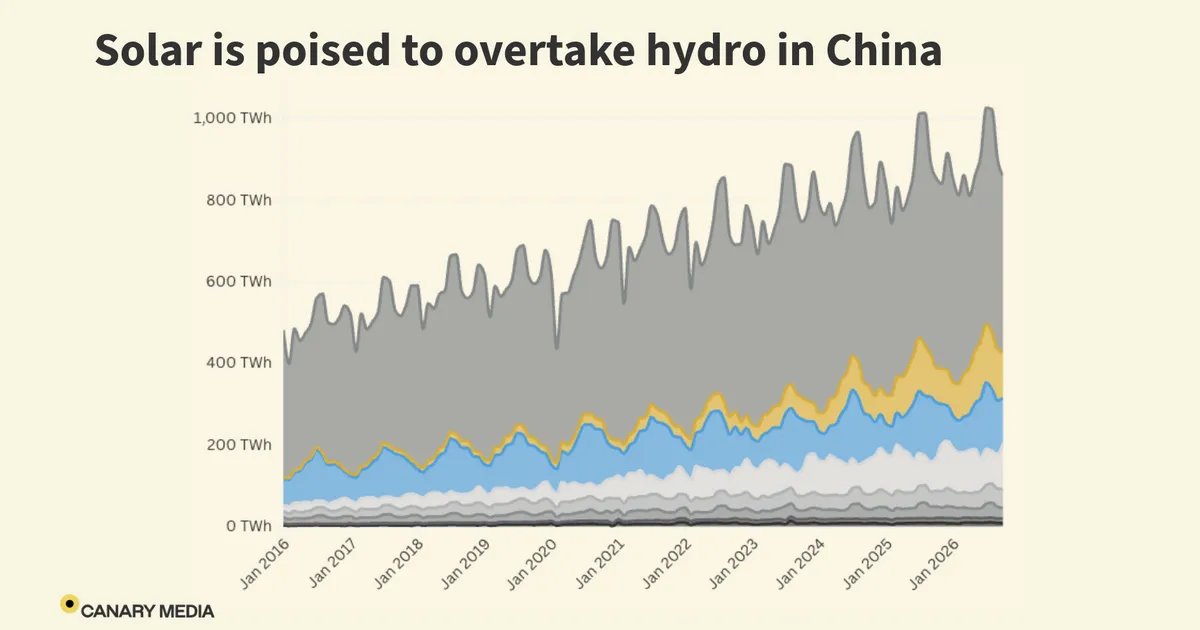
Driven by a decade-long infrastructure boom, solar energy is set to become China's second-largest electricity source, overtaking hydropower.
EXECUTIVE BRIEF // KEY TAKEAWAYS
Driven by a decade-long infrastructure boom, solar energy is set to become China's second-largest electricity source, overtaking hydropower.
Solar energy is poised to become the second-largest source of electricity in China, marking a historic milestone in the nation's decade-long clean energy transition and reshaping the dynamics of the global power grid. According to data featured in Canary Media’s “Chart of the Week” column, the rapid ascent of photovoltaic generation is fundamentally altering a power mix that has long been dominated by fossil fuels and traditional renewables.
While coal remains the nation's primary source of electricity by a wide margin—providing more than half of the country's power and driving its position as the world's leading carbon dioxide emitter—solar power has experienced an exponential trajectory. Over the past ten years, solar generation has climbed from accounting for less than 1 percent of China’s total electricity mix to more than 13 percent through October, effectively catching up to and surpassing hydropower, which has historically held the runner-up position.
Shifting Grid Dynamics and Emissions Mitigation
The structural shift in China's electrical grid carries profound implications for global energy markets and enterprise decarbonization strategies. For decades, hydropower served as the principal alternative to coal in China. However, recent generation figures place hydropower at just under 13 percent for 2026, allowing solar to capture the No. 2 ranking. This rapid deployment of photovoltaic capacity, alongside wind power, has provided essential buffering capacity against rising national energy demand, mitigating the need for even higher coal consumption.
According to the source reporting, the expansion of renewable generation capacity directly contributed to a decline in domestic coal power generation last year, yielding a measurable drop in overall national emissions. Nevertheless, energy analysts emphasize that maintaining this downward trajectory in carbon output will require sustained deployment velocity to meet aggressive international climate benchmarks.
Macroeconomic Factors and Policy Adjustments
Despite the remarkable long-term growth trajectory highlighted in the Canary Media analysis, the near-term economic and regulatory landscape presents notable friction points for developers and capital markets. Government policy adjustments have caused the pace of new solar installations to experience a relative slowdown this year compared to the blistering deployment rates recorded previously.
Industry observers note that while short-term policy recalibrations have cooled the frantic pace of installations, the overarching structural momentum remains intact. The fundamental economics of solar generation, paired with strategic national directives favoring low-carbon infrastructure, ensure that photovoltaic technology will retain a central role in China's industrial strategy and power generation portfolio for the foreseeable future.
Strategic Outlook and Long-Term Trajectory
Looking ahead, the institutionalization of solar as China's second-largest electricity source establishes a new baseline for the global clean energy transition. For scientists and international policymakers monitoring global carbon budgets, the pivotal question is whether deployment rates can reaccelerate to align with aggressive decarbonization pathways required to avert the worst impacts of climate change.
As regulatory frameworks evolve and grid operators adapt to high penetrations of intermittent renewable generation, the technological and financial focus will increasingly shift toward storage integration and transmission infrastructure. The milestone reached by China's solar sector underscores the feasibility of rapid utility-scale transformation, even within economies heavily anchored by legacy fossil-fuel assets.


