Rural AI Specialist Bridges University Research to Farm Economies
Colorado State University Extension specialist Alice Dong deploys retrieval-augmented AI systems and workshops to modernize rural agricultural enterprises.
EXECUTIVE BRIEF // KEY TAKEAWAYS
Colorado State University Extension specialist Alice Dong deploys retrieval-augmented AI systems and workshops to modernize rural agricultural enterprises.
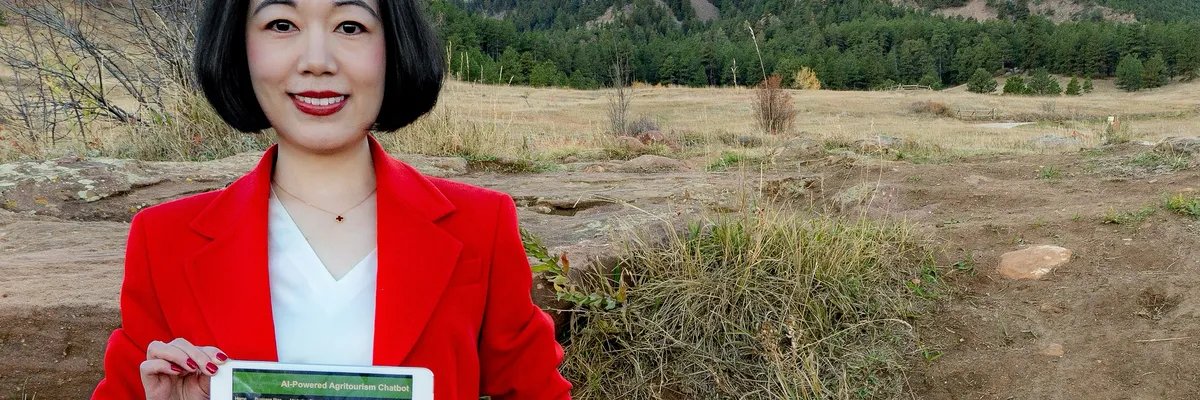
STERLING, Colo. — Across the agricultural expanse of eastern Colorado, where aging demographics and labor migration have widened the digital divide, an academic specialist is operationalizing generative artificial intelligence to safeguard rural farm economics. Xue “Alice” Dong, a regional specialist with Colorado State University Extension and an IEEE senior member based in Logan County, is translating cutting-edge university computer science into pragmatic commercial applications for producers across a 10-county farming territory in the state’s northeastern quadrant, according to a report published by IEEE Spectrum.
The initiative illustrates how frontier machine learning technologies can penetrate legacy sectors that sit far beyond conventional tech hubs, providing critical case studies for capital markets and enterprise software developers assessing the real-world adoption of generative systems. By tailoring domain-specific AI models to agritourism ventures and small rural holdings, the project demonstrates how localized deployment models can mitigate operational friction, unlock ancillary revenue streams, and overcome systemic technological barriers across regional economies.
Academic Research Meets Ground-Level Agricultural Extension
Operating from Sterling, Dong serves within the nationwide Cooperative Extension System, a tripartite network overseen at the federal tier by the U.S. Department of Agriculture’s National Institute of Food and Agriculture, managed statewide through land-grant universities, and executed across more than 3,000 county-level offices. Rather than operating from an academic campus, Dong resides directly within her operational territory, where clients often work hours away across remote rural tracts.
“We act as a bridge,” Dong said in an interview published by IEEE Spectrum. “We bridge our campus to the rural communities we serve.”
Dong’s background bridges environmental science, education, and machine learning. Born in Beijing to physician parents, she earned two undergraduate degrees in geographical science and education from Inner Mongolia Normal University in 2013, followed by a master’s degree in curriculum and instruction from Beijing Normal University in 2016. After relocating to the United States, she completed a master’s in environmental biology at the State University of New York College of Environmental Science and Forestry in 2020. Prior to joining CSU Extension in 2023, she coordinated watershed protection and invasive-species-prevention programs at Paul Smith’s College in New York and managed coastal education initiatives for Stewards of the Coast and Redwoods in California.
After completing a third master’s degree in artificial intelligence and machine learning at CSU Global in 2025, Dong sought to apply advanced computational tools to direct rural challenges. “I’ve always had a passion to create something tangible that can solve problems in the real world,” Dong noted, emphasizing that complex research outputs must be adapted for non-technical operators: “We need to translate that research into something more practical, and easier to use, that farmers and ranchers can understand immediately.”
Operational Mechanics and Documented Economic Impact
Central to Dong’s enterprise deployment is the AI-Powered Agritourism Chatbot, hosted at AgriTourismAI.com, engineered to assist producers in establishing commercial agritourism operations such as pick-your-own orchards, educational tours, and seasonal events. Developed in Python, the system utilizes retrieval-augmented generation to anchor generative outputs strictly in peer-reviewed CSU Extension publications, preventing erroneous fabrications. The interface operates entirely in standard web browsers, ensuring compatibility across desktop computers and tablets without requiring specialized mobile applications or modern smartphones.
The economic impact of the tool was evaluated at Prairie Ridge Buffalo Ranch in eastern Colorado and documented in a 2025 peer-reviewed case study published in CABI Tourism Cases. Farmers use the platform to resolve regulatory questions, structure business plans, establish admission pricing models, and evaluate liability insurance and permitting protocols. Dong presented the architecture at the Conference on Neural Information Processing Systems in 2025, making the underlying source code open-source on GitHub to facilitate adoption by other land-grant institutions.
Dong’s hands-on educational curriculum has extended these technologies directly into local enterprise. She has conducted 20 instructional workshops covering foundational models such as ChatGPT, Claude, and Gemini for more than 200 entrepreneurs and business proprietors across 32 Colorado counties. Partnering with the Logan County Economic Development Corp., the Rural Community Assistance Corp., Colorado Startup Week, and Boulder Startup Week, Dong recorded a 90 percent adoption rate among surveyed attendees, who confirmed executing at least one operational business task using AI tools following instruction.
Strategic Outlook and Emerging AI Governance Frameworks
As generative tools proliferate across commercial enterprise, Dong has expanded her focus toward institutional governance and cross-sector utility. In 2026, alongside Utah State University Extension specialist Paul Hill, she published a governance-aware design framework in the journal AI, detailing methodologies for small enterprises and agricultural extension agents to adopt generative tools with structured compliance and risk oversight.
Dong’s work has garnered significant competitive capital and international recognition. She has secured seven grants totaling more than $250,000 as principal or co-principal investigator, including awards backed by the USDA’s National Institute of Food and Agriculture. In 2026, her AgriPivot AI Agent was selected as a finalist from 318 entries spanning 79 countries in the GenAI for Good Challenge, organized by IEEE Humanitarian Technologies and the United Nations International Telecommunication Union. She also received the 2026 Award for Innovation from the National Extension Technology Community and consecutive educational technology honors from the National Association of Community Development Extension Professionals.
Broadening her technical scope, Dong integrated an AI assistant into Project Pythia in 2026, an open-science initiative funded by the U.S. National Science Foundation and spearheaded by the National Center for Atmospheric Research. The tool translates raw aviation weather observations into structured advisory data for agricultural operators, systematically notifying users when data points are absent rather than estimating missing values. Affiliated with the IEEE Society on Social Implications of Technology and the IEEE Denver Section, Dong continues to position localized, domain-anchored intelligence as an essential conduit for regional enterprise modernization. “They really need this kind of a bridge,” Dong said.


