Remedy Robotics Targets Critical Gaps in Remote Stroke Care
Remedy Robotics secures $62 million to deploy remote catheter systems, aiming to bring emergency stroke surgery to underserved and rural medical centers.
EXECUTIVE BRIEF // KEY TAKEAWAYS
Remedy Robotics secures $62 million to deploy remote catheter systems, aiming to bring emergency stroke surgery to underserved and rural medical centers.
SAN FRANCISCO — Medical technology startup Remedy Robotics has developed a specialized teleoperated catheter system designed to perform emergency mechanical thrombectomies from hundreds of miles away, addressing a critical geographic divide that leaves millions of acute ischemic stroke patients without timely intervention, IEEE Spectrum reported. By combining computer vision, steerable micro-catheters, and networked remote controls, the San Francisco-based firm aims to decentralize high-acuity neurovascular surgery, allowing specialized surgeons stationed at metropolitan medical hubs to extract brain clots from patients admitted to regional and community hospitals.
The commercialization of long-distance surgical robotics marks a pivotal frontier for healthcare systems, enterprise telecommunications, and medical device capital markets, which have long sought practical models for telesurgery outside controlled metropolitan campuses. With acute ischemic stroke afflicting more than 5 million individuals globally each year and standing as the fourth leading cause of death in the United States, timely revascularization dictates clinical survival and lifetime disability outcomes. Yet despite mechanical thrombectomy becoming the established standard of care over the past decade, only an estimated one in 10 eligible patients worldwide receives the procedure due to a severe shortage of neurointerventional specialists outside major urban tertiary centers.
Clinical Origins and the Overhaul of Endovascular Navigation
Traditional mechanical thrombectomies require a skilled interventionalist standing at the patient’s bedside, manually advancing a guide wire through an arterial incision in the groin toward the occlusion in the cerebral vasculature. Operators rely on two-dimensional fluoroscopic X-ray silhouettes and intermittent pulses of radiopaque contrast dye to navigate tortuous blood vessels they cannot directly see. In more than 1 percent of standard procedures, accidental arterial wall perforations occur—a complication that carries severe or fatal consequences.
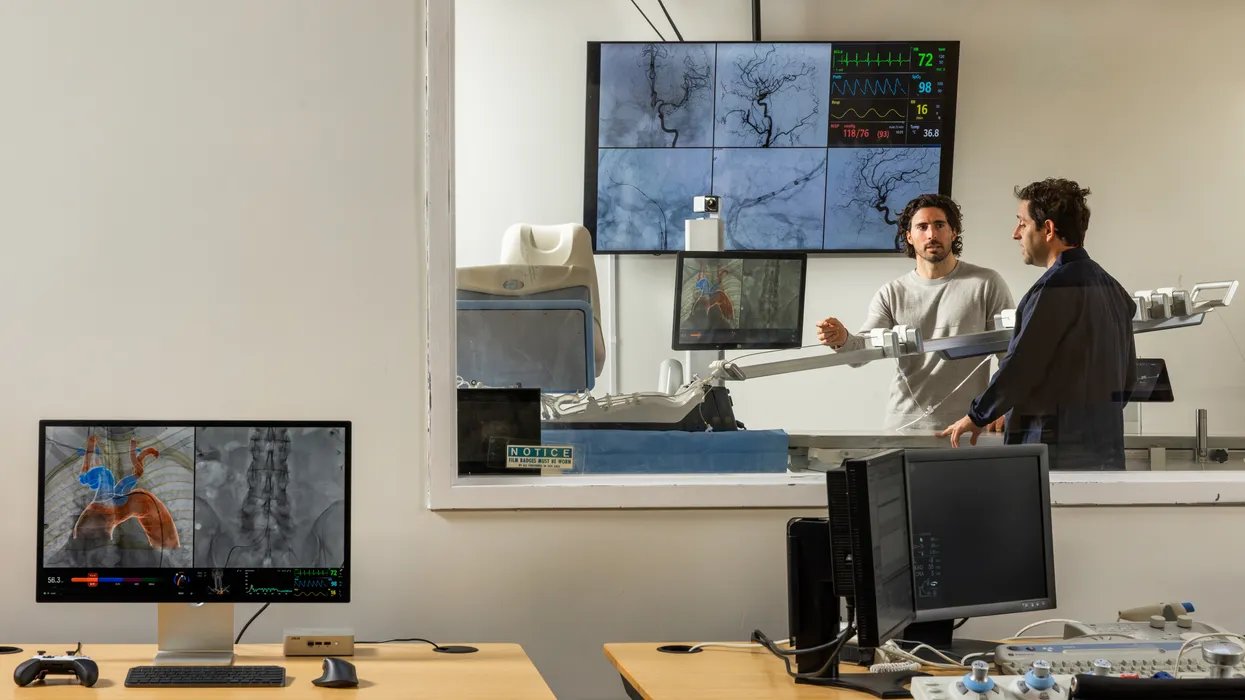
Remedy Robotics was founded by Dr. David Bell, an Australian clinician and former cardiac-surgery trainee, and Jake Sganga, an engineer who previously developed pathfinding navigation algorithms for robotic bronchoscopes at Stanford University. Seeking to eliminate the tactile ambiguity of manual wire advancement, the founders engineered the Remedy N1 platform: a multi-module motorized robotic arm equipped with gear-driven actuators that feed a proprietary, steerable catheter directly into the vascular tree without requiring a conventional guide wire. Integrated computer-vision algorithms track rotational markings on the catheter, automatically translating the surgeon’s directional inputs from a standard console interface into precise movements inside the vessel while overlaying preoperative three-dimensional computed tomography scans onto live fluoroscopy.
“Smoothness and precision are not clinical outcomes. Neither is a surgeon’s ergonomics,” Bell told IEEE Spectrum, emphasizing that clinical efficacy is measured strictly by whether the technology broadens therapeutic access. “The remote stroke need is well known. It’s just a hard problem to take on,” Sganga added.
Infrastructural Demands and Latency Economics
The operational feasibility of telerobotic stroke treatment hinges on overcoming severe networking and institutional hurdles. During acute cerebral ischemia, neurological tissue degrades rapidly. According to Dr. Archit Bhatt, a neurologist with Providence Medical Group in Portland, Oregon, delays carry catastrophic physiological costs.
“Every minute wasted or delayed, 2 million brain cells are going to die,” Bhatt told IEEE Spectrum. “You really need to act fast.”
In the United States, one in five residents lives more than an hour away from a specialized thrombectomy center. In vast rural regions such as Alaska, the state’s sole two comprehensive stroke facilities are located exclusively in Anchorage, leaving more than half of the population of 739,000 outside rapid transport windows. Transferring patients via ground or air ambulance often expends the critical “golden period” required to preserve brain function.
However, deploying telerobotics to peripheral hospitals introduces significant latency and infrastructural constraints. While industry consortia have called for “surgical-grade networks” maintaining round-trip latencies below 100 milliseconds, research led by University of Washington information systems investigator Mike Teodorescu shows that rural communities across the United States and globally frequently fail to meet such thresholds. Remedy has calibrated its N1 architecture to tolerate up to 150 milliseconds of latency—comfortably beneath the 200-millisecond human reflex threshold—incorporating automated safety cutoffs that freeze all instrument actuation if latency spikes occur. Brad Nelson, head of surgical robotics at ETH Zurich, noted that intravascular operations provide an intrinsic safety buffer against sudden communication dropouts: if data transmission stalls, endovascular tools simply pause safely within the lumen, avoiding the immediate tissue collapses associated with open cavitary surgeries.
Capital Allocation and the Regulatory Horizon
Remedy recently closed a $62 million funding round that included capital from the University of California system to underwrite formal clinical trials, IEEE Spectrum reported. The capital injection follows successful initial human feasibility testing conducted in September 2025 at Unity Health Toronto, where neurosurgeon Dr. Vitor Mendes Pereira performed nonemergency diagnostic angiograms on 10 patients—operating across adjoining rooms, across hospital wings, and between distinct municipal facilities—completing procedures at nearly twice the baseline clinical speed.
To navigate stringent medical device clearances, the 25-person startup is adopting a staged commercialization model. Because no remote telerobotic system has secured regulatory clearance from the U.S. Food and Drug Administration, Remedy will initially trial the N1 on-site within University of California hospitals for elective procedures, including unruptured cerebral aneurysms, before the close of 2026. Proving on-premise clinical superiority and workflow integration is critical before seeking expanded regulatory clearance for remote operations, which the firm plans to initiate in Australia and select California networks near the end of 2027.
Beyond regulatory and network barriers, enterprise adoption will require regional hospitals to invest in on-site support infrastructure, including computed tomography scanners, basic catheterization suites, and trained bedside teams. Global health analysts also note the technology must balance distribution models to prevent monopolization by urban centers. As clinical trials commence, Remedy’s trajectory will serve as a bellwether for whether remote medical robotics can transition from technological novelty to an economically viable pillar of acute emergency medicine.


