Perseverance Uncovers Ancient Hydrated Silica Formations at Idubi
NASA's Perseverance rover identified hydrated silica in the Idubi region outside Jezero crater, revealing evidence of ancient Martian hydrothermal systems.
EXECUTIVE BRIEF // KEY TAKEAWAYS
NASA's Perseverance rover identified hydrated silica in the Idubi region outside Jezero crater, revealing evidence of ancient Martian hydrothermal systems.
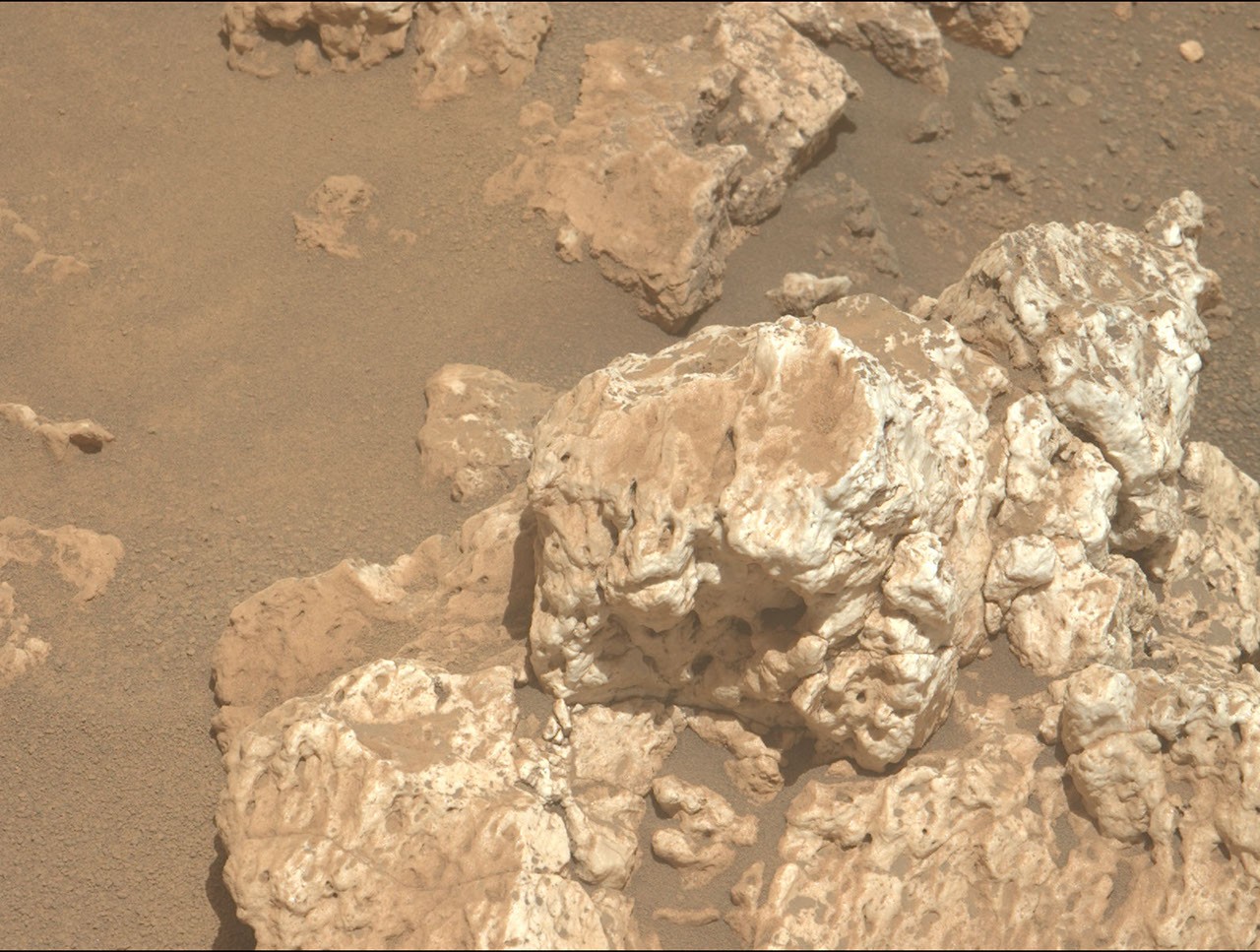
PASADENA, Calif. — NASA’s Perseverance rover has uncovered an unusual cluster of pale, light-toned boulders bearing significant concentrations of hydrated silica within the ancient Martian crust at a site designated “Idubi,” planetary scientists reported on Nov. 16, 2026. Situated in the rugged Lac de Charmes terrain immediately west of Jezero crater’s rim, the discovery provides conclusive geological evidence of sustained, low-temperature water-rock interaction or hydrothermal activity dating back several billion years. The spectroscopic identification marks an essential milestone in the rover’s ongoing exploration of pre-Noachian and early Noachian basement rock exposed beyond the crater basin.
For the broader scientific community and international aerospace consortia monitoring Mars exploration architectures, the finding underscores the strategic necessity of caching diverse geological specimens outside Jezero’s classic delta deposit. While orbital imagery initially mapped the rim terrain as primarily basaltic and impact-altered crust, the presence of localized hydrothermal or groundwater alteration demonstrates that habitable niches were far more widespread across early Mars than previously documented. Understanding these aqueous geochemical pathways is pivotal for calibrating next-generation remote-sensing instruments and validating site-selection criteria for joint NASA-ESA Mars Sample Return endeavors.
Spectroscopic Identification and Bedrock Context
The unusual outcrop captured the attention of mission scientists as Perseverance navigated the undulating slopes of Lac de Charmes, an area informally dubbed the "Wild West" of the mission due to its fractured, unstratified topography. Remote-sensing evaluations conducted with the mast-mounted SuperCam instrument suite—utilizing infrared spectroscopy and laser-induced breakdown spectroscopy—revealed that the luminous boulders were chemically distinct from the ubiquitous dark, iron- and magnesium-rich volcanic rocks dominating the region. Instead, spectral absorptions pointed directly to hydrated silica, a mineral matrix that forms almost exclusively in the presence of liquid water.
“During the Perseverance rover’s investigation of ‘Idubi’ — an area of ancient Martian crust exposed in the ‘Lac de Charmes’ region, outside of Jezero crater — the Perseverance rover team has been captivated by a cluster of eerily bright, light-toned rocks,” wrote Candice Bedford, a research scientist at Purdue University and member of the Perseverance science team, in an official mission dispatch.
Bedford noted that these bright remnants indicate prolonged aqueous activity, wherein fluids circulated through subterranean fractures in the Martian crust, leaching soluble elements and depositing silica veins and nodules before the surface transitioned into an arid, frozen desert. In terrestrial geology, hydrated silica deposits—such as sinters found in geothermal hot springs or opaline precipitates in deep-seated aquifer networks—are renowned for their capacity to entomb and preserve microscopic biosignatures, organic molecules, and cellular structures over billions of years.
Technological Execution and Operational Metrics
Operating a six-wheeled, 1,025-kilogram robotic laboratory across steep crater-rim gradients requires precision routing and autonomous navigation algorithms. Since departing Jezero's floor, Perseverance has logged cumulative traverses exceeding 30 kilometers across abrasive, boulder-strewn slopes. The identification at Idubi was executed through a multi-tiered remote sensing protocol: initial wide-angle multispectral imaging by the Mastcam-Z camera identified chromatic anomalies, which subsequently cued high-resolution SuperCam laser interrogation from distances spanning several meters without requiring immediate mechanical contact.
This rapid geochemical screening technique minimizes mechanical wear on the rover's robotic arm and coring drill while maximizing scientific return per operational sol. With power generated continuously by its Multi-Mission Radioisotope Thermoelectric Generator (MMRTG), the mission operations team at NASA's Jet Propulsion Laboratory (JPL) can rapidly triage potential sampling candidates. The presence of silica-rich material presents a high-priority target for proximal abrasion analysis, potentially deploying the Planetary Instrument for X-ray Lithochemistry (PIXL) and the Scanning Habitable Environments with Raman & Luminescence for Organics & Chemicals (SHERLOC) to map mineralogical micro-textures at sub-millimeter scales.
Strategic Trajectory and Mars Sample Return Implications
The discovery outside Jezero crater significantly alters scientific priorities for the Mars 2020 extended mission and subsequent sample retrieval campaigns. NASA and the European Space Agency (ESA) are currently reviewing cost-constrained, modular architectures for the Mars Sample Return (MSR) program, evaluating both lander-based extraction and commercial orbital rendezvous concepts. The inclusion of hydrated silica cores alongside sedimentary river-delta silts and igneous floor units would provide Earth-based laboratories with an unprecedented cross-section of Martian planetary evolution, ranging from primordial mantle crystallization to hydrothermal alteration.
As commercial aerospace providers and international space agencies refine automated surface vehicles and atmospheric transit systems for long-term Mars exploration, findings from Idubi demonstrate that aqueous mineral deposits remain accessible even in fractured basement terrains. Perseverance will continue mapping the Lac de Charmes corridor in the coming weeks, surveying contact boundaries between the silica-bearing outcrops and underlying bedrock to constrain the temporal duration and thermal regime of Mars' ancient hydrologic cycle.


