NFL Uniform Rules Fuel Unorthodox Growth for Cleat Startup Caddix
Strict league licensing rules force NFL stars to conceal Caddix cleats, sparking organic marketing momentum and surging sales for the safety-focused startup.
EXECUTIVE BRIEF // KEY TAKEAWAYS
Strict league licensing rules force NFL stars to conceal Caddix cleats, sparking organic marketing momentum and surging sales for the safety-focused startup.
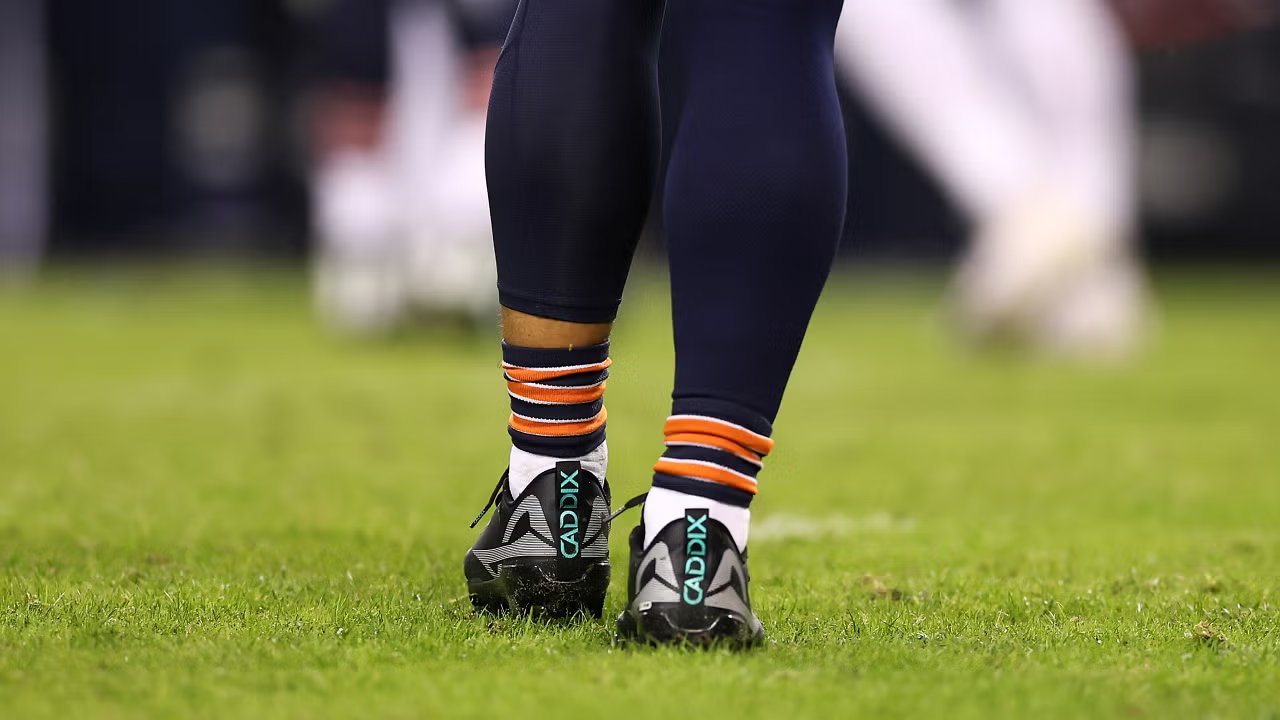
A regulatory clampdown by the National Football League has inadvertently propelled footwear startup Caddix into national prominence, as strict uniform licensing enforcement forces high-profile players to disguise the company's injury-mitigation cleats during regular-season games. Chicago Bears quarterback Caleb Williams was assessed $35,823 in league fines during October after leaving the Caddix insignia exposed in consecutive contests, highlighting a rigid corporate apparel boundary that bars unauthorized commercial branding on professional sidelines. While the NFL has officially approved Caddix footwear for on-field competition, the upstart remains excluded from the league's triopoly of licensed footwear partners—Nike, Adidas, and Under Armour—obligating athletes to conceal the logo with tape or wear unbranded silhouettes.
The regulatory clash underscores a widening structural divide within the multi-billion-dollar athletic apparel market, where entrenched league licensing agreements costing tens of millions of dollars face unexpected disruption from niche equipment designers. By transforming punitive league fines and forced concealment into a compelling narrative of organic player adoption, Caddix is demonstrating how product-led health claims can challenge legacy sponsorship monopolies without traditional marketing capital.
Biomechanical Claims and Independent Scrutiny
Developed since 2015 by founder and Chief Executive Jack Rasmussen alongside his father, Jeff, Caddix commenced commercial distribution in December 2024 with a lean operational staff of four employees. The startup’s design thesis centers on a specialized stud mechanism embedded beneath the cleat. Unlike traditional rigid cleats that lock firmly into synthetic turf, Caddix studs are engineered to flex and pivot marginally under excessive rotational force, releasing the foot before severe rotational torque can twist joints or tear knee ligaments.
Grassroots interest gained momentum after Super Bowl-winning quarterback Joe Flacco, an investor in the firm, became the first player to wear the cleats in an NFL game in 2024 with the Indianapolis Colts. By Week 9 of the current season, prominent starters including Joe Burrow, Cooper Kupp, and Williams had adopted the $230 footwear, contributing to a company-tracked roster exceeding 80 active NFL players across all 32 team franchises.
"The longer you play, the more valuable you are," Rasmussen told Fast Company, framing the cleat's adoption around career longevity.
Williams noted that his feet, knees, and ankles experienced less strain wearing Caddix than with conventional cleats, emphasizing that marginal physical preservation compounds over a sustained professional career. However, clinical validation of the startup's safety claims remains contested. A seminal 2013 study of 555 high school football players led by University of Calgary researcher John Wannop established that players wearing cleats with the greatest rotational traction suffered noncontact lower-limb injuries at more than four times the rate of those with the least rotational traction. Yet Wannop cautioned in remarks to Yahoo Sports that Caddix's specific performance assertions lack public scientific documentation, while Rasmussen acknowledged that the startup's comparative testing data remains privately owned and unreleased.
Licensing Costs, Earned Media, and Balance Sheet Expansion
The institutional barriers protecting the NFL's authorized apparel ecosystem remain financially prohibitive for emerging enterprises. Rasmussen estimated that joining Nike, Adidas, and Under Armour as an official NFL footwear licensee would demand tens of millions of dollars—an outlay impossible for a venture that recorded just under $1 million in revenue last year. The restrictive framework extends across professional sports; the National Women’s Soccer League instituted policies requiring commercial footwear brands to pay both league and athlete fees to display logos during matches. Rasmussen declined the NWSL's $100,000 league fee, calling it a severe detriment to the business, and instead remitted a $5,000 player fee directly to Kansas City Current defender and Caddix investor Kayla Sharples before the league ultimately rescinded uniform fines following a union settlement.
When the NFL sanctioned Williams for his visible branding, Caddix orchestrated a guerrilla marketing countermeasure, leasing billboards across Chicago displaying the message, "Caleb, we’ll pick up the tab," and pledging to cover the quarterback's financial penalties. Media-monitoring firm Meltwater calculated that news and social media mentions surged to nearly 300 daily references following the initial fine on October 24, estimating the earned media equivalent at approximately $6 million—nearly double the startup's projected $3 million revenue target for 2026. Baylor University sports marketing professor Lane Wakefield told Yahoo Sports that Williams’s unpaid preference carried an authentic consumer credibility that paid endorsement arrangements cannot replicate.
Supply Chain Pressures and Institutional Distribution
The viral exposure generated by league disciplinary actions has exerted unprecedented strain on Caddix’s manufacturing and fulfillment infrastructure. Direct consumer transactions alongside retail distribution through Dick’s Sporting Goods and Scheels have caused inventory shortages, while spurring equity financing inquiries from current and retired NFL players. Although equipment managers across all 32 NFL franchises have independently procured pairs, the company faces the logistical challenge of scaling inventory while coaching athletes on masking requirements to prevent further league interventions.
"We look up on Sunday, and we see guys wearing the cleats that we have no idea how they got a hold of them," Rasmussen said of the organic dispersion through team locker rooms.
As professional leagues face heightened scrutiny regarding playing surface safety and athlete welfare, Caddix's trajectory signals a shift in sports equipment commerce. By prioritizing biomechanical differentiation over multi-million-dollar institutional licensing agreements, the startup has established a viable blueprint for challenger brands seeking commercial scale through voluntary athlete endorsement.


