New Study Disputes Early Universe Outsize Black Hole Claim in UHZ1
A reanalysis led by the University of Michigan finds no hidden black hole activity in galaxy UHZ1, pointing instead to a low-mass, star-forming system.
EXECUTIVE BRIEF // KEY TAKEAWAYS
A reanalysis led by the University of Michigan finds no hidden black hole activity in galaxy UHZ1, pointing instead to a low-mass, star-forming system.
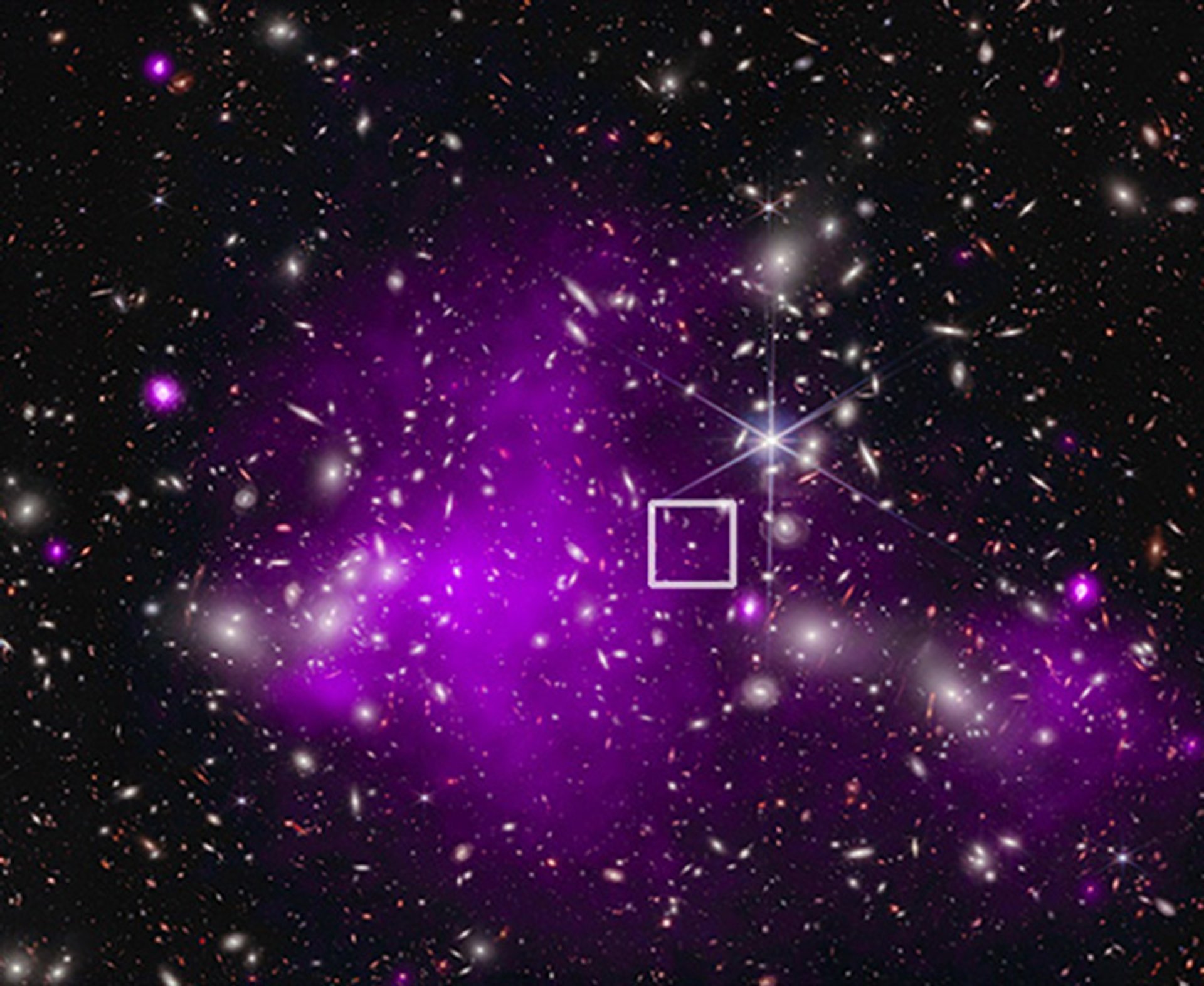
A new astrophysical reanalysis of the distant galaxy UHZ1 has challenged previous scientific claims that the system hosts an unusually massive, dust-obscured black hole formed in the early universe. Led by researcher Fan Zou of the University of Michigan and published Oct. 14 in The Astrophysical Journal, the study combines existing X-ray data with new infrared observations to re-evaluate the object, which first drew international scientific attention three years ago. According to findings reported by Phys.org Space, the updated observational synthesis reveals no detectable signs of hidden black hole activity, suggesting instead that UHZ1 is likely a low-mass, metal-poor, star-forming galaxy.
The reassessment carries substantial weight for space science institutions, observatory resource allocation, and theoretical models governing early cosmic evolution. Three years ago, UHZ1 was widely cited as foundational observational evidence for the "direct collapse" model of black hole formation, a mechanism proposed to explain how supermassive black holes could reach extreme masses so shortly after the Big Bang. By calling that interpretation into question, the University of Michigan-led findings highlight both the analytical complexity of interpreting high-redshift signals and the necessity of cross-wavelength verification across flagship space telescopes before establishing new cosmological paradigms.
Reassessing the Direct Collapse Hypothesis
When UHZ1 first made headlines three years ago, researchers proposed that it harbored an "outsize" black hole whose mass was unusually large relative to its host galaxy. In standard astrophysical models, black holes grow gradually over hundreds of millions of years from the remnants of the first stars. To account for a disproportionately massive object existing so early in cosmic history, the original claim pointed to direct collapse, a theoretical process in which massive clouds of pristine gas bypass normal stellar evolution and collapse directly into a heavy black hole seed obscured by dense cosmic dust.
As detailed in the Oct. 14 paper in The Astrophysical Journal and summarized by Phys.org Space, the reanalysis led by Fan Zou of the University of Michigan reports no signs of hidden black hole activity within UHZ1 when pairing existing X-ray data with new infrared observations.
In observational astrophysics, heavily dust-obscured active galactic nuclei are expected to absorb high-energy optical and ultraviolet radiation and re-emit that energy at infrared wavelengths, alongside characteristic X-ray signatures. By testing the earlier hypothesis against expanded infrared datasets and re-examining the archival X-ray record, Zou and the research team found that the multi-wavelength emissions from UHZ1 do not require an accreting, dust-shrouded black hole to explain the observed data.
Observational Impact and Multi-Wavelength Reanalysis
The operational and scientific significance of the study rests on how astronomers classify ambiguous sources at the frontier of the observable universe. High-redshift galaxies sit at extreme distances, meaning their light is faint and shifted toward longer wavelengths as the universe expands. Distinguishing between a heavily obscured, actively feeding black hole and intense star formation in a young galaxy requires rigorous calibration across both X-ray and infrared instruments.
According to the Phys.org Space report on the study, removing the hidden black hole interpretation alters the physical profile of UHZ1 across three primary dimensions. Rather than representing an exotic gravitational anomaly, the system can be accounted for as a low-mass galaxy undergoing active star formation within a metal-poor environment—a chemical composition consistent with galaxies in the early universe that have not yet been enriched by multiple generations of stellar supernovae. For research consortia managing observation time on space-based infrared and X-ray observatories, the findings underscore the value of systematic archival reanalysis paired with targeted follow-up imaging to prevent misclassifying star-forming systems as active black hole hosts.
Strategic Outlook for Early-Universe Cosmology
The debate surrounding UHZ1 illustrates the self-correcting methodology of modern space science as observational capabilities mature. While the Oct. 14 publication in The Astrophysical Journal removes a prominent piece of evidence supporting direct collapse in this specific galaxy, the broader scientific question of how early supermassive black holes assembled remains a central priority for observational cosmology.
Moving forward, astronomy teams examining candidate early black holes are expected to apply stricter multi-wavelength vetting protocols before confirming direct-collapse seeds. Future survey milestones will depend on deeper spectroscopic follow-ups and coordinated X-ray and infrared campaigns to separate genuine active galactic nuclei from low-mass, metal-poor, star-forming galaxies in the early cosmos.