NASA Visualizes Massive Galactic Collision in NGC 7771 Group
NASA releases imagery of the NGC 7771 galactic merger, providing vital observational data to model long-term galactic evolution and the Milky Way's fate.
EXECUTIVE BRIEF // KEY TAKEAWAYS
NASA releases imagery of the NGC 7771 galactic merger, providing vital observational data to model long-term galactic evolution and the Milky Way's fate.
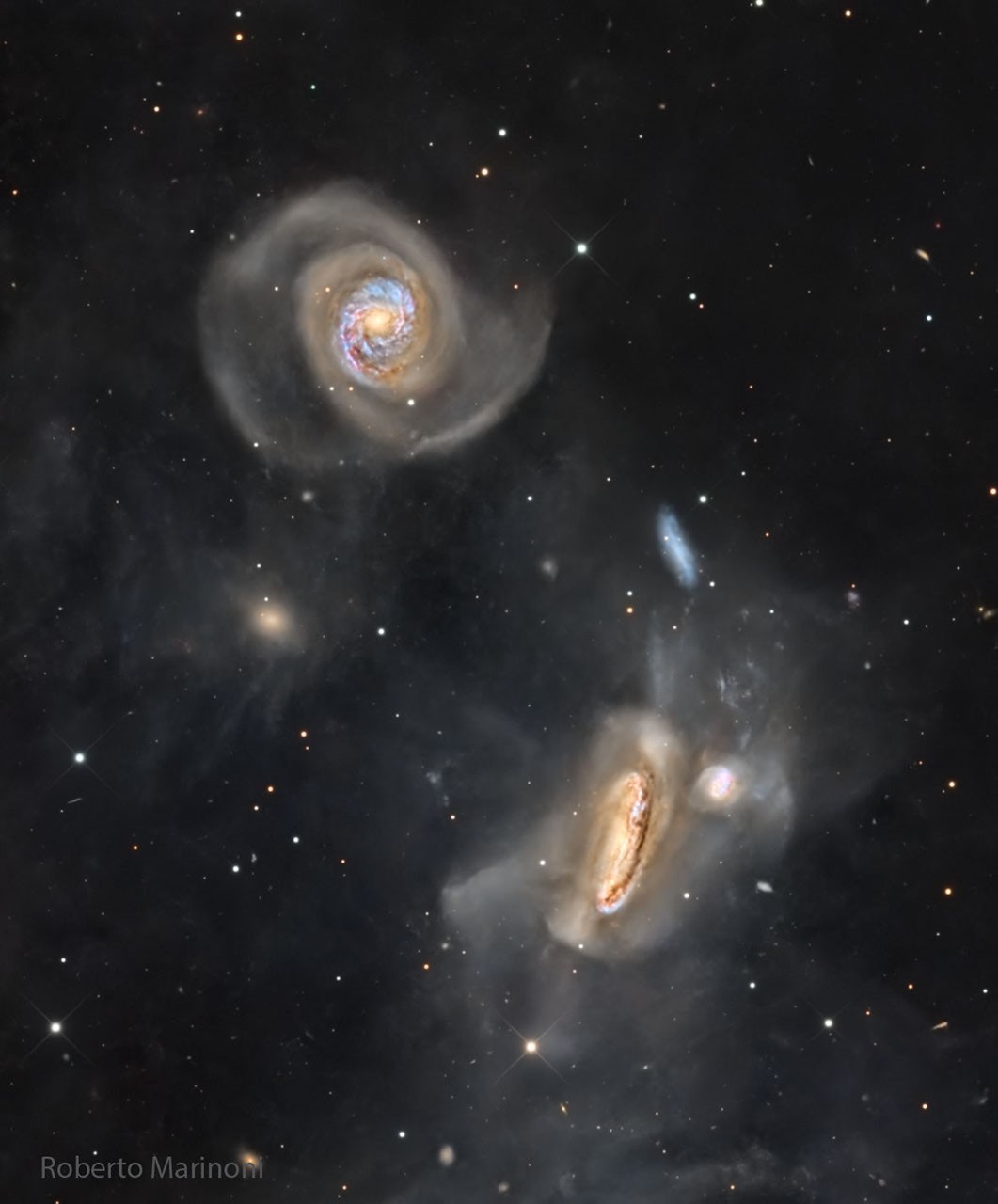
WASHINGTON — NASA has published observational records capturing a multi-billion-year gravitational collision within the NGC 7771 galaxy group, offering crucial empirical insights into the mechanical evolution of colliding cosmic structures. Located approximately 200 million light-years from Earth within the high-flying constellation Pegasus, the interacting galactic system showcases the protracted, high-energy dynamics that eventually coalesce multiple star systems into a single composite entity. The release, curated through NASA's Astronomy Picture of the Day program on Nov. 24, 2026, details how violent gravitational interactions reshape celestial architecture across cosmic epochs.
For the broader scientific enterprise, aerospace telemetry consortia, and computational modeling sectors, empirical captures of gravitational disruption provide essential benchmarks for validating high-performance fluid dynamics and astrophysical simulations. As commercial and public capital continues to flow into hyperscale orbital imaging instruments, spectroscopic arrays, and supercomputing clusters, verifying the physics of deep-space galactic mergers remains critical for refining predictive algorithms that track large-scale mass distribution and orbital mechanics across the universe.
Gravitational Disruption and Observational Evidence
The visual analysis released by NASA highlights pronounced structural distortions caused by mutual gravitational pull between the primary constituents of the NGC 7771 group. Prominently featured in the lower right quadrant of the imaging frame is barred spiral galaxy NGC 7771, spanning an estimated 75,000 light-years in diameter. Hovering in the upper left is spiral galaxy NGC 7769, whose physical dimensions approach a comparable scale. Accompanying these titans are smaller satellite galaxies caught in their shared gravitational envelope, resulting in repeated close orbital passages.
Observational instruments captured structural remnants of previous close passes, including faint stellar swirls, tidal tails, and disrupted galactic rings that trace out the historical trajectory of the encounter. As noted in the certified NASA commentary accompanying the release:
"After this galaxy battle, only one galaxy will remain. Already visible in the featured picture are rings and faint star swirls from previous gravitational encounters."
The official analysis emphasizes that such chaotic interactions are not exceptional anomalies, but rather standard evolutionary milestones governing the life cycles of large galaxies. As these cosmic bodies complete successive orbital circuits, mutual gravitational drag steadily bleeds orbital momentum from the individual members, inexorably steering them toward an eventual catastrophic coalescence into a single, vast merged structure.
Computational Scale and Deep-Space Data Infrastructure
Translating observations of galactic interactions situated nearly 200 million light-years away into measurable physical baselines requires sophisticated orbital observation, digital signal processing, and high-fidelity noise reduction algorithms. Capturing features as diffuse as stellar rings and faint star swirls requires optical sensitivity capable of distinguishing micro-variations in luminosity against the deep cosmic background. This operational reality has driven heightened technical integration between astronomical observation platforms and advanced data processing infrastructures.
Supercomputing clusters dedicated to astrophysics rely on raw observational data from groups like NGC 7771 to test N-body gravitational simulations that model hundreds of billions of solar masses over multi-billion-year timelines. By comparing empirical snapshots of tidal distortion against mathematical projections, researchers can calibrate dark matter density assumptions, gas cooling rates, and stellar formation thresholds triggered by shockwaves during close encounters. The processing demands of these multi-dimensional datasets are accelerating the adoption of specialized hardware accelerators and automated telemetry pipelines across international research consortia.
Strategic Implications for Galactic Evolution and the Milky Way
Beyond immediate structural cataloging, the analytical value of the NGC 7771 observations extends directly to understanding the long-term trajectory of Earth's local galactic neighborhood. Astrophysics research teams utilize the dynamics recorded in the NGC 7771 group as an observational proxy for the projected collision between our own Milky Way galaxy and the neighboring Andromeda spiral galaxy, expected to unfold over the coming billions of years.
As international space agencies advance next-generation space telescope deployments and wide-field survey mandates, tracking galactic merger precursors provides the foundational reference frames needed to validate cosmic life-cycle theories. Continued public and institutional funding for space exploration and open astronomical archives remains contingent on demonstrating how deep-space monitoring answers fundamental questions regarding matter distribution and structural stability. The NGC 7771 release reaffirms that celestial collisions represent an enduring engine of cosmic transformation, cementing the necessity of ongoing investment in high-resolution orbital reconnaissance and scalable data analytics.


