NASA SPHEREx Pierces Milky Way Dust in Infrared Breakthrough
NASA's SPHEREx satellite reveals how mid-infrared wavelengths pierce cosmic dust obscuring the Milky Way center, advancing space observation capabilities.
EXECUTIVE BRIEF // KEY TAKEAWAYS
NASA's SPHEREx satellite reveals how mid-infrared wavelengths pierce cosmic dust obscuring the Milky Way center, advancing space observation capabilities.
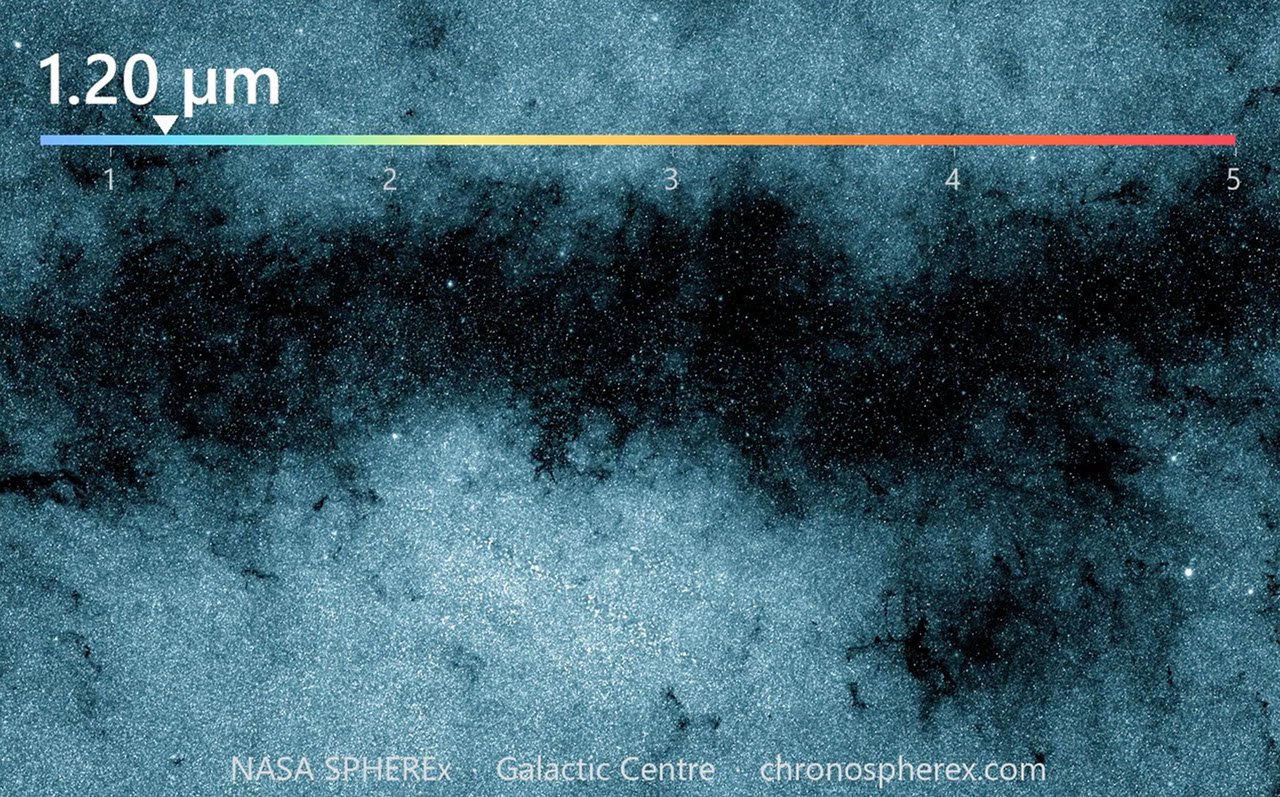
WASHINGTON — NASA has unveiled new spectroscopic observations from its SPHEREx space observatory showing the heavily obscured center of the Milky Way across the infrared spectrum, demonstrating the spacecraft's capability to pierce through dense cosmic dust accumulated over 13 billion years of galactic evolution. Disclosed through the agency's Astronomy Picture of the Day scientific repository, the imaging sequence contrasts how short-wavelength infrared radiation scatters against interstellar particles while longer mid-infrared wavelengths penetrate directly to orbital detectors, unlocking critical vantage points into regions long concealed from optical telescopes.
For the frontier aerospace sector, advanced optics manufacturers, and data-driven orbital research enterprises, the operational validation of SPHEREx's all-sky spectroscopic technology signals a significant leap forward in infrared instrumentation. The ability to methodically resolve obscured galactic structures without atmospheric attenuation provides aerospace contractors, optical sensor developers, and commercial payload operators with valuable empirical validation for multi-band infrared detector architectures, while laying foundational data pipelines for future deep-space surveillance and scientific instrumentation markets.
Interstellar Debris and Wavelength-Dependent Transparency
The galactic core of the Milky Way has historically presented severe observational challenges due to vast reservoirs of interstellar dust that absorb and disperse visible light. According to scientific disclosures accompanying the imagery, cosmic dust differs fundamentally from terrestrial debris, consisting of microscopic compounds of oxygen, carbon, and other heavy elements expelled during stellar mortality across the galaxy's multi-billion-year lifespan. Because these particulates are hundreds of times smaller than ordinary household dirt, their microscopic physical scale dictates how electromagnetic radiation interacts with them.
"In the near-infrared, like 1.2 microns, light gets absorbed and scatters off of dust particles. SPHEREx then sees the Galactic Center almost entirely blocked by clouds of dust. In the mid-infrared, though, light is able to pierce through the dust and reach SPHEREx," the mission overview stated.
This scattering dynamic mirrors the atmospheric phenomenon that renders terrestrial sunsets red, wherein shorter wavelengths scatter broadly while longer wavelengths travel uninterrupted through particulates. In near-infrared bands centered around 1.2 microns, dust lanes remain opaque barriers, while mid-infrared bands successfully penetrate the dense clouds, confirming that orbital infrared observatories can accurately map previously invisible core structures and celestial formations.
Technical Architecture and Observational Metrics
The SPHEREx observatory employs false-color infrared imaging mapped directly to specific spectral wavelengths to decouple complex thermal signatures from particulate absorption profiles. By systematically indexing each wavelength bracket across wide survey corridors, the platform establishes empirical baselines for how distinct element compounds alter signal transmission in deep space. The resulting multi-band mapping offers unprecedented granularity into the elemental composition of interstellar clouds, detailing the spatial distribution of oxygen, carbon, and complex molecular compounds generated over the Milky Way's 13-billion-year operational history.
The engineering validation of mid-infrared penetration also bolsters the broader market for cryogenically cooled focal plane arrays, diffraction gratings, and radiation-hardened spaceborne spectrometers. Commercial satellite integrators and scientific agencies increasingly rely on these spectral bands to assess cosmic microwave background variations, identify organic ices, and monitor low-reflectivity objects across dynamic orbital regimes where optical instruments routinely fail due to particulate clutter or low ambient illumination.
Strategic Horizons and Space-Based Spectrometry Outlook
As space agencies and sovereign programs scale expenditures in frontier space exploration, spectroscopic platforms like SPHEREx represent pivotal infrastructure for international astrophysics and commercial sensor commercialization. The ongoing data acquisition campaign is designed to provide comprehensive, calibrated spectral surveys that complement major assets, expanding the global scientific community's understanding of galactic evolution and star formation kinetics.
Looking ahead, future milestones will focus on mapping extended star fields and analyzing dusty molecular environments across peripheral galactic corridors. The continuing pipeline of observations promises to refine cosmological models and clarify the distribution of water ice and biogenic molecules across the cosmos, reinforcing NASA's foundational mission directive to innovate for humanity's benefit through discovery and systematic spaceborne exploration.


