NASA Resolves Dark Nebula LDN 1251 Through 20-Hour Exposure
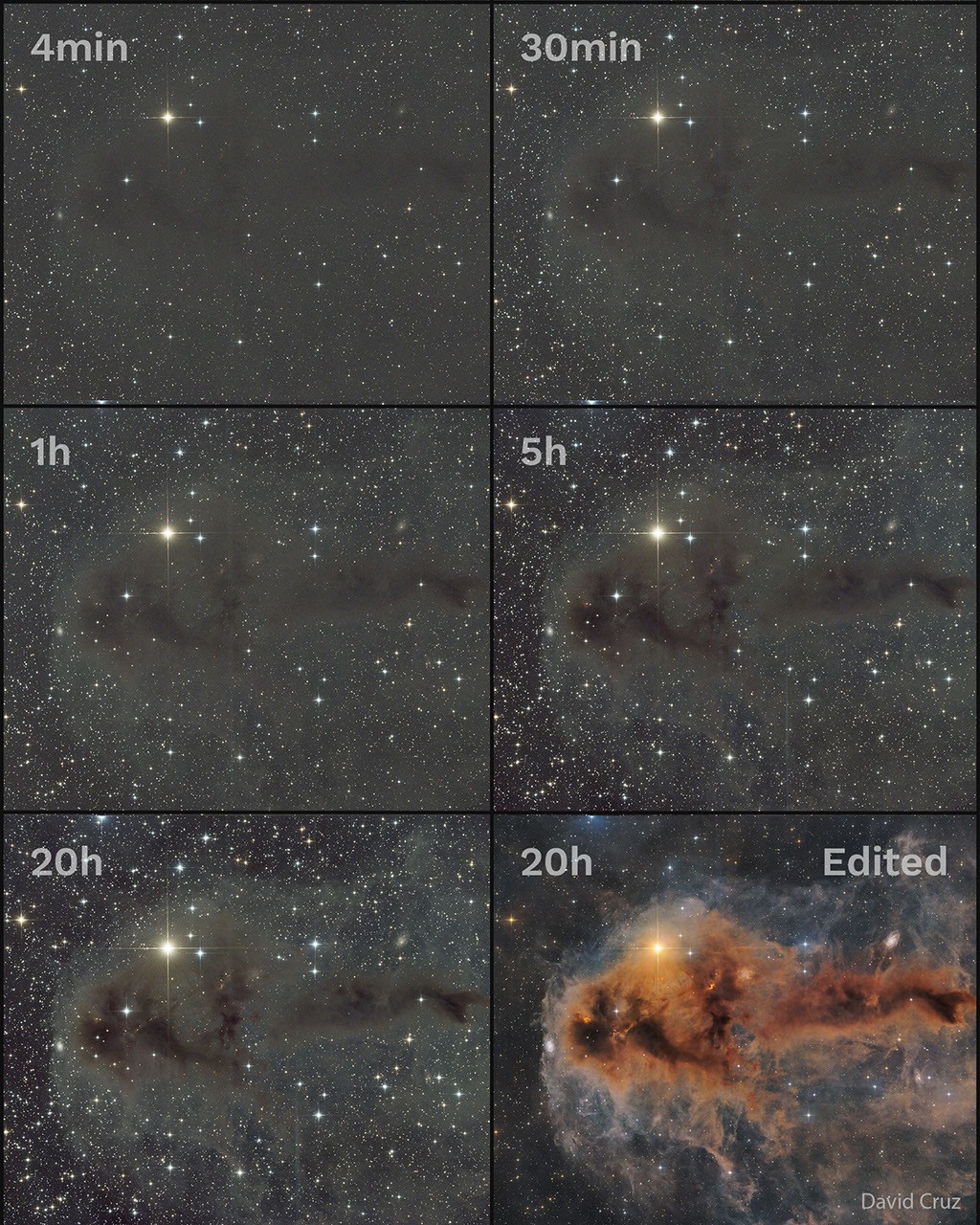
A 20-hour composite exposure published by NASA reveals stellar winds, shock waves, and dense dust structures inside the star-forming nebula Lynds 1251.
EXECUTIVE BRIEF // KEY TAKEAWAYS
A 20-hour composite exposure published by NASA reveals stellar winds, shock waves, and dense dust structures inside the star-forming nebula Lynds 1251.
WASHINGTON — In an observational data release highlighting the analytical power of extended sensor exposure, NASA on Monday showcased the emergence of dark nebula Lynds 1251, a complex star-forming structure laced with opaque interstellar dust. Published on Nov. 23, 2026, through the agency's Astronomy Picture of the Day service, the composite visual reveals deep physical phenomena embedded within the formation—colloquially designated the Rotten Fish Nebula—that remain virtually invisible during conventional, short-duration astronomical viewing.
The release carries measurable significance for the frontier space science and computational imaging sectors, demonstrating how sustained photon accumulation coupled with advanced post-capture digital processing unlocks detailed telemetry from low-luminosity cosmic environments. As public space agencies and commercial Earth-and-space observation enterprises increasingly deploy autonomous sensors and ultra-sensitive detectors, mapping high-density dust reservoirs like LDN 1251 offers crucial baselines for understanding the energetic drivers behind early-stage stellar ignition and astrophysical fluid dynamics.
Contextual Background and Interstellar Dynamics
According to the technical breakdown published by NASA, observing an object of this magnitude requires cumulative exposure times that conventional human sight cannot achieve. While brief visual observation in the direction of the target reveals starless voids, prolonged exposure progressively defines the opaque silhouette of the molecular cloud. The showcased rendering represents a full 20 hours of continuous light collection, followed by deliberate digital processing designed to brighten the faint field and enhance subtle color gradients across the dust spectrum.
Within the obscured corridors of LDN 1251, astronomers trace an environment undergoing turbulent mechanical evolution. Rather than serving as an inert curtain of space debris, the nebula functions as an active stellar incubator. NASA noted that the long-duration capture indicates the presence of young stars embedded within the brown-hued particulate matter, flanked by high-velocity physical phenomena. Specifically, the data confirms energetic shock waves propagating through the gas clouds, driven by fast stellar winds and powerfully beamed astrophysical jets originating from newborn proto-stars.
Technological Mechanics and Sensor Dwell Economics
From an imaging engineering standpoint, resolving the fine structural boundaries of LDN 1251 illustrates the operational imperative of sensor dwell time in deep-sky reconnaissance. Capturing faint emission and scattering across 20 hours demands rigorous optical stabilization, precision thermal control of focal plane arrays to minimize dark current noise, and calibrated algorithmic post-processing to tease out low-contrast features without introducing synthetic artifacts.
"NASA explores the unknown in air and space, innovates for the benefit of humanity, and inspires the world through discovery."
The capacity to differentiate between completely opaque obscuration and active accretion disks highlights progress in wide-field sensor instrumentation. In modern astrophysics and commercial optical telemetry, the ability to isolate high-energy outflows—such as collimated stellar jets and shock wave fronts—within thick dust blankets serves as a benchmark for multi-spectral imaging pipelines.
Frontier Instrumentation and Observational Outlook
Looking ahead, the techniques applied to capture LDN 1251 provide an empirical foundation for next-generation astronomical survey platforms and commercial orbital imaging arrays. As deep-space observation missions transition toward autonomous detection of dynamic interstellar events, processing multi-hour exposures will increasingly rely on automated edge-computing architectures capable of calibrating noisy sensor data in real time.
Upcoming research milestones across orbital observatories and ground-based facilities will focus on probing the interior velocity fields of LDN 1251 at infrared and submillimeter wavelengths, bypassing dust opacity entirely. For the broader frontier technology ecosystem, the ongoing characterization of complex star-forming complexes underscores the vital link between high-precision optical hardware, extensive exposure budgets, and sophisticated image reconstruction in expanding the empirical boundaries of modern astrophysics.


