NASA Releases 3D Anaglyph of Apollo 17 Landing Site
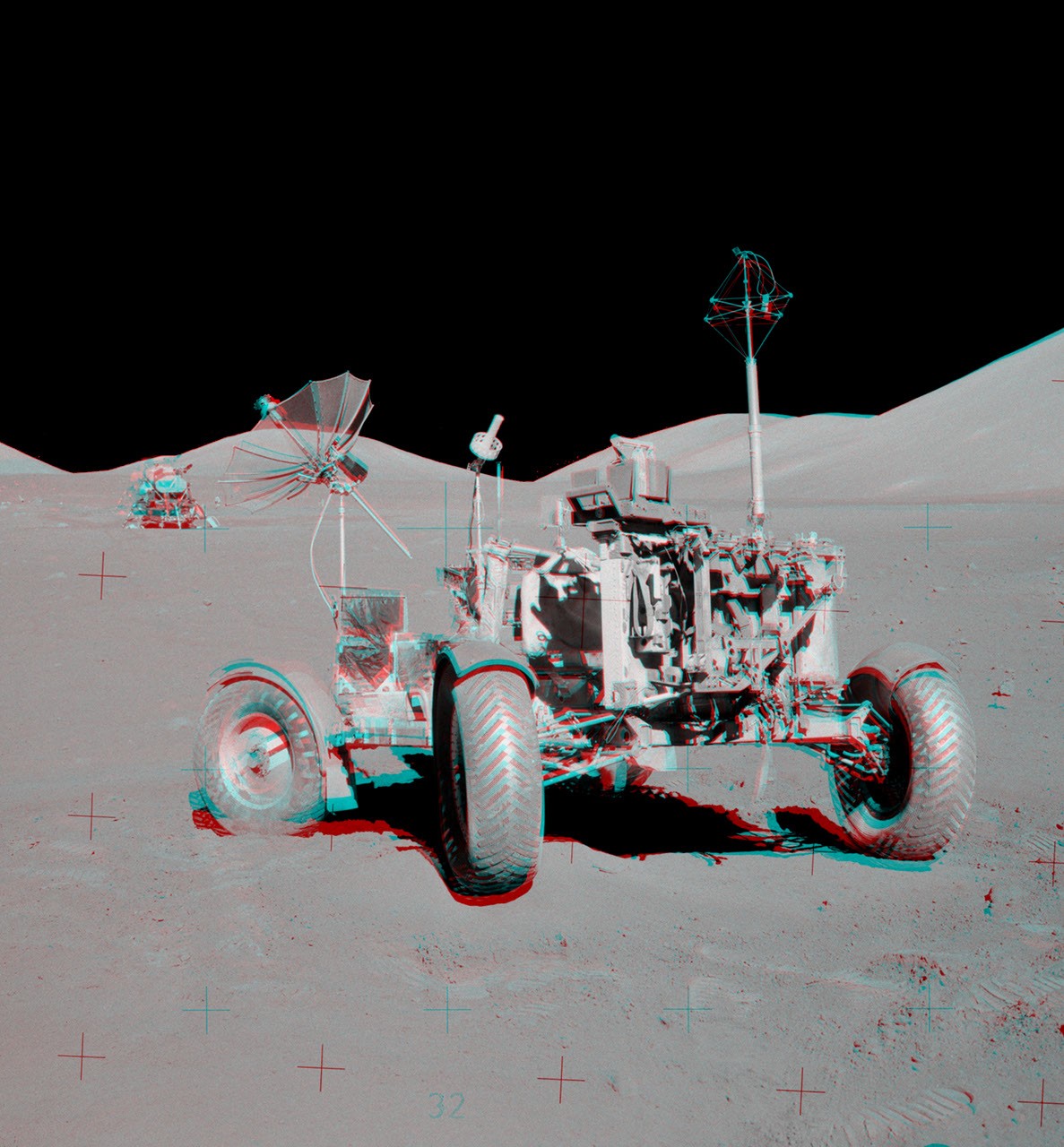
NASA's Astronomy Picture of the Day highlights a historic 3D stereo view of the Apollo 17 Taurus-Littrow landing site and Lunar Rover.
EXECUTIVE BRIEF // KEY TAKEAWAYS
NASA's Astronomy Picture of the Day highlights a historic 3D stereo view of the Apollo 17 Taurus-Littrow landing site and Lunar Rover.
WASHINGTON — Marking a distinct archival focus on humanity's final crewed lunar mission, NASA featured a high-resolution color anaglyph of the Taurus-Littrow valley on the Moon as its Astronomy Picture of the Day. Released through official agency channels, the detailed stereoscopic image reconstructs the historical topography of the Apollo 17 landing site, foregrounding the iconic Lunar Rover alongside the historic Lunar Module and distant lunar highlands. The archival release serves as both a technological retrospective of early space exploration telemetry and an educational reminder of the foundational infrastructure established during the closing era of the Apollo program.
For the modern aerospace sector, planetary science community, and commercial lunar enterprise, revisiting the operational parameters of Apollo 17 provides critical historical benchmarks as global space agencies and private entities prepare for sustained surface habitation. The meticulous documentation preserved from the December 1972 mission offers invaluable insights into lunar dust mechanics, surface navigation, and remote operational capabilities under extraterrestrial environmental constraints.
Archival Legacy of the Taurus-Littrow Valley
According to background documentation provided in NASA News Releases, the featured stereo scene captures the specific parking location designated as the Variable In-Place (VIP) Site. This vantage point was strategically selected because the Lunar Rover's television camera was positioned to broadcast the historic liftoff of the Lunar Module's ascent stage directly back to television audiences on Earth. During their mission, astronauts Eugene Cernan and Schmitt spent approximately 75 hours operating on the lunar surface while command module pilot Ronald Evans maintained orbit overhead.
NASA notes that the mission's scientific return remains unparalleled among the Apollo landings. Cernan and Schmitt successfully returned 110 kilograms of pristine rock and soil samples to Earth, representing the largest mass of geological material retrieved from any single lunar exploration site. Crucially, more than five decades after their departure from the Taurus-Littrow valley, Cernan and Schmitt retain the historical distinction of being the final human beings to walk and drive upon the lunar surface.
Technological Evolution from Analog to Autonomous Exploration
The operational framework utilized during Apollo 17 established early paradigms for remote telemetry and audiovisual broadcasting in deep space. The capacity to transmit live video feeds from a surface-deployed rover platform demonstrated early feasibility for complex robotic and human-operated networks in low-latency environments. In the contemporary landscape, these legacy architectures inform the development of advanced automated rovers, autonomous resource prospecting systems, and high-definition communication relays currently slated for deployment under modern lunar exploration architectures.
Economic and technical evaluations of the Apollo sample repository continue to drive modern instrumentation design. The 110 kilograms of geological samples secured by the 1972 crew have provided decades of analytical data, helping researchers map the geological history of the inner solar system and establishing rigorous contamination-control protocols that modern sample-return missions must still emulate.
Strategic Implications for Commercial Spaceflight
As international space programs and private commercial entities pivot toward establishing permanent outposts under upcoming lunar initiatives, the operational lessons of the Apollo era remain highly relevant. Regulatory frameworks, planetary protection protocols, and hardware durability standards are heavily influenced by the engineering solutions pioneered during the Apollo program's terminal phase.
Furthermore, public engagement initiatives like NASA's Astronomy Picture of the Day continue to play a vital role in sustaining global interest in space exploration. By translating complex historical missions into accessible digital formats—such as the recent red-and-blue anaglyph visualization—the agency maintains educational momentum while inspiring the next generation of engineers, scientists, and commercial spaceflight operators tasked with returning humanity to the Moon for the first time in over fifty years.


