NASA Showcases Milky Way and Aurora as Space Weather Risks Rise
NASA’s latest celestial study highlights the intersection of galactic light and auroral geomagnetic storms, carrying vital data for orbital infrastructure.
EXECUTIVE BRIEF // KEY TAKEAWAYS
NASA’s latest celestial study highlights the intersection of galactic light and auroral geomagnetic storms, carrying vital data for orbital infrastructure.
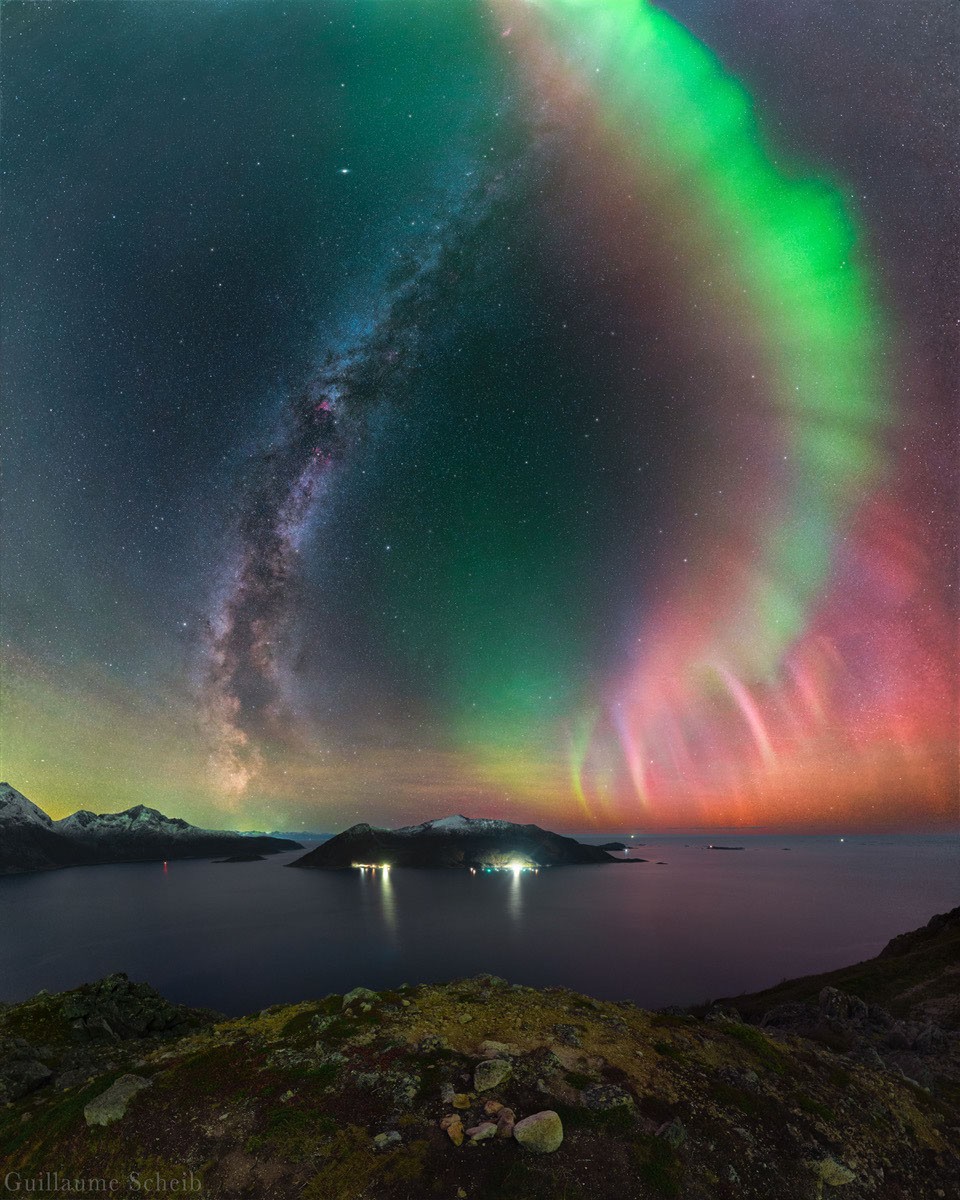
WASHINGTON — NASA’s Astronomy Picture of the Day service released observational imagery capturing the visual confrontation between the Milky Way’s galactic plane and geomagnetic auroral luminescence, illustrating the physical boundary where terrestrial magnetospheric dynamics meet deep-space stellar architecture. The comparative documentation, curated by professional astronomers under NASA’s Science Mission Directorate, juxtaposes the diffuse emissions of atmospheric ionization with the ancient starlight of the galactic core, offering researchers an empirical benchmark for examining electromagnetic disturbances across Earth's upper atmosphere.
The visual intersection between Earth’s immediate space environment and cosmic structures comes amid an era of intensified solar activity, transforming what was once a purely aesthetic astronomical inquiry into an operational priority for global aerospace and telecommunications enterprises. As commercial satellite operators deploy thousands of assets into low-Earth orbit, understanding the solar-driven mechanisms responsible for high-latitude auroral displays has shifted from academic curiosity to a critical variable in mitigating orbital drag, preserving radio communications, and securing orbital logistics.
Atmospheric Physics and Deep-Space Visual Alignment
According to release notes published through the NASA platform, the dual phenomenon illustrates two distinct branches of astrophysics operating on vastly divergent spatial and temporal scales. Auroral arcs represent immediate, localized interactions within Earth's thermosphere and ionosphere, initiated when streams of energized solar wind collide with the planet's magnetic shield. These charged particles funnel down geomagnetic field lines toward polar latitudes, exciting atomic oxygen and molecular nitrogen at altitudes between 80 and 300 kilometers.
Each day a different image or photograph of our fascinating universe is featured, along with a brief explanation written by a professional astronomer, documenting key mechanisms spanning planetary systems to deep cosmic structures.
Conversely, the Milky Way’s backdrop represents integrated starlight, interstellar dust lanes, and molecular gas clouds spanning tens of thousands of light-years across the galactic disk. While the auroral light fluctuates on timescales of seconds to minutes due to shifting interplanetary magnetic field orientations, the galactic plane provides a fixed celestial background. The contrast emphasized by NASA's educational curators demonstrates how optical ground observations continue to complement spaceborne sensor suites by establishing baseline atmospheric transparency and tracking light pollution metrics.
Operational Impacts on Orbital Assets and Grid Resilience
The geomagnetic phenomena underlying bright auroral displays present direct operational vulnerabilities for space-based and ground-based infrastructure. Solar energetic particle events and coronal mass ejections that heighten auroral brilliance simultaneously inflate the upper atmosphere through localized heating. This expansion dramatically increases aerodynamic atmospheric drag on low-Earth orbit constellations, forcing commercial constellation managers to expend vital onboard propellant reserves for station-keeping maneuvers or risk premature orbital decay.
During intense geomagnetic storms rated at G4 or G5 thresholds, induced geomagnetically induced currents also threaten high-voltage terrestrial electrical grids, transoceanic fiber-optic cable repeaters, and pipelines. In the orbital domain, heightened ionospheric electron density introduces scintillation across high-frequency radio bands and degrades global navigation satellite systems, resulting in positional telemetry errors that can disrupt commercial aviation routing and precision maritime navigation.
Strategic Implications for Heliophysics and Commercial Aviation
Looking ahead, the alignment of scientific imaging platforms with commercial space weather monitoring reflects a structural transition toward predictive space situational awareness. Sovereign space agencies and private aerospace consortia are accelerating investments in next-generation solar observatories positioned at the Sun-Earth Lagrange points to provide earlier warning horizons for geomagnetic anomalies. Such early-warning telemetry allows satellite operators to configure spacecraft into safe modes and enables power transmission utilities to adjust transformer load distributions before plasma shock fronts strike the magnetopause.
As space traffic expands across commercial launch corridors, standardizing real-time atmospheric data feeds will become an essential regulatory condition for flight clearance and orbital debris tracking. NASA’s systematic tracking of near-Earth electromagnetic interactions continues to serve as an indispensable foundational dataset, connecting the physical visual beauty of auroral and galactic phenomena with the rigorous engineering demands of an increasingly space-dependent global economy.