NASA Enlists Global Citizen Astronomers to Hunt Fleeting Kilonovae
NASA expands its Kilonova Catcher network, uniting global amateur observers to track fleeting cosmic collisions ahead of Roman Space Telescope data streams.
EXECUTIVE BRIEF // KEY TAKEAWAYS
NASA expands its Kilonova Catcher network, uniting global amateur observers to track fleeting cosmic collisions ahead of Roman Space Telescope data streams.
WASHINGTON — An expanding international collaboration connecting amateur astronomers with multi-messenger astrophysics has transformed rapid-response transient tracking, establishing a distributed observational network to capture the optical counterparts of deep-space cataclysms. Co-led by researchers at the Minnesota Institute for Astrophysics and the French Alternative Energies and Atomic Energy Commission, the initiative—known as Kilonova Catcher—deploys volunteer observers equipped with camera-enabled telescopes to localize and monitor rapid-fading kilonovae triggered by neutron star collisions across the universe.
As next-generation astronomical observatories prepare to flood research pipelines with unprecedented volumes of transient alerts, institutional astrophysics faces critical bandwidth bottlenecks. The integration of decentralized, crowd-sourced optical nodes directly into formal research infrastructures demonstrates how institutional science can scale sensor networks without commensurate capital outlays. By institutionalizing citizen participation into official discovery feeds, the project establishes a resilient operational model for managing the data deluges anticipated from flagship orbital platforms and ground-based multi-messenger arrays.
Rapid-Response Science and Observational Coordination
Kilonovae occur when ultra-dense, city-sized neutron stars collide, releasing intense gravitational waves alongside short-lived electromagnetic radiation. These violent cosmic events serve as cosmic crucibles, forging significant proportions of the universe's gold, platinum, and other heavy elements. However, because kilonovae fade within days of detection, astronomical instruments face narrow observational windows that single terrestrial observatories cannot adequately monitor in isolation.
To overcome planetary coverage gaps, Kilonova Catcher synchronizes volunteer astronomers spanning several continents. When alerts register from gravitational-wave detectors or space-borne telescopes, network participants pivot their personal optics to identify and record the dissipating light. The operational protocol also conducts rapid optical follow-ups on gamma-ray bursts—the most energetic explosive events in the cosmos—and tracks incidental short-duration celestial phenomena.
"Here at Kilonova Catcher, by chasing the light from gravitational-wave events, we’re seeing how a single collision reaches across the universe," said Cristina Andrade, Kilonova Catcher head of operations at the Minnesota Institute for Astrophysics. "The observatories that make this possible will produce an unprecedented amount of data. We need more human minds, more people with their eyes on the sky and on the data, both literally and figuratively. And more importantly, we need more people to realize they are capable of great feats of science, regardless of their background."
Project leadership emphasizes that amateur engagement bridges critical gaps between theoretical modeling and observational verification.
"I am inspired by the expertise and drive of our amateur astronomers," said Dr. Damien Turpin, principal investigator and researcher at the French Alternative Energies and Atomic Energy Commission (CEA). "They are always digging for more information and pushing the limits of their understanding. This science could not be done without their contributions."
Operational Integration and Multi-Messenger Output
The operational framework of Kilonova Catcher has matured beyond informal crowd-sourcing into an accredited scientific pipeline. Comprising more than 150 registered participants across multiple continents, the collaborative network operates in direct tandem with professional observatories and researchers. Participants feed observational telemetry into NASA’s General Coordinates Network, the global clearinghouse utilized by the international scientific community to broadcast transient discoveries in real time.
To date, member contributions have underpinned more than 64 formal reports disseminated through the General Coordinates Network. Reflecting rigorous data integrity and scientific attribution, participating amateur astronomers have secured co-authorship credentials in peer-reviewed scientific research journals. Beyond deep-space transients, the consortium participated in NASA’s lunar Impact Flash! campaign conducted during the Artemis II mission, measuring minute optical flashes generated when meteoroids strike the lunar surface.
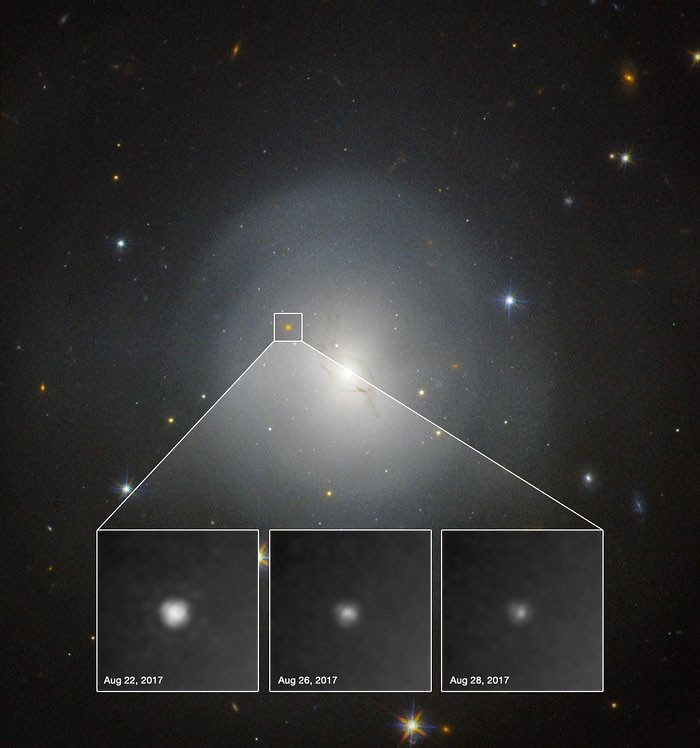
The foundational paradigm for this optical follow-up originated on Aug. 17, 2017, when the Laser Interferometer Gravitational-Wave Observatory (LIGO) and the Virgo Interferometer captured gravitational waves emanating from a binary neutron star merger. Within 12 hours of the gravitational trigger, astronomical observatories successfully pinpointed the optical counterpart within the lenticular galaxy NGC 4993. NASA’s Hubble Space Telescope subsequently gathered decisive imagery of the event, marking the first time in history that astronomers observed the visible counterpart of a gravitational-wave detection.
Strategic Outlook and Next-Generation Sky Surveys
Looking ahead, the Kilonova Catcher consortium is scaling its operational infrastructure to absorb massive data flows from incoming space missions. Network managers are currently conditioning the volunteer base to ingest and triage thousands of transient candidate alerts expected from NASA’s upcoming Nancy Grace Roman Space Telescope. The wide-field infrared observatory will conduct sweeping sky surveys, generating alerts at a scale that necessitates rapid automated filtering paired with dedicated human ground validation.
As public registration remains open to individuals operating camera-mounted telescopes, the project models how international institutions can reconcile computational scale with distributed human oversight. By embedding citizen observers directly into rapid-response multi-messenger pipelines, space agencies and research institutes are securing essential capacity to track the cosmos's most volatile transient signatures before their signals vanish into the void.


