NASA Juno Data Sharpens Mystery of Jupiter's Atmospheric Chemistry
High-altitude observations from NASA's Juno orbiter spotlight unresolved questions in planetary atmospheric models and trace chemical composition.
EXECUTIVE BRIEF // KEY TAKEAWAYS
High-altitude observations from NASA's Juno orbiter spotlight unresolved questions in planetary atmospheric models and trace chemical composition.
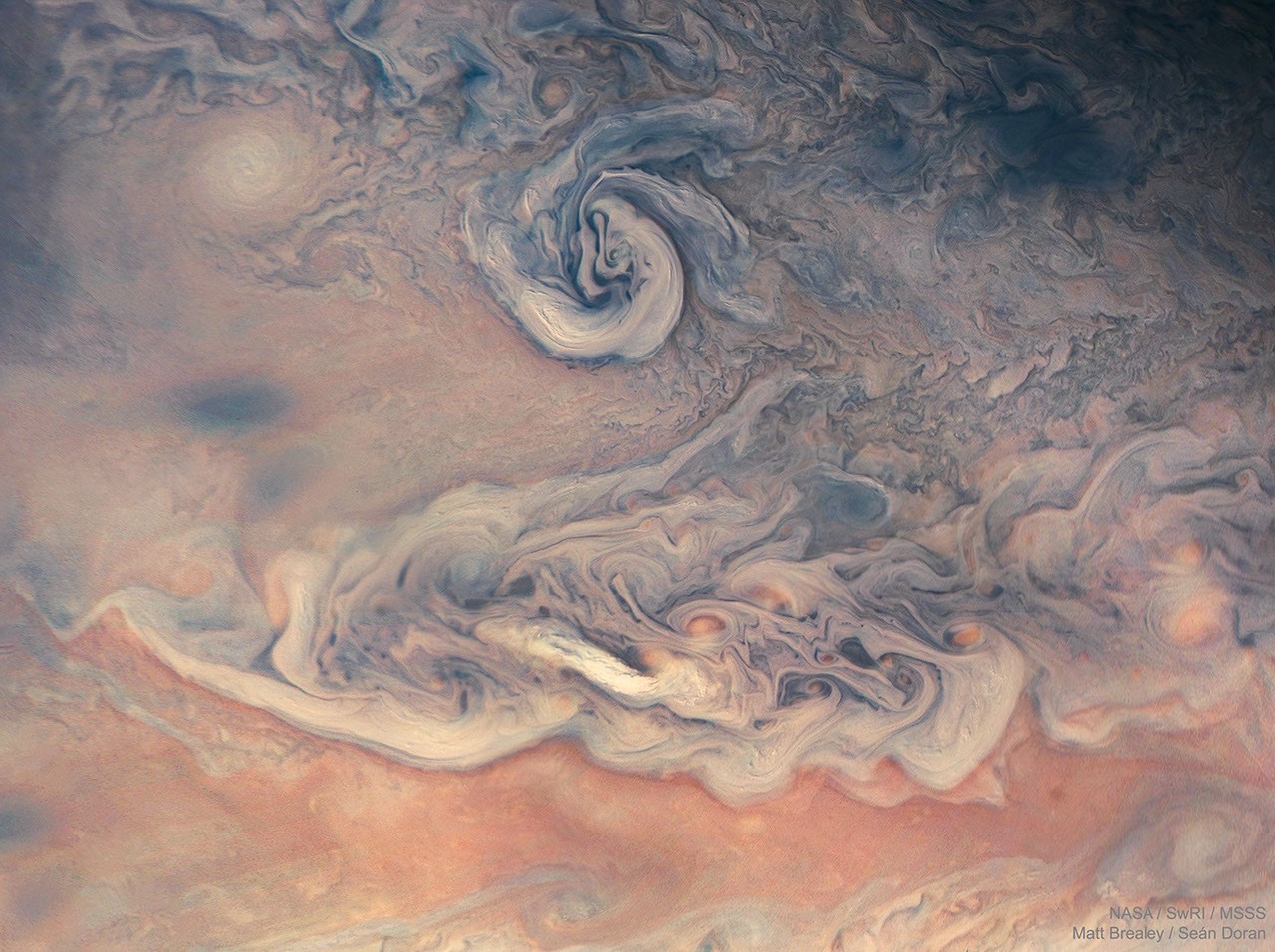
WASHINGTON — Fresh visual and analytical telemetry highlighted by NASA has brought renewed scrutiny to the foundational chemistry of Jupiter's complex cloud layers, pointing to significant unresolved questions regarding the compounds responsible for the gas giant's vibrant chromatic bands. Relying on color-enhanced imaging captured by the robotic Juno orbiter during its fourteenth close flyby, planetary researchers emphasize that the specific trace elements imparting vivid hues across the planet's hydrogen- and helium-dominated atmosphere remain unconfirmed, according to disclosures published through NASA's Astronomy Picture of the Day service.
The observations carry direct significance for the broader astrophysical and planetary science sectors, where atmospheric modeling frameworks established for Jovian gas giants serve as primary baselines for interpreting chemical signatures detected across thousands of extrasolar planets. Discrepancies in understanding the vertical distribution, photochemical transformation, and chemical composition of our solar system's largest planet underline persistent gaps in commercial and institutional space observation models, directly impacting capital allocation for next-generation spectroscopic missions and deep-space instrumentation.
Observational Context and Stratified Cloud Dynamics
The primary compositional structure of Jupiter presents an enduring chemical puzzle for planetary scientists. In its bulk composition, the planet's thick outer envelope consists almost entirely of hydrogen and helium. Under the frigid ambient temperatures observed at the Jovian cloud tops, both gases are entirely colorless, indicating that the prominent reddish and ochre pigments visible across its swirling cloud bands are generated by low-abundance trace constituents rather than bulk atmospheric media.
According to researchers reviewing the Juno mission data, small quantities of ammonium hydrosulfide represent a primary candidate among atmospheric scientists seeking to explain the chromatic variance. However, empirical verification of the compound's precise optical properties under extreme radiation and solar ultraviolet exposure remains incomplete. As documented in the NASA release:
"What creates the colors in Jupiter's clouds? No one is sure. The thick atmosphere of Jupiter is mostly hydrogen and helium, elements which are colorless at the low temperatures of the Jovian cloud tops. Which trace molecules provide the colors remains a topic of research, although small amounts of ammonium hydrosulfide are one leading candidate."
The color-enhanced imagery provides critical empirical confirmation regarding the vertical stratification of Jovian weather systems. Structural patterns across the frame confirm that lighter, paler cloud decks sit systematically higher in the altitude profile than darker, reddish formations. In the specific sector surveyed, light-toned clouds are observed swirling around deeper reddish regions toward the lower right quadrant, while concurrently overlaying and concealing darker domains across the upper right section of the observation corridor.
Technological Execution and Mission Architecture
The underlying data was obtained by the robotic Juno spacecraft as part of its fourteenth close perijove pass over Jupiter. Managed by NASA's Jet Propulsion Laboratory, Juno operates within an engineered looping elliptical polar orbit designed specifically to minimize exposure to Jupiter's intense, electronics-destroying radiation belts while optimizing observational resolution.
To achieve this balance, the orbiter swoops in close proximity to the giant planet every 33 days, executing a highly eccentric trajectory that shifts its longitudinal coverage across successive passes. This orbital cadence enables Juno to map distinct atmospheric sectors and longitudinal corridors over time, building a multi-epoch dataset of atmospheric motion, magnetospheric dynamics, and gravitational variations. The 33-day orbital profile represents a pivotal design parameter, providing mission engineers with consistent recurring windows for deep-space telemetry relay and payload calibration.
The deployment of color enhancement techniques on Juno's optical imaging instruments has proven critical for resolving subtle thermodynamic boundaries and fluid transitions that remain otherwise undetectable in raw spectral bands. By amplifying subtle variations in cloud reflectance and chromophore absorption, analysts can track convective upwelling zones and map the shear interfaces separating opposing zonal jet streams.
Strategic Implications for Planetary Science and Exploration
Resolving the exact chemical catalysts responsible for Jupiter's color bands holds critical technological and scientific implications for orbital instrumentation design. As institutional agencies and aerospace contractors prepare future flagship initiatives targeted at outer planet systems, sensor suites must be precisely calibrated to differentiate between volatile condensation products and photochemically altered trace species.
Furthermore, Jupiter functions as the quintessential archetype for massive gas exoplanets observed by space-based observatories such as the James Webb Space Telescope. If legacy atmospheric chemistry codes cannot definitively account for the chromophores present within our solar system's most accessible gas giant, exoplanet characterization pipelines face heightened systemic uncertainty when inferring atmospheric metallicity and thermal profiles around distant stars.
Looking ahead, Juno continues its extended mission operations, systematically collecting high-resolution telemetry across its recurrent 33-day perijove sweeps. Each subsequent periapsis passage provides fresh opportunities to sample unmapped sectors of Jupiter's dynamic atmosphere, gradually constraining theoretical models of Jovian meteorology and refining the scientific framework governing outer planet evolution.


