NASA Curiosity Rover Marks 49 Drill Samples Across Martian Surface
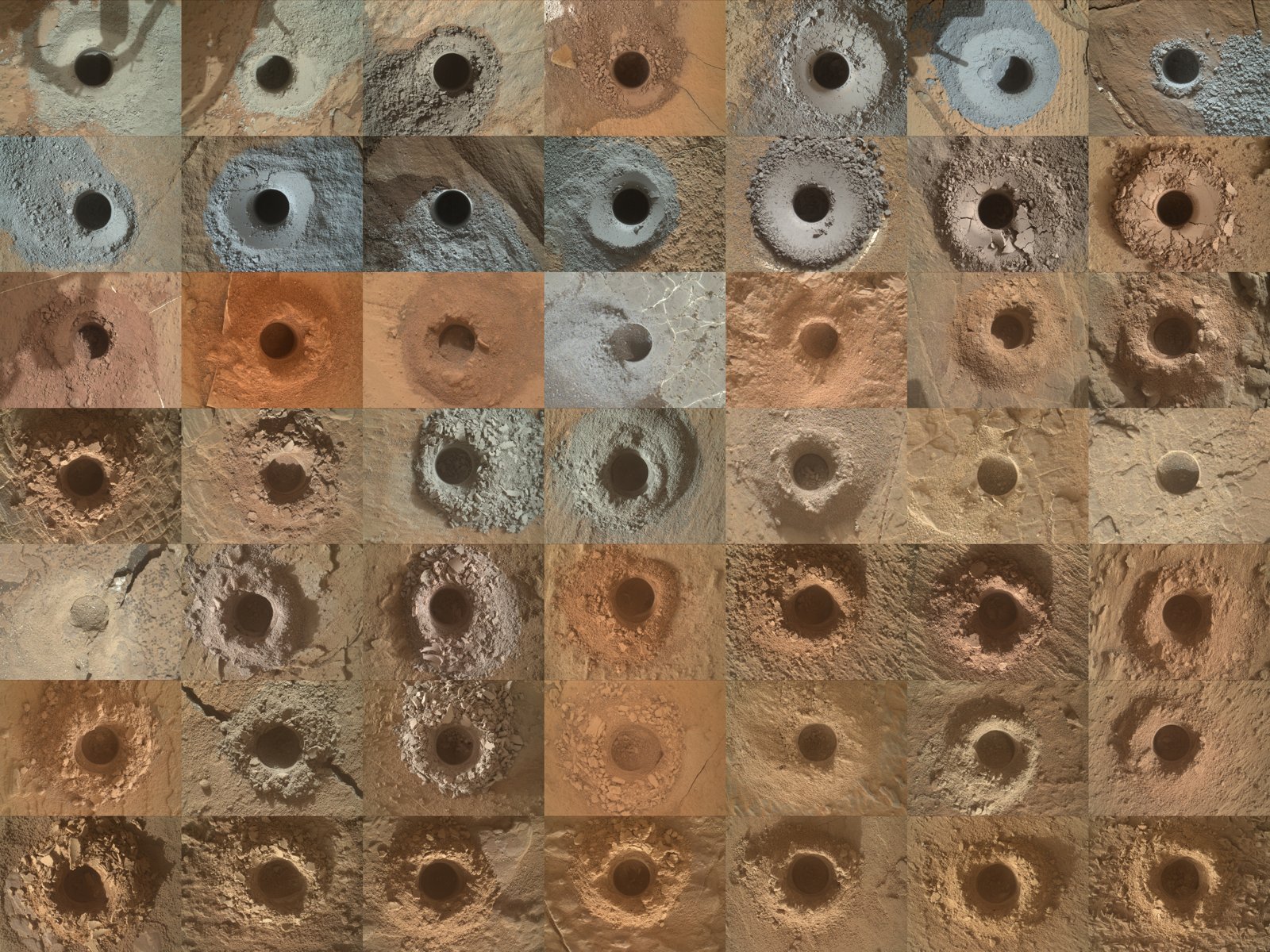
A newly released NASA collage documents 49 drill holes from the Curiosity rover, highlighting a decade-plus robotic campaign to decode Martian composition.
EXECUTIVE BRIEF // KEY TAKEAWAYS
A newly released NASA collage documents 49 drill holes from the Curiosity rover, highlighting a decade-plus robotic campaign to decode Martian composition.
WASHINGTON — NASA’s Curiosity Mars rover has documented 49 rock core extractions across the Martian terrain, marking a sustained technical milestone in automated planetary geology, according to mission documentation and imagery released by the U.S. space agency on Nov. 16. The compiled photographic record illustrates an expansive robotic drilling initiative conducted across diverse geological targets on the Martian surface as of November 2026, generating vital geochemical baselines required to decipher the historical habitability and environmental evolution of the Red Planet.
For the international aerospace sector and planetary exploration initiatives, Curiosity’s continued surface operations demonstrate the long-term utility of autonomous robotic sampling architectures. As sovereign space programs and private aerospace enterprises evaluate hardware durability for long-duration surface missions, in-situ extraction and compositional analysis remain critical precursors for future robotic sample-retrieval campaigns, planetary resource identification, and multi-mission scientific return.
Technical Architecture and In-Situ Analysis
The operational cadence documented in the 49-sample record reflects a specialized end-to-end extraction and analysis sequence deployed by mission engineers. Unlike surface imaging systems, the rover’s physical sampling mechanism relies on mechanical extraction to access pristine interior rock materials shielded from cosmic radiation and surface weathering processes.
“Curiosity’s drill, located on the end of its robotic arm, drops pulverized rock samples into instruments in its belly that analyze their composition,” the agency detailed in its source release.
According to NASA News Releases, each puncture visible in the 49-hole collage represents an individual sample systematically retrieved from surface rock formations. Once the percussive rotary drill mechanism on the robotic arm penetrates target bedrock, the resulting fine powder is channeled into dedicated internal laboratory suites located inside the rover’s main chassis. These instruments process the mineral particulates to determine their elemental, isotopic, and mineralogical structures, bypassing the necessity of immediate sample return to Earth for primary characterization.
Operational Durability and Geological Metrics
Surpassing 49 drill sites represents a notable engineering achievement given the extreme operating environment of the Martian surface, characterized by sharp diurnal thermal cycling, abrasive dust, and variable rock hardness. Mechanical drilling on an extraterrestrial body introduces severe physical stresses on robotic actuators, torque sensors, and drill bits, requiring precise terrestrial command sequencing and autonomous instrument safeguards to prevent hardware binding or premature wear.
The progressive accumulation of 49 discrete drill samples as of November 2026 also underscores the systematic geographic coverage Curiosity has maintained across its exploration corridor. By pulverizing and analyzing disparate strata, the rover provides scientists with continuous cross-sectional data spanning multiple sedimentary layers. The ability to verify mineral distribution through direct internal instrumentation reduces analytical uncertainty and allows planetary scientists to construct highly detailed environmental timelines of regional Martian basins.
Strategic Implications for Frontier Exploration
The enduring performance of Curiosity’s extraction system carries strategic significance for upcoming exploration frameworks spearheaded by global space agencies and commercial payload developers. Autonomous sample acquisition remains one of the highest technical hurdles for deep-space surface exploration, serving as a critical prerequisite for proposed commercial mining surveys and sovereign return architectures.
As deep-space exploration programs mature toward more ambitious robotic sample return and crewed planetary expeditions, the operational data harvested from Curiosity’s 49 drill operations will inform future robotic tooling, dust mitigation strategies, and autonomous payload handling standards. By confirming that robotic arm drill assemblies can reliably pulverize rock and supply onboard diagnostic instruments over protracted timescales, NASA’s ongoing mission establishes an empirical foundation for next-generation automated planetary science across the solar system.


