NASA Features Horsehead and Flame Nebulas in Deep-Space Release
NASA’s Astronomy Picture of the Day highlights the Horsehead and Flame Nebulas, showcasing star formation dynamics and advanced astronomical imaging data.
EXECUTIVE BRIEF // KEY TAKEAWAYS
NASA’s Astronomy Picture of the Day highlights the Horsehead and Flame Nebulas, showcasing star formation dynamics and advanced astronomical imaging data.
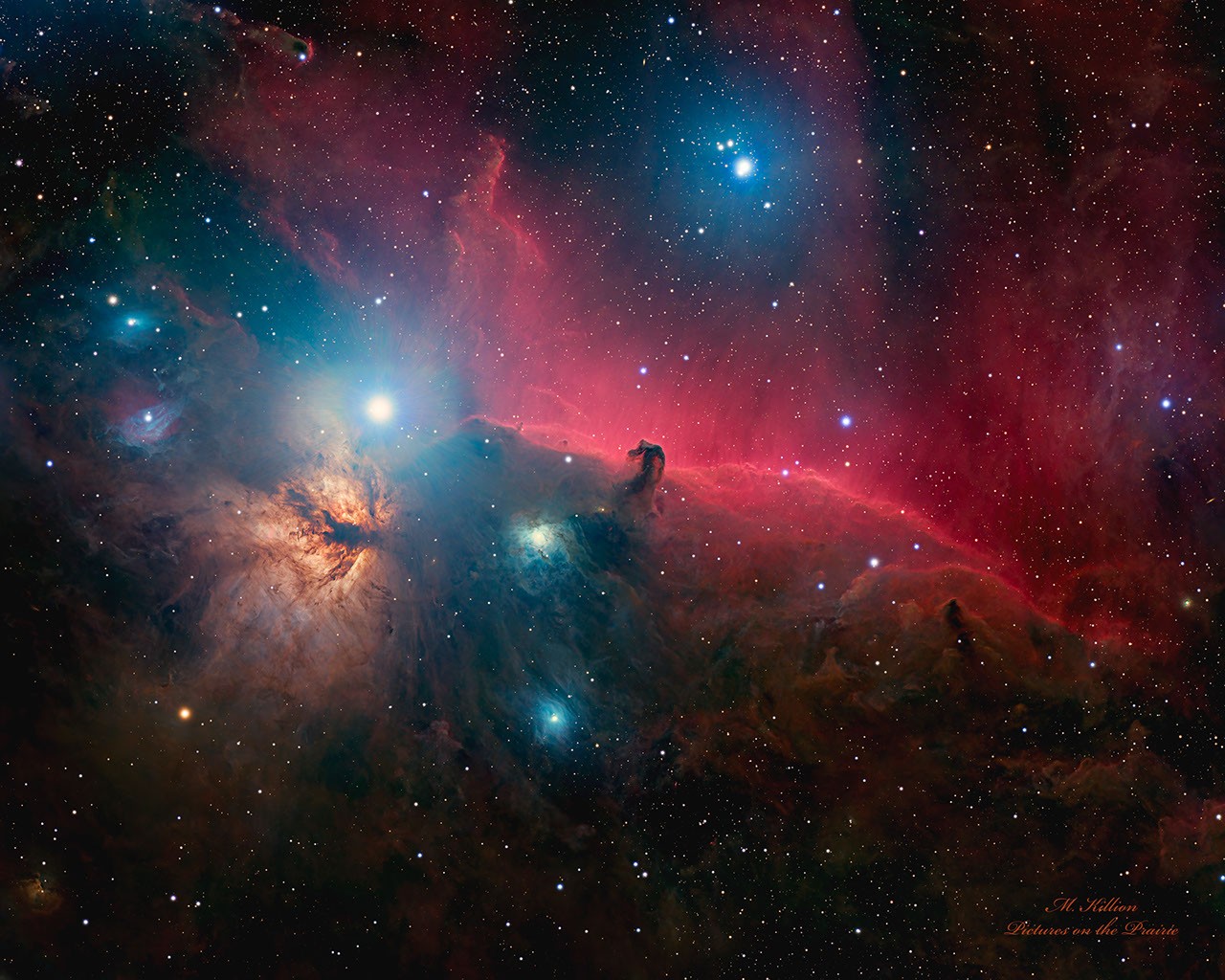
WASHINGTON — The National Aeronautics and Space Administration featured the Horsehead and Flame Nebulas in its Astronomy Picture of the Day service on Thursday, presenting an intricate view of active stellar formation within the constellation Orion. The release synthesizes deep-sky observations of the Orion B molecular cloud complex, located approximately 1,500 light-years from Earth, illustrating the complex physical interactions between intense stellar radiation fields and dense interstellar dust.
For the international scientific community and the expanding aerospace sensor sector, the continuous documentation of these star-forming complexes provides an indispensable benchmark. High-resolution astronomical imaging and spectral processing techniques, frequently cataloged through foundational programs such as APOD, directly inform the sensor architectures, optical calibration algorithms, and remote-sensing instruments deployed across commercial, governmental, and scientific orbital platforms.
Astrophysical Context and Cloud Dynamics
The Horsehead Nebula, formally cataloged as Barnard 33, remains one of the most recognizable dark absorption nebulae in the northern celestial hemisphere. Situated adjacent to the easternmost star of Orion's Belt, Alnitak, the characteristic equine silhouette emerges against a luminous curtain of ionized hydrogen gas energized by ultraviolet radiation from embedded massive stars. Nearby, the Flame Nebula, designated NGC 2024, exhibits a striking emission signature bisected by an intricate central dust lane, illuminated internally by high-energy emissions from an otherwise obscured cluster of nascent protostars.
"Each day a different image or photograph of our fascinating universe is featured, along with a brief explanation written by a professional astronomer," NASA noted in its institutional summary of the Astronomy Picture of the Day service.
Astronomers systematically utilize the wider Orion molecular cloud complex as an observational testbed for star birth dynamics. Because the region is relatively nearby in galactic terms, modern instruments can distinguish individual protostellar envelopes, stellar wind boundaries, and magnetic field alignments. The Nov. 19 presentation features both annotated and original perspectives, offering researchers and technical specialists detailed spatial references across multiple light-years of interstellar gas and dust.
Technological and Computational Significance
Resolving faint nebular morphology demands advanced astrophotographical techniques and sensor engineering that closely align with commercial satellite payload developments. Capturing narrowband emission lines, such as Hydrogen-alpha, alongside broad-spectrum reflection signals requires detectors characterized by wide dynamic ranges, high quantum efficiency, and stringent thermal noise suppression. Research teams and astrophotographers increasingly deploy cooled complementary metal-oxide-semiconductor and charge-coupled device arrays capable of integrating minute photon fluxes across dozens of hours.
These complex imaging workflows depend on computational routines encompassing multi-frame alignment, background gradient modeling, and astrometric plate-solving. The mathematical models refined to isolate delicate dust filaments in Barnard 33 parallel the image-processing and machine-vision algorithms applied in low-Earth orbit satellite navigation, space situational awareness, and automated orbital debris tracking. As public agencies and private spaceflight operators construct larger optical survey systems, the data-handling methodologies demonstrated in astronomical archives provide an operational standard for processing high-volume spatial datasets.
Strategic Implications and Observational Milestones
Looking ahead, the detailed characterization of regions such as Orion B directly intersects with upcoming observational campaigns and major spaceborne missions. Advanced infrared observatories and future wide-field platforms, including the planned Nancy Grace Roman Space Telescope, are designed to penetrate dense dust envelopes that impede visible-light inspection of early protostellar evolution in regions like NGC 2024.
Such investigations are projected to refine core astrophysics models, including the stellar initial mass function and protoplanetary disk survival rates. Furthermore, open scientific archives maintained by NASA provide a transparent foundation for academic collaboration and open-source data science across international borders. As astronomical data volumes grow exponentially, maintaining robust public dissemination channels alongside rigorous analytical archiving remains central to advancing space science and technology policy.


