NASA Ames Honors Science Directorate Standouts for November 2026
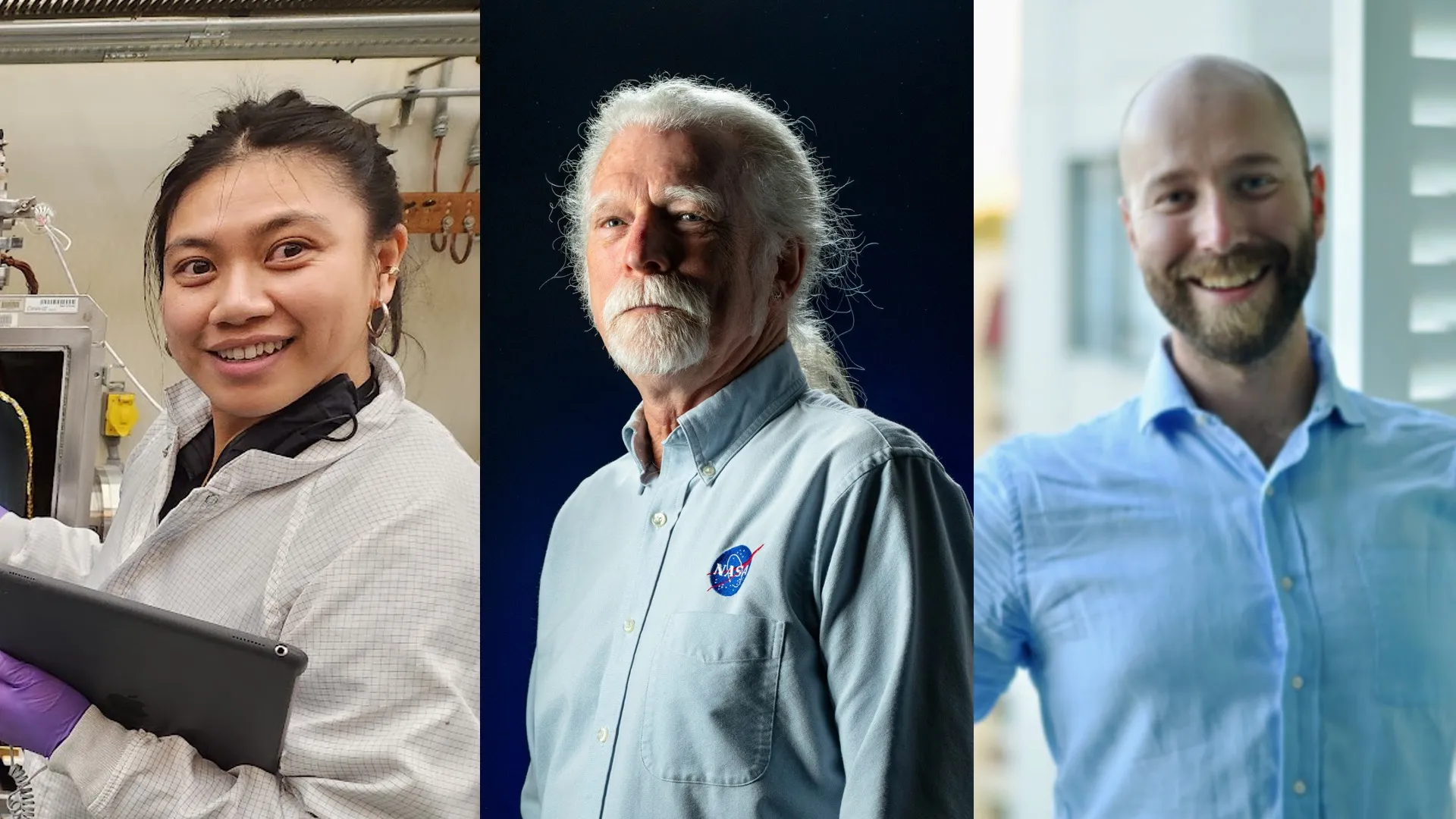
NASA Ames Research Center recognizes Alyssa Villanueva, Steve Howell, and Samuel LeBlanc for advancing space biosciences and planetary exploration.
EXECUTIVE BRIEF // KEY TAKEAWAYS
NASA Ames Research Center recognizes Alyssa Villanueva, Steve Howell, and Samuel LeBlanc for advancing space biosciences and planetary exploration.
The National Aeronautics and Space Administration (NASA) Ames Science Directorate has formally recognized Alyssa Villanueva, Steve Howell, and Samuel LeBlanc as its Stars of the Month for November 2026, highlighting critical technical and scientific contributions across space biosciences and observational research. Announced via NASA News Releases, the monthly commendation underscores the agency's reliance on multidisciplinary engineering, cross-institutional collaboration, and specialized technical execution to sustain its orbital, planetary, and earth-observing research portfolios at the Silicon Valley research hub.
While monthly personnel recognitions appear routine on the surface, institutional awards within the NASA Ames Science Directorate serve as an operational barometer for the agency's core research priorities. Located in Moffett Field, California, Ames functions as a primary nerve center for astrobiology, space biosciences, airborne earth science, and exoplanet astrophysics. By elevating personnel working at the intersection of biological payloads, astronomical instrumentation, and atmospheric or planetary observation, the directorate signals how workforce continuity and external aerospace contractor integration remain central to executing complex mission architectures under constrained federal budgets.
Recognizing Technical Excellence Across Directorate Divisions
According to the official statement released by the NASA Ames Science Directorate, the November 2026 honorees—Alyssa Villanueva, Steve Howell, and Samuel LeBlanc—were selected for demonstrating the foundational competencies required to advance modern space exploration. In its citation, the directorate noted that the trio's dedication to the agency's mandate exemplifies the entrepreneurial spirit, deep technical expertise, and collaborative disposition necessary to investigate terrestrial systems and deep-space environments alike.
"Their commitment to the NASA mission represents the entrepreneurial spirit, technical expertise, and collaborative disposition needed to explore this world and beyond."
Within the Space Biosciences division, the directorate named Alyssa Villanueva as the Space Biosciences Star for November 2026. As detailed in the NASA release, Villanueva serves as an engineer associated with Blue, operating within the collaborative public-private framework that characterizes modern NASA research centers. Space biosciences engineering at Ames encompasses the design, validation, and operational management of biological hardware and life-support experiment payloads deployed aboard low-Earth orbit platforms and deep-space flight systems. Engineers in this sector ensure that biological specimens and automated analytical instruments withstand launch loads, microgravity conditions, and radiation exposure while returning high-fidelity telemetry to principal investigators on the ground.
Alongside Villanueva, the Science Directorate recognized Steve Howell and Samuel LeBlanc for their respective achievements across the directorate's broader scientific divisions. Within the organizational structure of the Ames Science Directorate, research tracks span Space Biosciences, Earth Science, and Space Science and Astrobiology. By honoring contributors across these complementary domains in a single cohort, center leadership reinforces an integrated approach where engineering rigor directly supports observational and experimental science.
Operational Impact and the Public-Private Workforce Model
The composition of the November 2026 recognition cohort illustrates the structural evolution of federal aerospace research centers. Rather than operating as isolated civil-service enclaves, facilities like NASA Ames increasingly rely on blended teams comprising career federal scientists, university consortium researchers, and specialized contractor engineers. The explicit highlight of an engineer affiliated with an external partner within the Space Biosciences division reflects how commercial engineering practices and agile hardware development are embedded directly into NASA's foundational science programs.
From an operational standpoint, maintaining technical momentum in space biosciences and observational science is vital as NASA transitions from legacy orbital operations toward commercial low-Earth orbit destinations and sustained lunar exploration under the Artemis framework. Biological research conducted at Ames informs human health countermeasures, closed-loop life support reliability, and fundamental cellular behavior beyond Earth's magnetosphere. Simultaneously, the instrumentation and data analysis workflows managed by senior researchers within the directorate's space and earth science branches provide essential baseline calibration for orbital observatories and suborbital airborne campaigns.
Institutional recognition programs also play a measurable role in talent retention within highly competitive technical markets. Operating in the heart of Silicon Valley, NASA Ames competes directly with commercial aerospace firms, defense primes, and well-capitalized technology enterprises for systems engineers, astrophysicists, andinstrumentation specialists. Formal directorate-level commendations help codify performance benchmarks and highlight mission-critical leadership across project lifecycles that often span a decade or more from initial concept to data publication.
Strategic Outlook for Ames Research Initiatives
Looking ahead, the technical capabilities represented by the November 2026 Stars of the Month will remain under rigorous demand as the Ames Science Directorate navigates its upcoming manifest of flight experiments and observational campaigns. In the space biosciences arena, engineering teams face the complex task of adapting payload interfaces for next-generation commercial space stations and lunar lander platforms, requiring standardized, autonomous hardware capable of operating with minimal crew intervention.
Across the broader Science Directorate, sustaining collaborative synergy between engineering specialists and observational scientists will determine how effectively NASA translates raw experimental telemetry into actionable scientific discovery. As federal space agencies deepen their reliance on multi-organizational teams, the blend of entrepreneurial problem-solving and disciplined technical execution highlighted in the November 2026 awards will serve as the operational standard for future mission success.


