JAXA Launches MMX Mission to Unravel Martian Moon Phobos
The international Martian Moons eXploration mission embarks on a complex journey to sample the low-gravity rubble pile of Phobos.
EXECUTIVE BRIEF // KEY TAKEAWAYS
The international Martian Moons eXploration mission embarks on a complex journey to sample the low-gravity rubble pile of Phobos.
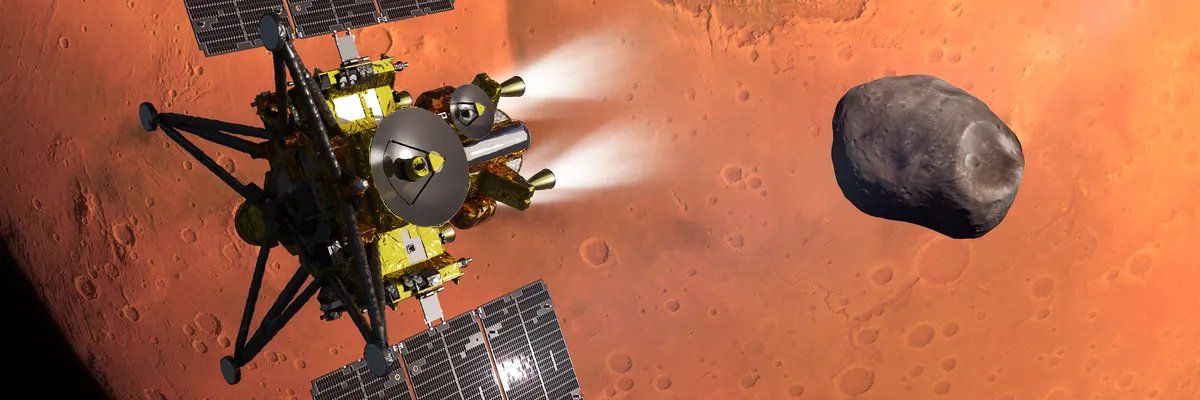
The international Martian Moons eXploration (MMX) mission successfully launched on Oct. 20 aboard Japan’s flagship H3 rocket from the Tanegashima spaceport, beginning a five-year voyage to investigate Phobos, the larger of Mars's two enigmatic moons. According to data disclosed by IEEE Spectrum, the spacecraft will travel to Mars, enter a specialized orbit around the red planet in 2027, deploy a French-German rover named Idefix, and execute a high-risk series of landings to gather at least 10 grams of subsurface material. The mission aims to resolve longstanding scientific debates regarding the origins of Phobos and Deimos, which are classified as loosely consolidated rubble piles rather than solid celestial bodies. Engineers and mission planners face unprecedented operational hurdles, including navigating microgravity environments, managing communications blackouts caused by solar positioning, and executing precise sample extraction techniques designed to return pristine material to Earth by the second half of 2031.
Strategic Significance for Planetary Science and Solar System Evolution
For the global aerospace and planetary science communities, the MMX mission represents a critical milestone in understanding how terrestrial planets develop habitable environments. Operating at the gateway between the inner and outer solar system, Mars and its moons serve as historical archives that could confirm whether water and organic compounds were delivered inward from the icy-rich outer regions during the formative stages of the solar system. According to Yasuhiro Kawakatsu, project manager of MMX at the Japan Aerospace Exploration Agency (JAXA), the mission seeks to shed light on these fundamental processes. By integrating macroscale orbital measurements, microscale rover investigations, and laboratory-grade sample analyses, researchers hope to construct a comprehensive profile of planetary accretion and orbital mechanics that will inform future deep-space exploration frameworks.
Orbital Dynamics and the Engineering Challenges of Microgravity
Navigating the gravitational environment of Phobos requires innovative astrodynamics, as the tiny moon possesses only 1/1,800th of Earth’s gravity and spans roughly 27 kilometers in length. Because Phobos is too small to maintain a conventional orbit, MMX will utilize a quasi-satellite orbit, flying in an egg-shaped path alongside the moon while accelerating and decelerating relative to Mars. Nicola Baresi, an astrodynamicist who co-authored research on the orbital strategy, noted the high stakes of the trajectory, explaining that deviations could result in the spacecraft being catapulted out into the solar system. Furthermore, landing on the lumpy, potato-shaped body presents severe mechanical obstacles. Patrick Michel, director of research at CNRS and co-principal investigator on Idefix, characterized the initiative as the most complex mission he has ever observed, citing the extreme difficulty of preventing a lander or rover from bouncing or tilting in negligible gravity.
Surface Operations, Idefix Deployment, and Dual-Sampler Architecture
Before the main spacecraft attempts its primary touchdown, the mission will deploy the 23-kilogram Idefix rover—developed jointly by the French space agency CNES and the German space agency DLR in collaboration with JAXA—during a low-altitude pass in 2028 or early 2029. Designed to withstand a free-fall impact of less than one meter per second, Idefix will tumble onto the surface, right itself autonomously using four articulated legs, and traverse the regolith at a maximum speed of one millimeter per second using paddle-like metal wheels. Stephan Ulamec, co-principal investigator and project manager at DLR, emphasized that Idefix will bridge the observational gap between remote orbit data and eventual terrestrial sample analysis. Following the rover's assessment, the main MMX exploration module will execute a controlled descent to deploy two distinct sampling mechanisms: a JAXA-developed robotic coring arm capable of reaching two centimeters beneath the weathered surface, and a pneumatic sampler provided by NASA and built by Honeybee Robotics that injects pure nitrogen gas to capture stirred grains. This redundancy ensures that the mission can successfully procure material regardless of the surface hardness encountered.
Outlook, Return Logistics, and Potential Martian Ejecta Analysis
Following a tightly timed two-hour surface operation, the exploration module will lift off, dock with the return module, and initiate a homeward trajectory in November 2030. In 2031, a 60-centimeter-wide sample return capsule will plunge into Earth's atmosphere at roughly 12 kilometers per second, targeting a landing in Australia. JAXA’s Institute of Space and Astronautical Science will curate the retrieved materials, which will also be shared internationally. Intriguingly, analysis of oxygen isotopes within the samples may reveal hundreds of grains of Martian ejecta hurled into space by ancient meteor impacts, offering an indirect window into Mars geology. Because planetary protection panels determined that biological contaminants from Mars could not survive the intense radiation and impact ejection process, MMX bypassed the extensive quarantine protocols required for direct Mars sample-return missions. As these multi-agency efforts converge, the resulting data will establish new operational benchmarks for autonomous microgravity navigation and sample acquisition across the inner solar system.


