Humanoid Home Robotics and Samsung Chip Expansion Signal AI Shift
MIT Technology Review highlights residential humanoid cleaning trials alongside Samsung's semiconductor buildout for accelerating artificial intelligence demand.
Recent dispatches documented in MIT Technology Review’s weekday briefing, The Download, underscore a dual trajectory in the contemporary artificial intelligence landscape: the deployment of general-purpose humanoid robotics into residential environments and the simultaneous expansion of semiconductor manufacturing capacity led by Samsung to support the ongoing artificial intelligence boom.
The convergence of consumer-facing embodied artificial intelligence and capital-intensive silicon fabrication illustrates how the technology sector is operating at both ends of the value chain. While robotics startups test the commercial viability of automated domestic labor in private apartments, global hardware incumbents are committing substantial industrial resources to ensure that compute infrastructure keeps pace with foundational model scaling and edge deployment requirements.
Residential Robotics Move From Laboratory to Apartment Trials
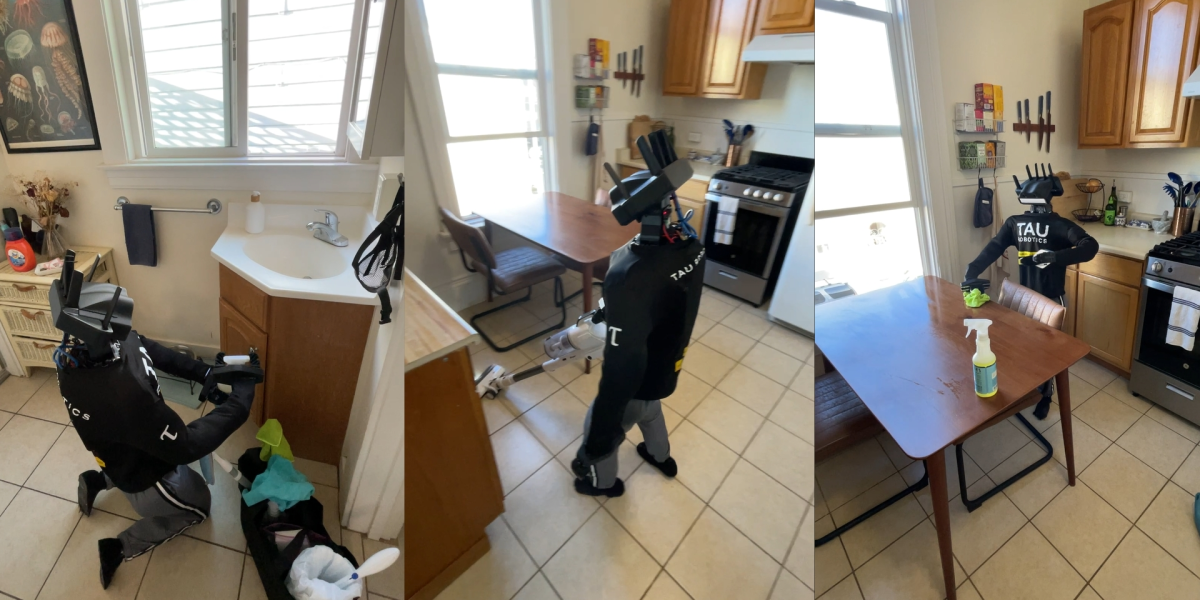
In a firsthand account published by MIT Technology Review, contributor Grace Huckins detailed the experience of observing a humanoid robot perform cleaning duties inside a private apartment after discovering the service through a post on the social media platform X. The demonstration represents a notable transition for bipedal and humanoid robotic systems, which have historically been confined to controlled research laboratories, structured automotive assembly lines, or logistics warehouses.
"I watched a humanoid robot clean my apartment. It felt like a taste of the future."
Operating a humanoid platform within a residential living space presents distinct engineering challenges compared to industrial automation. Domestic environments are inherently unstructured, featuring variable floor plans, fragile household objects, narrow corridors, and unpredictable obstacles. For a robotic cleaning service to function outside a laboratory setting, underlying control architectures must integrate visual perception, tactile feedback, and spatial path planning capable of adapting to unfamiliar rooms without extensive prior mapping or environmental modification.
The emergence of on-demand or residential humanoid cleaning services marketed directly via social channels also indicates a shift in go-to-market strategies among robotics developers. Rather than waiting for consumer hardware unit costs to drop to household purchasing levels, service-based deployment models allow operators to amortize expensive robotic hardware across multiple residential appointments while gathering real-world telemetry and manipulation training data in diverse home layouts.
Samsung Builds Capacity for the Artificial Intelligence Boom
Parallel to advances in physical robotics, the same MIT Technology Review briefing highlights how Samsung is actively building out its industrial capabilities to capture demand generated by the artificial intelligence boom. Every layer of modern AI deployment—ranging from cloud-scale large language model training clusters to the neural processing units required for robotic perception and teleoperation—depends on advanced memory architectures and leading-edge logic fabrication.
As enterprise adoption of generative and embodied AI intensifies, semiconductor manufacturers face sustained pressure to expand fabrication throughput and high-bandwidth memory supply. Samsung’s infrastructure buildout reflects broader capital expenditure trends across the global semiconductor supply chain, where integrated device manufacturers and foundries are racing to alleviate compute bottlenecks and secure long-term supply agreements with hyperscale cloud providers and AI hardware designers.
The interplay between physical automation and semiconductor manufacturing is structural. Autonomous and semi-autonomous machines rely on low-latency inference chips at the edge alongside massive cloud training clusters that refine vision-language-action models. Consequently, industrial investments by major chipmakers directly influence the pace at which robotics developers can train, iterate, and deploy commercial fleets.
Strategic Outlook for Embodied AI and Hardware Infrastructure
Looking ahead, the parallel developments reported by MIT Technology Review point toward several critical milestones for the technology industry. In the domestic robotics sector, moving from early apartment demonstrations that offer a glimpse of the future to scalable commercial operations will require rigorous validation of safety protocols, liability frameworks, residential privacy standards, and operational reliability across thousands of service hours.
Simultaneously, the success of Samsung’s expansion for the AI boom will be measured by its ability to bring new semiconductor capacity online efficiently amid intense international competition and complex supply chain logistics. Together, residential humanoid trials and large-scale silicon investments demonstrate that the next phase of the artificial intelligence cycle will be defined both by the physical tasks machines can perform in everyday spaces and by the industrial scale of the semiconductor infrastructure powering them.