Hubble Imager Unveils NGC 4394, Probing Galactic Bar Architecture
New Hubble Space Telescope observations of barred spiral galaxy NGC 4394 offer critical data on stellar dynamics and environmental star-formation quenching.
EXECUTIVE BRIEF // KEY TAKEAWAYS
New Hubble Space Telescope observations of barred spiral galaxy NGC 4394 offer critical data on stellar dynamics and environmental star-formation quenching.
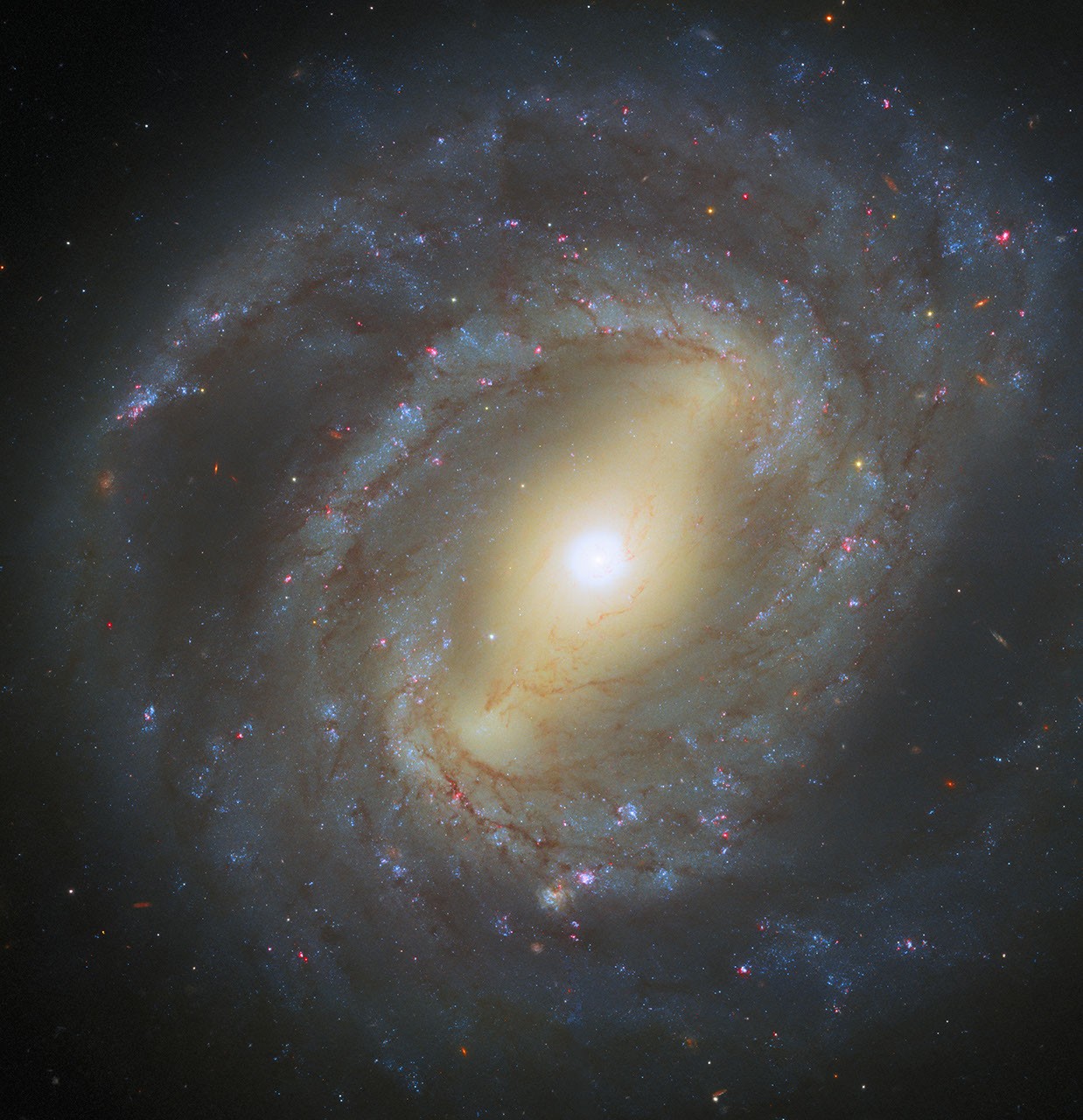
WASHINGTON — New observational data released by the NASA/ESA Hubble Space Telescope has delivered an expansive, high-resolution view of NGC 4394, a barred spiral galaxy situated approximately 55 million light-years from Earth in the constellation Coma Berenices. The imaging provides critical empirical clarity on the formation and stability of linear stellar bars, offering researchers a pristine, face-on surrogate model to decipher the internal dynamics and evolutionary trajectory of humanity’s home galaxy, the Milky Way.
For the broader scientific enterprise and frontier aerospace programs, the dual-program imaging pipeline underscores the high economic and operational efficiency achievable through long-baseline orbital infrastructure. As international space agencies allocate capital toward next-generation observatories, the sustained scientific return from legacy assets like Hubble validates multi-epoch observation strategies, demonstrating how integrated spectroscopic and optical surveys continue to de-risk cosmological models of galactic maturation and cluster dynamics.
Architectural Analog to the Milky Way and Nuclear Phenomena
NGC 4394 is an established member of the Virgo Cluster, an expansive gravitational assembly comprising more than 1,000 galaxies that represents the nearest major cluster to the local group. With its symmetrically curved spiral arms flanking a pronounced central linear axis of stars, the system mirrors the structural morphology astronomers ascribe to the Milky Way when viewed from an equivalent polar orientation. While cosmic structures frequently display amorphous or curved geometries shaped by stellar births and deaths, straight linear features like galactic bars represent a dominant structural paradigm, present in an estimated 65 percent of nearby spiral galaxies.
According to the mission analysis published by NASA and the European Space Agency, these elongated stellar assemblies emerge when a galaxy’s rotating disk becomes dynamically unstable due to stellar interactions, internal gravitational shifts, or tidal perturbations from passing companion systems. Once equilibrium is disrupted, standard circular orbital trajectories stretch into pronounced elongated loops, giving rise to rigid stellar bars. The investigation also confirmed the presence of spectral indicators consistent with a low-ionization nuclear emission-line region (LINER) in the core of NGC 4394, pointing to an environment where atomic spectra reveal weakly ionized or neutral gas driven either by low-accretion supermassive black holes or centralized bursts of starburst activity.
Multi-Epoch Instrumentation and Cluster Quenching Dynamics
The newly synthesized visual representation is the product of coordinated multi-epoch investigations conducted over more than a decade of orbital operations. Hubble first imaged the immediate cosmic neighborhood of NGC 4394 under observing program #10515, led by Principal Investigator E. Peng, which targeted the neighboring lenticular galaxy Messier 85. During those operations, Hubble’s Advanced Camera for Surveys recorded parallel-field exposures capturing NGC 4394 while primary instruments characterized the cluster systems of Messier 85, illustrating the operational leverage inherent in dual-instrument data capture protocols.
The composite perspective incorporates recent targeted data from observing program #18103, directed by Principal Investigator D. Thilker and the MAUVE-HST research team. Operating Hubble’s Wide Field Camera 3 across broad optical and ultraviolet wavelength bands, the team isolated the spectral signatures and absolute ages of individual star clusters. NGC 4394 represents one of 40 distinct systems evaluated under this initiative, which systematically assesses how dense cluster environments deplete cold gas reservoirs and terminate star formation in comparison to isolated field galaxies drifting through lower-density regions of intergalactic space.
Evolutionary Instabilities and Future Research Trajectories
Cosmological surveys indicate that stellar bars are significantly more prevalent across the contemporary universe than they were several billion years ago, reflecting a progressive morphological transition as disk galaxies mature. However, computational models and observational surveys synthesized by the research team indicate that bar structures remain inherently transient. As these central conduits channel gas inward and accumulate mass, their increasing gravitational density eventually triggers secondary kinematic instabilities that can disperse the bar back into a uniform central bulge.
The ongoing characterization of NGC 4394’s stellar clusters and core emission profile establishes foundational baseline data for upcoming wide-field space missions and terrestrial giant telescopes. By resolving the environmental mechanisms that suppress star formation across dense Virgo Cluster domains, the MAUVE-HST initiative provides the predictive benchmarks required to calibrate global astrophysical simulations, ensuring that archival orbital datasets continue to drive discovery across frontier astrophysics programs worldwide.


