Hubble Gravitational Lens Gallery Sets Target Baseline for Roman
A newly released Hubble gallery of gravitational lenses establishes the observational baseline for NASA's upcoming Nancy Grace Roman Space Telescope.
EXECUTIVE BRIEF // KEY TAKEAWAYS
A newly released Hubble gallery of gravitational lenses establishes the observational baseline for NASA's upcoming Nancy Grace Roman Space Telescope.
A newly released gallery of gravitational lenses captured by NASA’s Hubble Space Telescope showcases the structural diversity of deep-space light bending and establishes the observational groundwork for follow-up surveys by the agency's upcoming Nancy Grace Roman Space Telescope, according to NASA News Releases.
For the global space science and observational astrophysics ecosystem, the coordination between heritage orbital assets and next-generation survey observatories marks a pivotal operational transition. By cataloging diverse gravitational lensing configurations now, mission planners can optimize target selection, calibration pipelines, and automated detection algorithms before Roman begins its wide-field infrared operations. This cross-mission synergy maximizes the scientific return on multi-billion-dollar orbital infrastructure investments while accelerating the mapping of dark matter distribution and early galactic evolution.
Cataloging Cosmic Magnifiers Across Deep Space
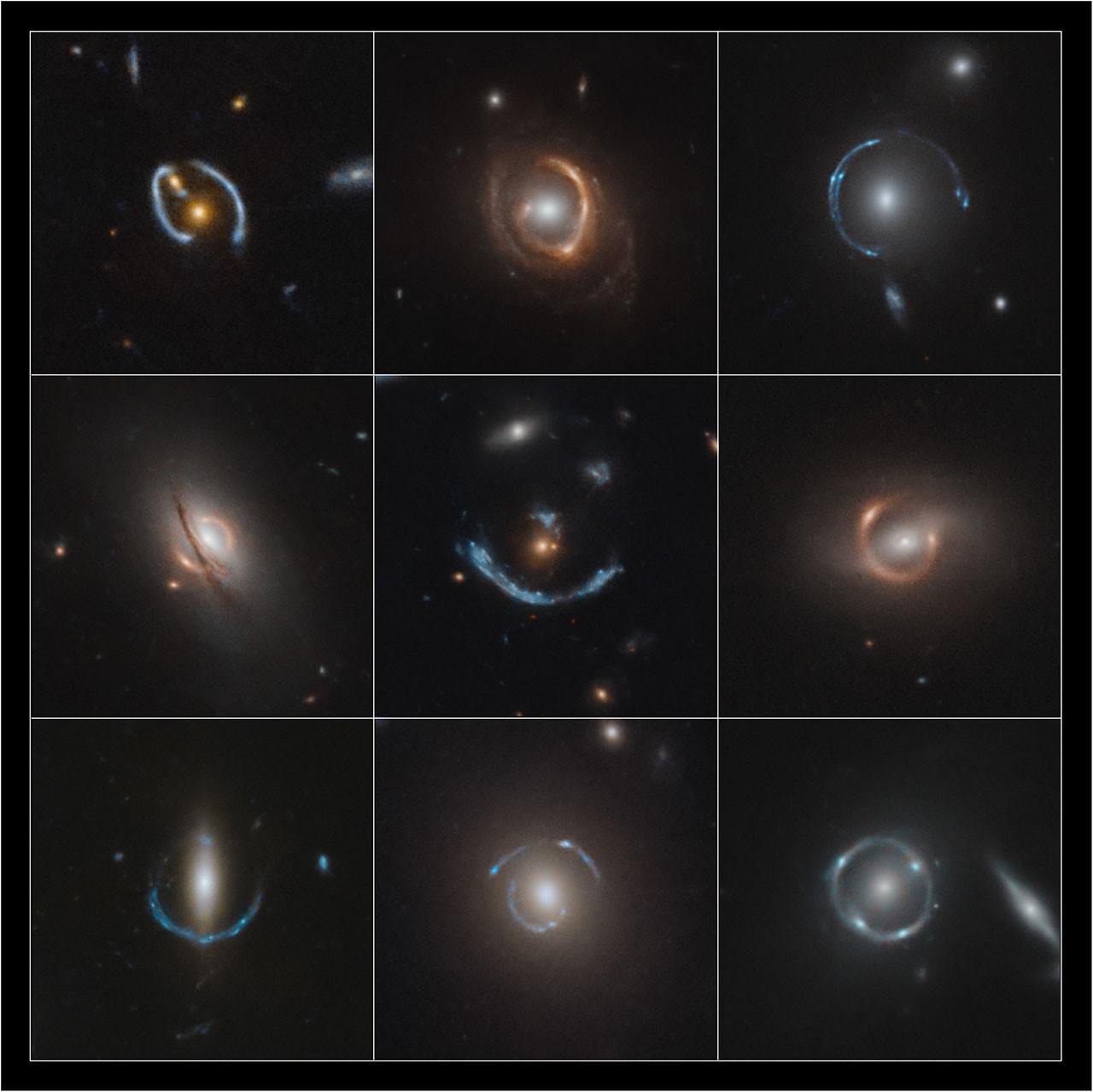
Gravitational lensing occurs when the immense gravitational field of a massive foreground object, such as a galaxy cluster, warps the fabric of spacetime and bends the light emitted by more distant background galaxies. As documented in the NASA News Releases report, the Hubble Space Telescope has compiled an extensive visual sampler of these cosmic phenomena, illustrating the varied geometries, arcs, and distorted rings produced when foreground and background structures align along the line of sight.
A gallery of gravitational lenses captured by NASA’s Hubble Space Telescope showcases the diversity of this cosmic phenomenon and lays the groundwork for follow-up observations by the Nancy Grace Roman Space Telescope.
Throughout its operational tenure, Hubble’s high-resolution optical and ultraviolet imaging capabilities have enabled astronomers to resolve fine structural details within individual lensed arcs. However, because Hubble was designed primarily as a targeted observatory with a relatively narrow field of view, identifying and characterizing these rare alignments has historically required dedicated, time-intensive pointing campaigns across select regions of the sky.
Operational Transition to Wide-Field Survey Architecture
The empirical baseline established by Hubble’s gravitational lens gallery directly informs the science operations model for the Nancy Grace Roman Space Telescope. While Hubble excels at detailed, narrow-field inspections, Roman is engineered to conduct expansive wide-field surveys across the infrared spectrum, capturing a field of view vastly larger than Hubble’s in a single exposure while maintaining comparable image sharpness.
In practical terms, the diversity of lensing morphologies documented by Hubble serves as an essential training and validation dataset for the automated data processing pipelines that will support Roman. When wide-field survey operations commence, data centers will need to sift through massive volumes of telemetry to identify gravitational lenses embedded within crowded star fields and deep extragalactic survey zones. Having a verified catalog of varied lensing profiles allows astrophysicists and software engineers to refine pattern-recognition models, calibrate photometric measurement tools, and prioritize high-value targets for multi-wavelength spectroscopy.
Furthermore, combining Hubble’s existing optical baselines with Roman’s planned infrared observations will allow researchers to examine lensed galaxies across a broader electromagnetic spectrum. This multi-instrument approach reduces observational uncertainty when calculating the mass profiles of foreground lensing clusters and measuring the redshifts of magnified background sources.
Strategic Outlook for Next-Generation Space Observatories
Looking ahead, the handoff from Hubble’s targeted cataloging to Roman’s wide-area survey campaigns represents a broader shift in how space agencies manage long-term cosmological research programs. Rather than operating orbital telescopes as isolated standalone missions, NASA is increasingly leveraging archival and ongoing observations from legacy platforms to de-risk and sharpen the scientific objectives of incoming flagship observatories.
As preparations for the Nancy Grace Roman Space Telescope progress toward launch and commissioning, the targets highlighted in Hubble’s cosmic sampler will serve as early benchmark fields. Confirming instrument performance against well-characterized gravitational lenses will help mission teams validate optical alignments, test wide-field detector sensitivity, and transition smoothly into full-scale cosmological survey operations.