Fast-Food Chains Deploy AI Tools to Rank and Reprimand Workers
Algorithmic scoring reshapes labor dynamics across the quick-service restaurant sector, testing worker retention and emerging state regulatory frameworks.
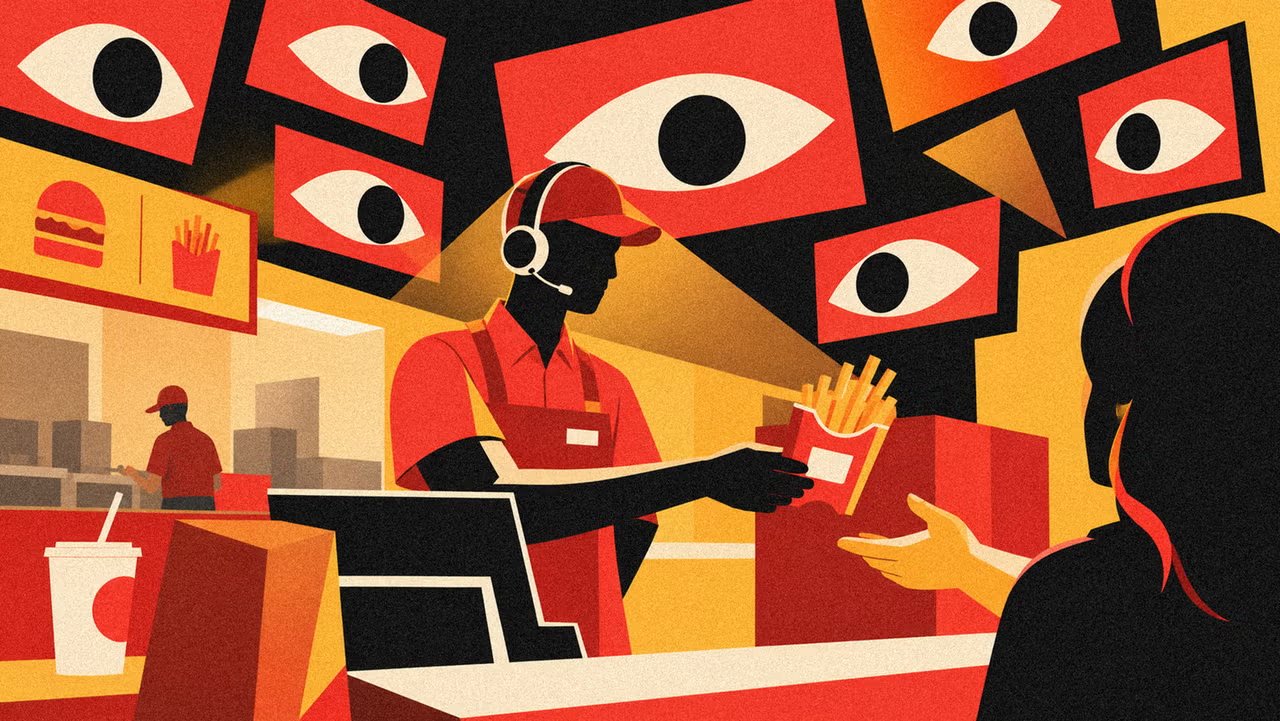
EXECUTIVE BRIEF // KEY TAKEAWAYS
Algorithmic scoring reshapes labor dynamics across the quick-service restaurant sector, testing worker retention and emerging state regulatory frameworks.
Global fast-food brands and franchise operators are accelerating the deployment of artificial intelligence systems to track, evaluate, and discipline low-wage employees in real time, converting standard service operations into an automated testing ground for algorithmic management, according to an investigation by Capital & Main published by Fast Company.
The expansion of behavioral tracking across prominent quick-service chains—including Domino’s, Burger King, and Papa John’s—signals a significant evolution in enterprise workforce governance, where proprietary scoring algorithms and surveillance architectures increasingly displace traditional managerial discretion. As restaurant conglomerates pursue productivity gains and tighter unit economics through specialized tech vendors, the practice is creating friction on the ground, fueling employee turnover and drawing scrutiny from civil rights advocates and state regulators.
Frontline Surveillance and Algorithmic Penalties
Frontline staff describe workplace environments where operational software translates everyday movements and customer interactions into granular performance metrics. At a Domino’s franchise in North Texas, delivery driver Corrin Kearney was required to install software developed by Drivosity, a vendor marketing GPS and artificial intelligence tracking systems to quick-service chains. The platform grades every trip on a scale of 0 to 100 by analyzing vehicular acceleration, braking, cornering, and speed, posting storewide leaderboards visible to all staff.
According to Kearney, drivers at the store were mandated to maintain scores above 85. Those falling below the threshold faced disciplinary write-ups and risked being locked out of Domino’s operational systems. As a driver captain tasked with issuing formal reprimands, Kearney observed that the automated software failed to account for basic road hazards, docking points when drivers braked abruptly to prevent collisions or accelerated rapidly to merge onto highways.
“Drivosity can effectively fire people,” Kearney said. “It’s infuriating. The AI can tell you you haven’t driven well enough and you get fired.”
Drivosity also markets a feature called HustleTime®, which calculates down to the second how quickly employees walk to their vehicles, deliver orders to customers, and return to the storefront. While franchise operators have praised the system's capacity to gamify operational efficiency, academic researchers warn that low-wage workforces bear the risks of unchecked automation.
“They basically use their population of workers as guinea pigs,” said Alexandra Mateescu, a researcher at the nonprofit Data & Society.
Similar pressures have emerged at the counter. In February, Burger King announced the rollout of an OpenAI-powered drive-thru assistant named Patty across roughly 500 U.S. locations, targeting a nationwide deployment by 2026. At a franchise in Niagara Falls, New York, former drive-thru worker Dante Vasquez reported that the software expanded into employee evaluation, scoring spoken customer interactions on friendliness and upselling while logging transcripts on managerial dashboards.
Workers scoring below a 70% friendliness benchmark faced reduced shift allocations, Vasquez said. The system penalized employees for hesitations such as “um” or conversational holds, eventually introducing an opaque metric for vocal “warmth.” Vasquez noted that Patty appeared to penalize Black co-workers more frequently for alleged improper tone, a trend that prompted concerns over algorithmic bias.
Mayu Tobin-Miyaji, counsel at the Electronic Privacy Information Center, characterized automated warmth and friendliness evaluations as “sort of pseudoscience,” cautioning that such systems inherently risk penalizing employees based on accents or speech disabilities.
In response to inquiries, Burger King communications director Kristen Viersen stated that the chain had “never before heard any example similar to the questions you raised about team members being penalized based on race, gender, ethnicity or accent,” adding that the company subsequently disabled the scoring features for further improvements. Burger King declined to confirm whether the platform had been audited for bias, while workers noted monitoring remained operational through August, prompting Vasquez to resign due to workplace stress.
Enterprise Vendor Proliferation and Operational Friction
The institutional adoption of algorithmic oversight extends far beyond drive-thru headsets. Major industry players have established high-profile partnerships with enterprise technology providers, such as Yum Brands’ deployment of Nvidia-powered computer vision to manage back-of-house kitchen labor through real-time operational alerts across Taco Bell, KFC, and Habit Burger & Grill locations.
Concurrently, a growing ecosystem of independent software providers is selling automated surveillance packages directly to store operators. Ottawa-based Solink, an enterprise backed by Goldman Sachs, markets video intelligence systems to franchisees operating Domino’s, Burger King, McDonald’s, Jack in the Box, and Five Guys. Solink’s documentation outlines capabilities to detect late arrivals, extended break durations, uniform infractions, mobile phone usage, and idle staff by integrating with existing security camera hardware.
A Solink spokesperson stated that its platform enables businesses to “improve operations, sales, safety, and customer experience,” emphasizing that the company does not provide biometric or facial recognition tools and obligates clients to follow local employment laws. Mateescu noted that vendors often frame monitoring software under the operational banners of “loss prevention” or “workflow management,” terminology that minimizes the scope of employee tracking.
At the entrepreneurial level, newer restaurant concepts are embedding algorithmic management directly into operational design. At MashMore, an Albany, New York-based restaurant, co-founder and chief executive Andy Gor built an automated HR chatbot named Mashy to direct staff routines, verify uploaded photographic evidence of completed cleaning chores, and allocate performance points that dictate bonuses and internal rankings.
“I’m in China right now,” Gor said of his ability to monitor store operations remotely. “I can see that during rush hour they cleaned the table nicely. Today, they pass.”
Regulatory Countermeasures and Workforce Pushback
As algorithmic workplace systems proliferate, legislative safeguards remain fragmented across the United States. Federal regulatory initiatives targeting automated worker management have largely stalled, leaving state legislatures to formulate statutory boundaries.
In California, Gov. Gavin Newsom enacted a landmark legislative package addressing workplace artificial intelligence. The statutory framework includes Senate Bill 947, known as the No Robo Bosses Act, which prohibits employers from relying exclusively on automated systems to execute disciplinary actions or terminations. Accompanying measures include Assembly Bill 1883, which outlaws algorithmic tools designed to infer employee emotional states or harvest neural data, and Senate Bill 951, requiring corporate disclosures when automated systems inform mass layoffs.
Legal analysts caution that enforcement gaps persist despite legislative intervention. Tobin-Miyaji noted that statutory bars against emotion analysis directly affect tools scoring vocal warmth, but warned that requirements prohibiting automated firings could be circumvented by nominal human sign-offs, leaving workers subject to continuous evaluation.
Institutional labor mechanisms have similarly lagged corporate adoption. California’s Fast Food Council, established in 2023 with statutory authority to regulate industry working conditions and wages, has remained without an appointed chairperson and has not convened in over a year. Council spokesperson Charles Hamilton confirmed that automated monitoring has not been introduced as an agenda item.
Faced with institutional delays, restaurant employees are organizing informal resistance. At an Oakland Burger King, four-year kitchen veteran Sergio Ceja reported that kitchen staff agreed to stage a walkout if automated monitoring systems were introduced, following workforce reductions at an affiliated store using automated drive-thru ordering.
“You’ll no longer have a co-worker,” Ceja said. “You’ll have the machine.”


