Enterprise AI Shifts from Discrete Pilots to Autonomous Workflows
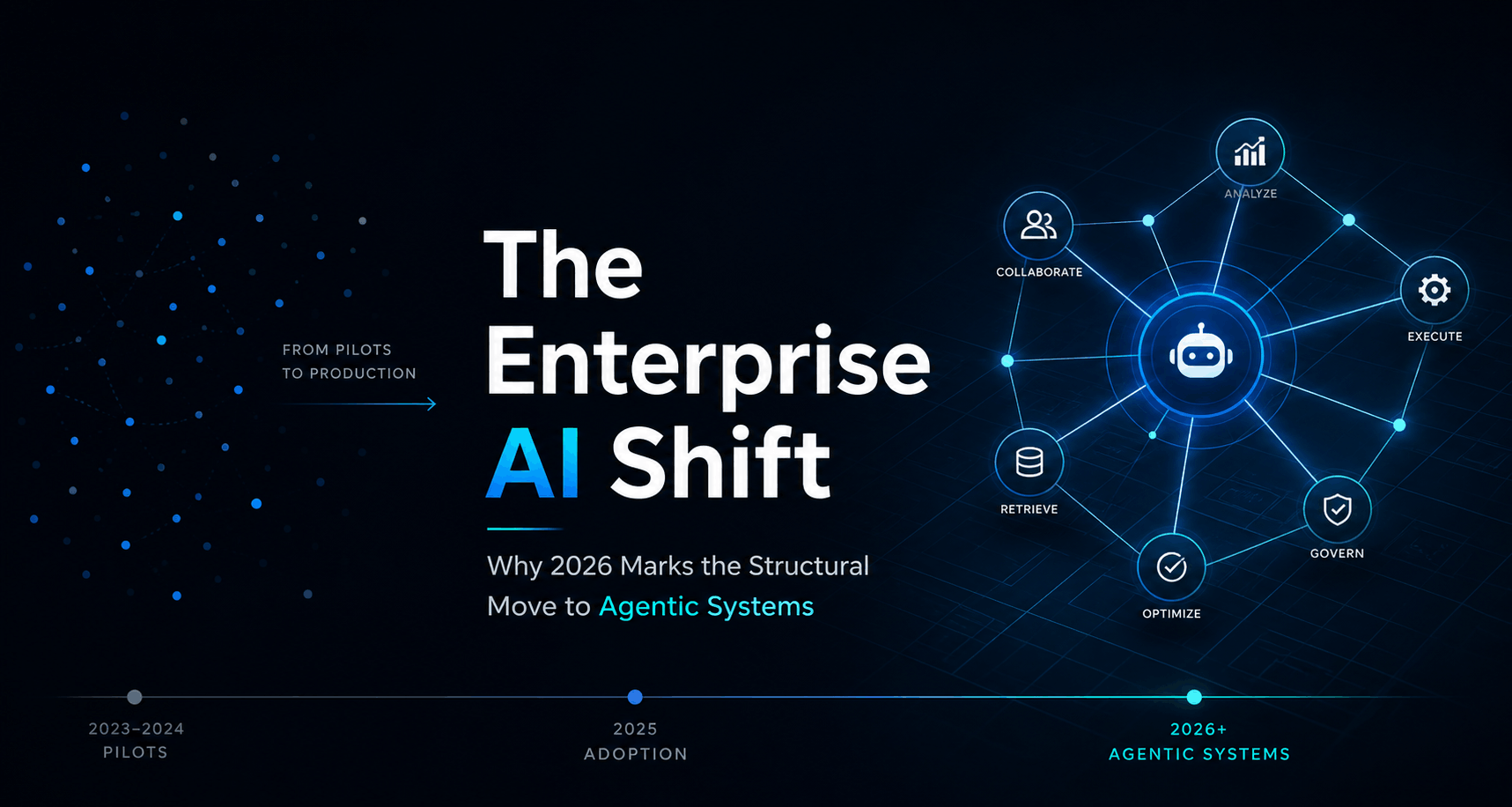
As organizations transition from isolated experiments to autonomous agents, corporate architectures require foundational restructuring to scale operational AI.
EXECUTIVE BRIEF // KEY TAKEAWAYS
As organizations transition from isolated experiments to autonomous agents, corporate architectures require foundational restructuring to scale operational AI.
CAMBRIDGE, Mass. — Major corporations are reaching the operational limits of isolated machine learning deployments as the demands of autonomous agentic workflows compel chief information officers to fundamentally re-engineer enterprise architectures, according to an analysis published by MIT Technology Review. The long-standing paradigm of deploying artificial intelligence through siloed, proof-of-concept experiments is collapsing under the operational requirements of systems designed to execute complex, end-to-end business operations rather than discrete analytical tasks.
For global enterprises and enterprise software markets, the transition from discrete generative tools to interconnected AI agents marks a critical inflection point in capital allocation and organizational design. While point solutions delivered incremental productivity gains inside marketing and software development teams, autonomous agents interact directly across core transaction systems, legacy databases, and operational pipelines. This shift elevates artificial intelligence from a peripheral software feature to an architectural foundation, forcing executive leadership to address compounding technical debt, fragmented corporate data, and systemic operational risks.
The Limits of Discrete Experimentation
Over the past three years, corporate investment in artificial intelligence has largely taken the form of departmental sandbox initiatives, discrete chatbot interfaces, and narrow productivity boosters. While these deployments allowed enterprises to test foundational models with minimal architectural risk, MIT Technology Review reported that this experimental posture is rapidly becoming obsolete. As software vendors and internal engineering teams deploy autonomous agents capable of perceiving context, formulating multi-step plans, and taking action across enterprise systems, the friction between modern models and legacy infrastructure has become acute.
Historically, enterprise software scaled within tightly controlled departmental silos, such as customer relationship management, enterprise resource planning, and human capital software. However, autonomous agents do not respect conventional organizational boundaries; an agent assigned to optimize procurement or resolve complex customer inquiries must traverse multiple data warehouses, interpret disparate data schemas, and execute transactions without manual human handoffs. Without comprehensive integration across data estates and unified governance protocols, enterprise pilots stall before reaching operational scale.
Restructuring Data Estates and Process Governance
The deployment of enterprise-wide agentic workflows requires organizations to undertake a structural overhaul of internal data engineering and process architecture. In its assessment, MIT Technology Review highlighted that moving from experimental pilots to production-grade autonomous systems forces companies to confront a deeper operational challenge: rebuilding the underlying pipelines that govern data access, process flows, and institutional memory.
Modern foundational models require low-latency access to clean, structured, and contextualized corporate knowledge to prevent catastrophic drift and hallucinations during autonomous execution. When autonomous software interacts with legacy transactional systems, the absence of standardized application programming interfaces and granular permissioning mechanisms presents severe security and data integrity vulnerabilities. Consequently, technology executives are increasingly reallocating budgets toward enterprise data fabric architectures, real-time observability pipelines, and deterministic guardrail frameworks to ensure that autonomous agents operate within strictly auditable boundaries.
Moreover, the integration of autonomous systems fundamentally alters corporate workflow design. Instead of simply accelerating human keystrokes, agents are assuming responsibility for coordinating interdependent subtasks across supply chain planning, automated reconciliation, and technical operations. This shift demands that business processes be codified into deterministic logic with unambiguous escalation thresholds, ensuring that human operators retain ultimate supervisory control over critical transactions.
Strategic Outlook and Capital Reallocation
As enterprises progress through this structural transition, the benchmark for return on technological investment is moving from preliminary model capabilities to sustained operational resilience. Organizations that fail to align their data architecture, internal talent, and operational governance with the requirements of agentic systems risk accumulating expensive layers of brittle automation that degrade under real-world enterprise conditions.
Looking ahead, the enterprise software ecosystem is poised for a significant consolidation cycle as corporate procurement priorities pivot from stand-alone AI tools toward comprehensive platforms that bundle workflow orchestration, identity and access management, and agent observability. Simultaneously, regulatory authorities across North America and Europe are preparing stricter governance mandates surrounding algorithmic accountability and automated decision-making in core economic sectors. For enterprise leadership, building artificial intelligence that works across the enterprise is no longer a matter of selecting superior model benchmarks, but of executing a comprehensive transformation of institutional infrastructure, governance, and operational strategy.


