Early Electric Vehicles Pioneered Modern Charging and Adoption Hurdles
Turn-of-the-century electric cars relied on mercury-arc rectifiers and targeted female drivers before internal combustion engines dominated.
EXECUTIVE BRIEF // KEY TAKEAWAYS
Turn-of-the-century electric cars relied on mercury-arc rectifiers and targeted female drivers before internal combustion engines dominated.
At the dawn of the 20th century, electric vehicles competed directly against steam and internal combustion engines for dominance in a rapidly expanding United States automotive market, according to a historical report by IEEE Spectrum. Between 1898 and 1908, the number of U.S. automakers increased fivefold from approximately 50 companies, while annual vehicle production surged from 7,000 units in 1901 to 181,000 by 1910. During this formative decade, manufacturers such as General Electric and S.R. Bailey & Co. marketed battery-powered cars and mercury-arc rectifier home charging systems primarily to women and physicians, capitalizing on the clean, quiet, and effortless operation of electric drivetrains prior to the 1911 invention of the gasoline electric starter.
This early chapter in automotive history offers critical perspective for contemporary technology and industrial sectors navigating the modern transition to electrified transportation. The technical bottlenecks that constrained early 20th-century electric vehicle adoption—specifically battery chemistry reliability, prolonged charging durations, high upfront capital costs, and fragmented charging plug standards—mirror the infrastructure and supply chain challenges facing global automakers and energy grid operators today.
Competing Powertrains and Demographic Targeting
Before powertrain standardization occurred, early motorists weighed distinct operational trade-offs across three competing propulsion technologies. Steam-powered vehicles benefited from established locomotive engineering but carried fire risks and generated excessive heat from onboard boilers and piping. Meanwhile, early gasoline-powered vehicles required dangerous physical hand-cranking to start and produced loud engine noise alongside noxious exhaust fumes. By contrast, fully electric vehicles started via a simple battery switch and key, emitting no exhaust and operating silently.
Seeking competitive differentiation, electric vehicle manufacturers and infrastructure suppliers positioned these operational advantages for specific demographics. Automakers marketed electric cars to doctors making late-night house calls who wished to avoid waking neighborhood residents, as well as to affluent women seeking clean, reliable urban transport. General Electric, which manufactured home charging systems, launched advertising campaigns featuring stylishly dressed women operating charging stations on their own.
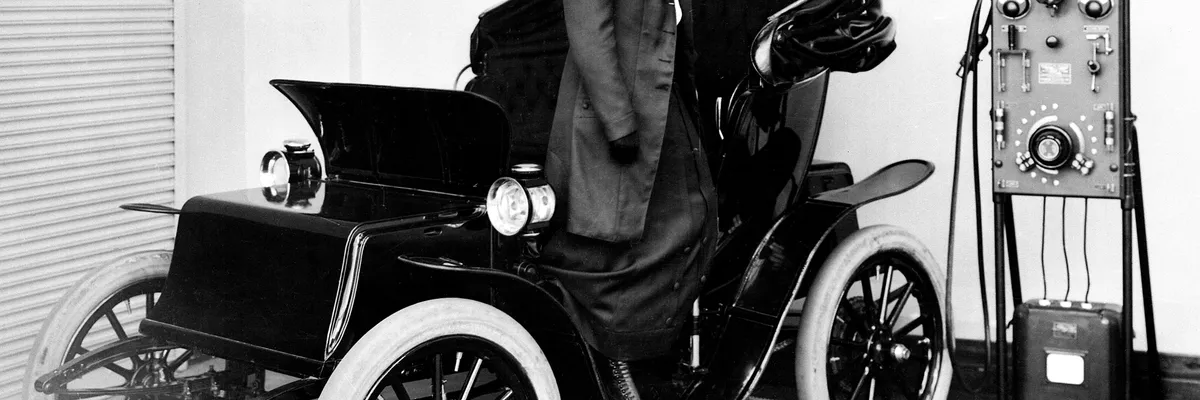
According to IEEE Spectrum, Boston-area resident Fannie Goodnow exemplified this early adopter profile. Goodnow purchased a 1908 Bailey Victoria Phaeton—an open two-seater built by S.R. Bailey & Co. of Amesbury, Massachusetts—and installed a General Electric mercury-arc rectifier charging station in the barn next to her parents' summer residence in Hull, Massachusetts. Her charging unit remained in place until 2022, when it was donated to the Heritage Museums & Gardens in Sandwich, Massachusetts.
Battery Chemistry Bottlenecks and Charging Physics
The transition from horse-drawn carriages to electric mobility required both traditional coachbuilders and electrical engineers to develop new power conversion and energy storage hardware. According to Galen Handy, who maintains the Early Electric Vehicles website, Samuel Robinson Bailey entered the carriage and sleigh trade in 1855, founded his own firm in 1882, and won a gold medal at the 1893 World's Columbian Exposition in Chicago. At that same exposition, Bailey's son Edwin likely observed the Morrison electric wagon transporting six passengers around the fairgrounds. As automobiles eroded the traditional carriage trade, S.R. Bailey & Co. formally pivoted to electric vehicle manufacturing in December 1906.
However, early battery engineering proved volatile. Bailey's initial Victoria Phaeton deployed an alkaline battery developed by Thomas Edison, who had worked since the 1890s to build a lighter, more durable automotive battery before announcing his design in 1903. In commercial deployment, the early Edison cells leaked and failed to hold a charge, forcing Edison to halt production and redesign the chemistry until an improved version arrived in 1910.
In the interim, S.R. Bailey & Co. sourced power packs from the Gould Storage Battery Co. of Depew, New York, a supplier for railroads, utilities, subways, and elevators. Goodnow's 1908 Victoria Phaeton utilized a 30-cell lead-acid battery suspended beneath the chassis in a wooden enclosure. The standard configuration delivered a range of 64 to 80 kilometers (40 to 50 miles), with an optional battery offering 50 percent greater capacity for an additional fee. Priced at $2,000 in 1908—equivalent to approximately $73,000 today—the vehicle occupied a market segment comparable to modern luxury electric vehicles.
Recharging those lead-acid cells required converting alternating current (AC) from residential power grids into direct current (DC). Early home chargers relied on the mercury-arc rectifier, invented by electrical engineer Peter Cooper Hewitt and refined through U.S. patents 968,896 and 1,163,706 granted to Percy H. Thomas, chief electrician at the Cooper Hewitt Electric Co., which Hewitt had co-founded with George Westinghouse. Acting as a diode, a glass bulb containing liquid mercury vaporized and glowed when energized, working with carbon anodes to permit unidirectional current flow. Recharging a depleted vehicle battery with this apparatus required approximately 12 hours.
Standardization Hurdles and Market Consolidation
Even as Thomas Edison introduced his improved battery in 1910—prompting S.R. Bailey & Co. to sponsor a 1,600-kilometer (1,000-mile) publicity tour from New York to Boston and up New Hampshire's Mount Washington in September 1910—structural barriers impeded mass market scale. As Bill Lillie of Vintage Electric Cars noted in IEEE Spectrum's report, early charging plugs lacked uniform specifications, forcing motorists to carry assortments of spare adapters and cables. Although the Electric Vehicle Association of America formed in 1910 to establish universal charging plug standards, infrastructure fragmentation persisted.
Simultaneously, Henry Ford's introduction of the gasoline-powered Model T and the 1911 arrival of the electric starter motor eliminated the primary usability drawbacks of internal combustion engines. Combined with the logistical simplicity of carrying spare cans of gasoline over long distances, internal combustion rapidly captured the automotive market. Unable to compete on price or range, S.R. Bailey & Co. sold its manufacturing plant in 1915 after producing between 500 and 600 electric vehicles, leaving its early charging artifacts as enduring case studies in technological adoption and infrastructure standards.