Darlington SMR Overruns Prompt Scrutiny of Four-Reactor Plan
Early budget and schedule slippages at Ontario's flagship small modular reactor project raise questions over expanding the four-unit deployment.
EXECUTIVE BRIEF // KEY TAKEAWAYS
Early budget and schedule slippages at Ontario's flagship small modular reactor project raise questions over expanding the four-unit deployment.
Ontario's flagship small modular reactor initiative at the Darlington nuclear site is experiencing budget and schedule slippages before its underlying reactor design has fully stabilized, according to an analysis published by CleanTechnica. The early-stage overruns on the first unit are prompting energy analysts to call for a comprehensive reassessment of the province's broader commitment to constructing three additional reactors at the facility.
For global utility executives, infrastructure investors, and energy policymakers, the developments at Darlington serve as a critical benchmark for the commercial viability of next-generation nuclear technology. Small modular reactors have long been positioned by industry proponents as a standardized, cost-predictable alternative to conventional gigawatt-scale nuclear plants. However, encountering cost and timeline pressures prior to design stabilization underscores the persistent capital risks associated with first-of-a-kind nuclear deployments as grid operators weigh competing decarbonization pathways.
Design Stabilization and First-Unit Pressures
The Darlington nuclear project has been widely watched across the international energy sector as a leading test case for grid-scale small modular reactor deployment in North America. The core premise of the modular strategy relies on resolving engineering complexities upfront so that subsequent units can be manufactured and assembled with predictable budgets and compressed construction schedules.
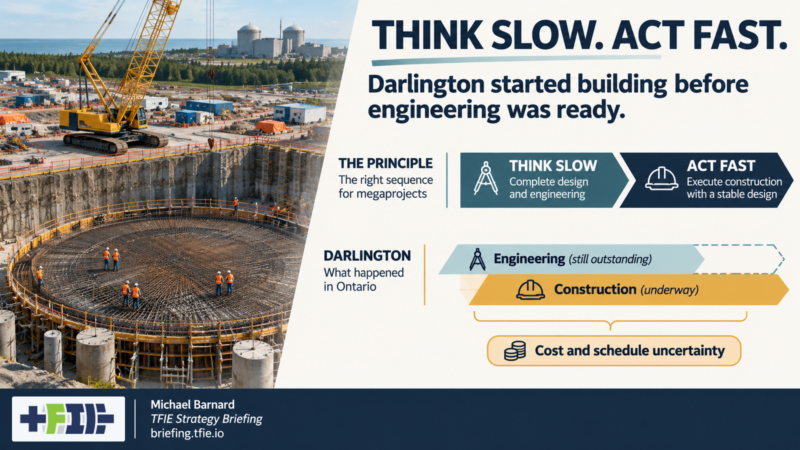
CleanTechnica reports that both the financial budget and project timeline for Darlington's initial unit have already broken from initial expectations before the reactor's engineering design has reached full stabilization. In complex capital projects, proceeding with site preparation and procurement while final design parameters remain in flux frequently introduces compounding schedule delays and rework expenses.
"Darlington's SMR budget and schedule have broken before the design has stabilised. Ontario has cheaper clean energy procurement contracts, but must compare complete reliability portfolios."
The emergence of these challenges on the lead reactor directly affects the risk profile of the multi-unit strategy. Rather than benefiting from a locked, standardized blueprint, provincial planners face the prospect of managing ongoing design adjustments alongside active construction commitments.
Economic Comparisons and Reliability Portfolios
The financial pressures at Darlington are unfolding against a backdrop of evolving clean energy economics in Ontario. According to the CleanTechnica assessment, the province already has access to cheaper clean energy procurement contracts outside of the small modular reactor program. On a pure levelized cost basis, alternative clean generation contracts present a lower immediate price point for ratepayers and procurement authorities.
However, evaluating grid infrastructure requires looking beyond standalone generation contracts. As CleanTechnica notes, provincial energy planners must compare complete reliability portfolios rather than isolated generation assets. Nuclear reactors are designed to provide continuous, dispatchable baseload power, whereas variable renewable generation requires complementary investments in energy storage, transmission upgrades, and grid-firming capacity to deliver equivalent system reliability.
For capital markets and utility regulators, the central economic question is whether the escalating costs of the Darlington small modular reactor program remain competitive once the full system costs of alternative clean reliability portfolios are calculated. If first-unit overruns erode the projected cost advantages of modular nuclear construction, the financial justification for locking in three follow-on units becomes significantly harder to sustain.
Strategic Implications for Multi-Reactor Commitments
The trajectory of the Darlington project carries substantial implications for both Ontario's long-term resource adequacy planning and the broader international nuclear supply chain. Committing ratepayer and public capital to a four-reactor sequence before the initial unit demonstrates cost containment and design maturity exposes provincial balance sheets to amplified construction risk.
Moving forward, energy policymakers and oversight bodies in Ontario face increasing pressure to establish strict stage-gate reviews before authorizing binding expenditures on the remaining three reactors. Ensuring that the first unit achieves full design stabilization—and conducting a transparent, apples-to-apples comparison against complete clean energy reliability portfolios—will be essential milestones in determining whether the full four-reactor vision at Darlington proceeds as originally planned.


