Cutting-Edge Bionic Limbs Open New Frontiers in Brain Research
Advanced bionic prosthetics connecting directly to human nerves offer unprecedented insights into neuroplasticity and neural reorganization.
EXECUTIVE BRIEF // KEY TAKEAWAYS
Advanced bionic prosthetics connecting directly to human nerves offer unprecedented insights into neuroplasticity and neural reorganization.
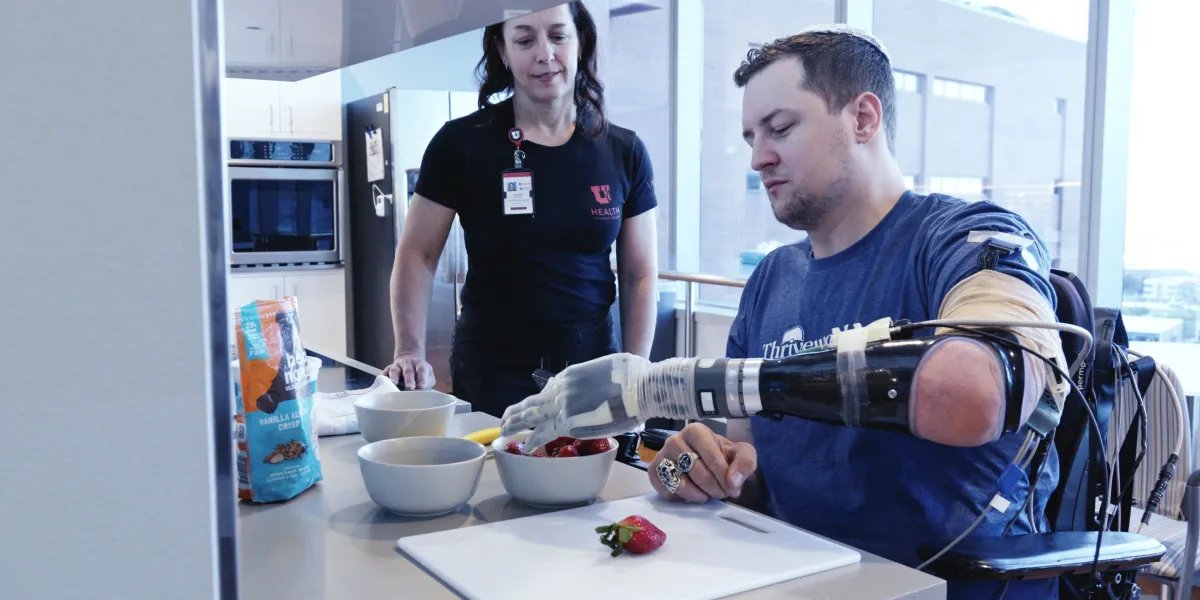
A clinical trial evaluating advanced bionic prosthetics that connect directly to human nerves is providing researchers with rare empirical opportunities to observe neuroplasticity and the complex ways the human brain maps lost limbs. According to reporting from the MIT Technology Review, a trauma therapist named Alexander (Avi) Davidson has volunteered to become the ninth person to trial this cutting-edge technology, and the first to take the apparatus home for independent, daily use. Unlike standard commercial prosthetics, the experimental device requires physical wires emerging directly from the user's arm to interface with implanted electrodes, enabling both motor movement and sensory feedback. While the immediate objective of the trial is to evaluate how bionic limbs perform in uncontrolled, real-world domestic environments outside of sterile laboratory settings, the long-term implications extend far beyond assistive technology. Neuroscientists are closely monitoring the study to determine whether continuous sensory feedback from a bionic hand can alter neural representations in the brain, potentially unlocking fundamental mechanisms of human cognition, sensory adaptation, and neurological recovery.
For the global technology sector, the intersection of advanced prosthetics and neural interfaces represents a critical frontier in human-computer interaction and cybernetic integration. As enterprise investments in neurotechnology accelerate, the ability to bridge biological nervous systems with external hardware holds profound commercial and clinical potential. Capital markets and medical device manufacturers are increasingly tracking clinical trials that test hardware durability, biocompatibility, and user autonomy in daily life. Understanding how a human brain processes sensory signals from an artificial limb provides foundational data necessary for the next generation of neural prosthetics, therapeutic rehabilitation tools, and assistive robotics.
The Real-World Trial and Subject Demographics
The clinical trial, managed by a research team at the University of Utah, is designed to answer longstanding operational questions regarding how advanced neural prosthetics fare over extended periods of unsupervised use. Participants in the study face significant physical and logistical burdens. For instance, Davidson has spent the 17 years since his teenage accident learning to operate approximately seven different prosthetic devices. To participate in the current study, he underwent invasive surgery to implant electrodes in his arm, integrated hundreds of hours of lab-based training and intensive physical therapy with his professional responsibilities as a trauma therapist, and faces an eventual follow-up surgery to have the electrodes removed.
Despite the physical toll and the reality that he will not retain ownership of the advanced device long-term, Davidson has emphasized his commitment to scientific advancement. As reported by the MIT Technology Review, Davidson noted regarding his participation: “While it’s unfortunate at times, and irritating at times, I do not regret what has come from [the accident], or the fact that it happened. I am not going to benefit from this … I wanted to be a part of this in the context of being able to help push the technology forward.”
Physiological Anomalies and Neuroscientific Unknowns
The integration of direct-nerve prosthetics has already yielded unexpected physiological phenomena that challenge current clinical assumptions. During independent use—such as performing delicate daily tasks like writing or drinking from a cup—Davidson observed that his prosthetic wrist occasionally becomes sore and stiff from overuse, mirroring the fatigue experienced in a biological limb. Remarkably, this artificial stiffness can be temporarily relieved through standard physical stretching. Investigators and medical researchers acknowledge that the exact neurological and physiological mechanisms driving this sensation remain unclear, highlighting the nascent state of human-machine sensory integration.
Furthermore, researchers are investigating whether daily interaction with a sensory-enabled bionic hand alters how the brain represents missing anatomy. Prior to the commencement of the trial, baseline brain scans were conducted to map the neural representation of Davidson's missing left hand. Scientists are now analyzing subsequent data to see if and how those neural maps shift over time. Such findings could revolutionize therapeutic approaches not only for individuals who have suffered traumatic amputations, but also for individuals born without limbs, offering profound insights into how the central nervous system adapts to cybernetic interventions.
Future Horizons and Regulatory and Funding Hurdles
The trajectory of this research remains contingent upon several critical variables, including ongoing trial progress, patient health outcomes, and the sustained acquisition of research funding. Davidson is scheduled to retain the experimental device until late January 2027 at the earliest, with the potential for an extension of up to an additional year. However, institutional uncertainty remains regarding the long-term operational lifespan of such internal neural interfaces within the human body.
As the scientific community monitors these developments, the outcomes of the University of Utah study will likely inform future regulatory frameworks, clinical trial designs, and commercialization strategies for neural prosthetics. By bridging the gap between mechanical engineering and cognitive neuroscience, trials of this caliber are laying the empirical groundwork for a future where bionic systems function not merely as replacement tools, but as active probes into the deepest mechanics of the human mind.


