Curiosity Captures Rare Twilight Clouds Over Gale Crater
Curiosity’s observation of Martian twilight clouds provides critical atmospheric data, shaping predictive modeling for future aerospace exploration.
EXECUTIVE BRIEF // KEY TAKEAWAYS
Curiosity’s observation of Martian twilight clouds provides critical atmospheric data, shaping predictive modeling for future aerospace exploration.
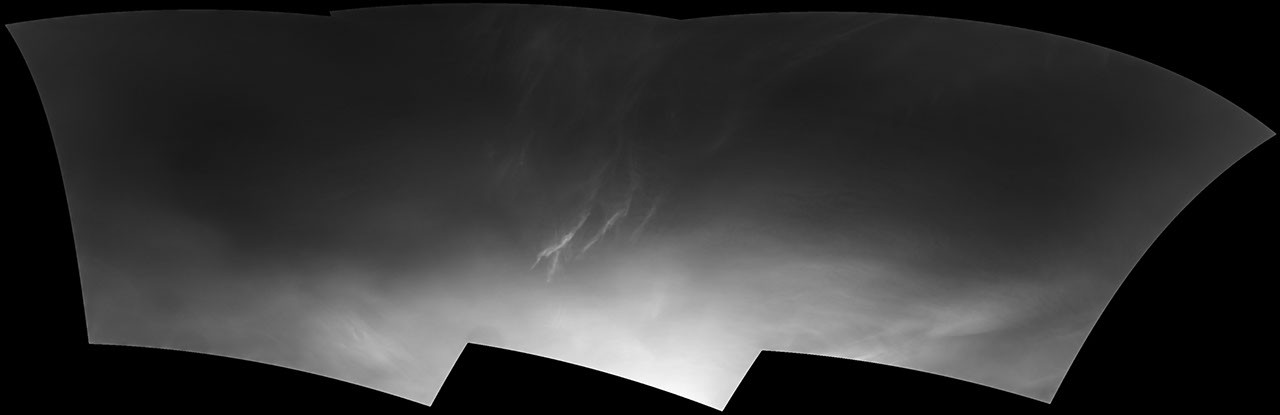
WASHINGTON — NASA’s Curiosity Mars rover has recorded rare twilight clouds drifting across the Martian sky after sunset on Oct. 31, 2026, marking the 5,061st Martian day, or sol, of its extended surface mission. Captured using the rover’s onboard navigation cameras, the imagery documents transient atmospheric phenomena that manifest exclusively during a brief seasonal window each autumn above Gale Crater, offering fresh empirical insight into high-altitude weather systems on the Red Planet.
For the broader aerospace sector and long-term interplanetary exploration roadmaps, understanding the microphysics of Martian cloud formation carries direct strategic relevance. As commercial launch providers and international space agencies develop next-generation Entry, Descent, and Landing (EDL) flight envelopes and surface habitability infrastructure, precise models of atmospheric density gradients, aerosol distribution, and seasonal vapor condensation reduce operational risk and optimize sensor calibration for future autonomous hardware.
Seasonal Atmospheric Phenomena in Gale Crater
The newly documented cloud formations, designated as twilight clouds, appear briefly in the post-dusk upper atmosphere, where elevated particles catch residual sunlight long after the planetary surface has slipped into darkness. Operating in the equatorial basin of Gale Crater, which the robotic explorer has traversed since its arrival in August 2012, Curiosity relied on its mast-mounted navigation cameras (Navcams) to capture the faint structural striations of the drifting formations against the evening sky.
“The rover uses its navigation cameras to capture post-sunset clouds, called twilight clouds, which appear for only a short time each fall over Gale Crater,” NASA reported in its official mission documentation.
According to NASA releases, such nocturnal optical phenomena require specific thermal and barometric thresholds that occur only during select phases of the Martian seasonal cycle. Because the Martian atmosphere consists primarily of carbon dioxide at less than one percent of Earth’s sea-level surface pressure, high-altitude cloud structures typically form through the deposition of either water ice crystals or carbon dioxide ice aerosols around micrometeorite dust nuclei, revealing subtle shifts in planetary thermodynamics.
Technological Endurance and Atmospheric Data Acquisition
The acquisition of high-altitude imagery past sol 5,000 underscores the extraordinary mechanical and computational endurance of the Curiosity platform. Originally engineered for a nominal primary mission lifespan of one Martian year (roughly 687 Earth days), the rover has sustained continuous scientific reconnaissance across Gale Crater for over 14 Earth years. Utilizing its multi-mission radioisotope thermoelectric generator (MMRTG) and redundant optical arrays, the robotic laboratory continues to deliver baseline climatological datasets without requiring dedicated atmospheric sounding rockets or auxiliary orbital relays.
From a systems engineering standpoint, utilizing baseline navigation cameras for atmospheric observation demonstrates the operational agility required in deep-space asset management. Standard navigation camera systems, primarily deployed for terrain mapping, hazard avoidance, and drive path validation, have been reprogrammed with targeted exposure sequencing to isolate faint contrast gradients in the Martian twilight. This multi-purpose sensor utilization mitigates the degradation of specialized spectrographic hardware, extending the operational return on capital invested in legacy planetary exploration infrastructure.
Strategic Implications for Future Interplanetary Missions
Looking forward, empirical records of seasonal Martian cloud patterns will play a foundational role in de-risking high-value scientific and uncrewed logistics missions planned for the coming decades. High-altitude clouds directly influence the radiative thermal balance of the middle and upper Martian atmosphere, inducing localized pressure variations that challenge aero-braking maneuvers and hypersonic glide profiles during planetary entry. By constraining the temporal and spatial boundaries of these seasonal cloud formations, aerospace flight engineers can refine aerothermodynamic algorithms used in commercial and governmental mission architectures.
Furthermore, the continuous observation of seasonal dust and cloud dynamics addresses ongoing regulatory and safety benchmarks established by international planetary protection frameworks. As uncrewed cargo freighters and robotic sample-return architectures advance toward final launch manifest approvals, atmospheric predictability remains a vital variable in landing error ellipses and surface solar power continuity. Curiosity’s ongoing reconnaissance within Gale Crater reaffirms that legacy robotic assets continue to supply indispensable telemetry, bridging the gap between historical surface surveys and the next generation of deep-space exploration.


