Beta Technologies Prioritizes Cargo Planes to Lead Electric Flight
By certifying a fixed-wing freighter before its vertical-lift airframe, Beta Technologies aims to de-risk FAA approval and build a charging ecosystem.
EXECUTIVE BRIEF // KEY TAKEAWAYS
By certifying a fixed-wing freighter before its vertical-lift airframe, Beta Technologies aims to de-risk FAA approval and build a charging ecosystem.
SOUTH BURLINGTON, Vt. — Beta Technologies is advancing a phased commercialization strategy for electric aviation, prioritizing conventional runway cargo aircraft and an open-standard charging network ahead of vertical-takeoff air taxis, according to a report by IEEE Spectrum. Operating out of a 17,500-square-meter production facility at Patrick Leahy Burlington International Airport, the Vermont-based aerospace manufacturer is developing two variants of its electric Alia airframe: the fixed-wing CX300 for conventional airport-to-airport logistics and the A250 electric vertical-takeoff-and-landing (eVTOL) aircraft. Test pilots have logged more than 300,000 kilometers across the Alia fleet, supporting an order and option-to-buy backlog of 991 aircraft.
The company's dual-track hardware and infrastructure strategy diverges sharply from top U.S. competitors Joby Aviation and Archer Aviation, which are focusing primarily on urban passenger air taxis. By certifying a conventional fixed-wing cargo plane first, Beta aims to lower regulatory hurdles with the Federal Aviation Administration (FAA), capture immediate regional logistics revenue across more than 5,000 existing U.S. public-use airports, and establish an interoperable ground charging standard across the commercial aviation sector.
Pragmatic Certification and Structural Commonality
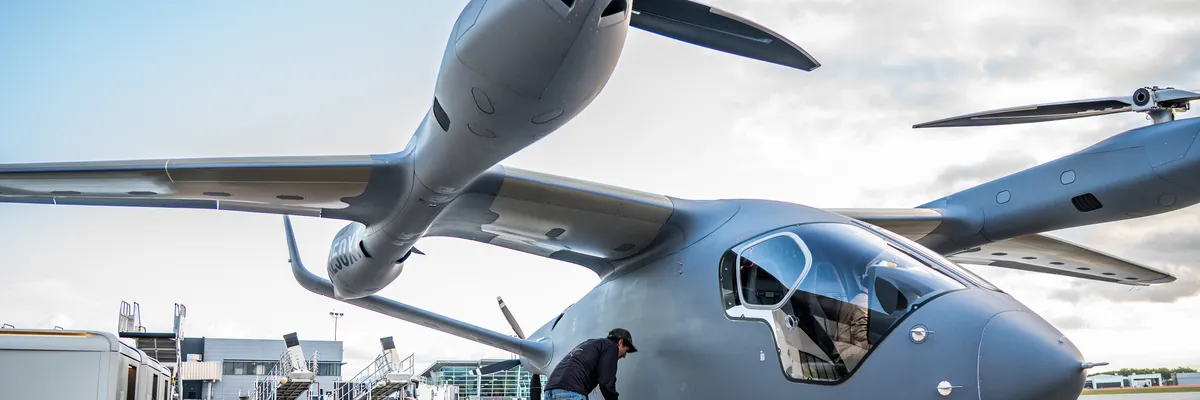
Founded in 2017 by chief executive Kyle Clark with an initial $48 million prototype investment from United Therapeutics CEO Martine Rothblatt, Beta has vertically integrated the manufacturing of its airframes, motors, inverters, battery packs, software, and charging hardware. The CX300 and A250 share the same fuselage, 15-meter wingspan, fly-by-wire flight controls, battery architecture, and rear pusher motor. While the CX300 retains twin tail booms that are structurally designed to hold the A250's four vertical lift rotors—adding weight and drag without providing lift on the runway model—the shared architecture is central to Beta's regulatory roadmap.
"We’re taking a pragmatic stepwise approach for both certification and market entry. We’re ready to go today with medical and cargo aircraft that fly from airport to airport." — Kyle Clark, CEO and Founder, Beta Technologies
Clark noted that the company intentionally omitted non-essential hardware, including cabin air-conditioning and wing flaps, on the initial cargo variant to eliminate weight, maintenance burdens, and certification complexity. Aviation analyst Sergio Cecutta, a managing partner at SMG Consulting, told IEEE Spectrum that while critics initially viewed the fixed-wing pivot as a setback for Beta's vertical-lift ambitions, splitting the certification process retires substantial technical risk because documentation for shared components can be reused when certifying the A250.
Propulsion Economics, Battery Physics, and Ecosystem Scale
In flight demonstrations reported by IEEE Spectrum, a 30-minute sortie in the Alia CX300 consumed approximately $9 worth of electricity, compared with 25 to 30 gallons of Jet A fuel costing $210 to $255 for a comparable conventional Cessna 208 Caravan. During descent, the aircraft's coasting propeller acts as a generator, feeding roughly 9 kilowatts of regenerative power back into the battery system. Propulsion is driven by Beta's proprietary H500A electric pusher motor, which weighs about 75 kilograms, produces 640 kilowatts of power, and achieves 97.5 percent efficiency in internal testing—far exceeding the 25 to 35 percent efficiency typical of conventional turboprops. To meet aviation safety thresholds requiring catastrophic failure probabilities of roughly one in a billion flight hours, the H500A splits inverters and stator sections into independent halves.
"You could lose an entire half of the system, and it would still function the same." — Adam Lowe, Flight Operations Lead, Beta Technologies
Despite drivetrain efficiency and an aerodynamic lift-to-drag ratio more than double that of combustion counterparts, mass remains the primary physical constraint. The CX300 carries five liquid-cooled battery packs totaling roughly 225 kilowatt-hours of rated capacity. Each pack weighs 255 kilograms and houses 2,772 standard cylindrical cells—placing approximately 14,000 cells beneath the cabin and accounting for nearly half of the aircraft's total mass. Unlike jet fuel, battery mass remains constant from takeoff to landing, requiring lightweight composite structures that aerospace engineering professor Anubhav Datta of the University of Maryland noted must carefully balance structural flexibility against vibration and fatigue.
Beyond aircraft manufacturing, where Beta employs roughly 1,500 workers, the company is positioning itself as a tier-one propulsion and infrastructure supplier. Beta has secured a contract worth up to $1 billion to supply pusher motors for Eve Air Mobility, sells flight-control computers to Horizon Aircraft, and builds the hybrid-electric autonomous MV250 for defense applications. On the ground, Beta has deployed 138 fast-charging locations utilizing the open Combined Charging System (CCS) standard. Its airport Charge Cubes draw 480-volt AC power to deliver up to 320 kilowatts at 1,000 volts DC, paired with water-glycol thermal management units capable of recharging an Alia airframe in about 35 minutes. Customers for Beta's charging hardware include Archer Aviation, Atlantic Aviation, Signature Aviation, and government agencies.
Regulatory Milestones and Commercial Outlook
Securing FAA type and production certificates remains the decisive hurdle before commercial entry. Although Beta's initial target to certify the H500A motor in the first half of 2026 passed without a public announcement, the company projects full FAA certification for the fixed-wing CX300 in 2027, followed by the A250 eVTOL in 2028. In the interim, Beta is executing real-world operational trials under the FAA's eVTOL Integration Pilot Program, including a Virginia-to-Maryland medical transport corridor flight carrying a manufactured transplantable organ, alongside six additional FAA-backed programs. Internationally, following a 23-flight demonstration across six Scottish cities, regional carrier Loganair signed a term sheet for five Beta aircraft with options for five more, targeting commercial service entry in 2029.