Apple Expands AI Lineup With Complex Hardware Rules and Paid Tiers
Apple has rapidly expanded its artificial intelligence ecosystem, but complex hardware requirements and tiered subscription costs risk alienating core users.
EXECUTIVE BRIEF // KEY TAKEAWAYS
Apple has rapidly expanded its artificial intelligence ecosystem, but complex hardware requirements and tiered subscription costs risk alienating core users.
CUPERTINO, Calif. — Apple Inc. is navigating a major strategic turning point as the rapid proliferation of its artificial intelligence tools creates growing complexity for global consumers, who face divergent hardware requirements, disjointed sub-brands, and an impending paywall for cloud-based features, according to a detailed market analysis published by Fast Company.
The technology titan’s evolving architecture represents a critical stress test for the enterprise consumer electronics sector, revealing how hardware limitations and ballooning cloud infrastructure expenditures are compelling even the world’s most disciplined platform operator to abandon its historic simplicity in favor of segmented monetization and multi-tiered software deployment.
Foundational Layers, Chatbots, and Third-Party Model Integration
Apple first entered the modern generative artificial intelligence landscape in 2024 with the debut of Apple Intelligence, trailing pioneers such as OpenAI, which triggered the ongoing boom in late 2021, and Google, which accelerated its deployments in 2022. While early iterations faced industry criticism for lackluster capabilities, Apple spent two years refining its core technologies before rolling out an expanded framework in 2026 that includes its Siri AI conversational chatbot, Audio Intelligence, and a specialized productivity tool known as "intelligent assistant."
Fast Company reported that Apple’s AI ecosystem now bifurcates into three distinct tiers that consumers frequently conflate. Apple Intelligence serves as the foundational operating layer embedded directly across iOS, macOS, and watchOS. This underlying system powers contextual features such as Visual Intelligence—which analyzes visual data from device cameras and screens to generate real-time feedback, including food nutritional metrics—as well as Audio Intelligence, live audio and message translation, photo editing suites, and automated summaries.
Contrasting with this foundational framework, Siri AI functions as a distinct natural-language interface to query Apple Intelligence, running primarily through the cloud across devices supporting version 27 operating systems, spanning iOS, macOS, iPadOS, visionOS, watchOS, and an upcoming release for tvOS. Devices handling Siri AI queries locally on silicon require significant compute thresholds, restricted to Macs equipped with an M3 processor and at least 12 gigabytes of random-access memory, or smartphones such as the iPhone 17 Pro and iPhone Air.
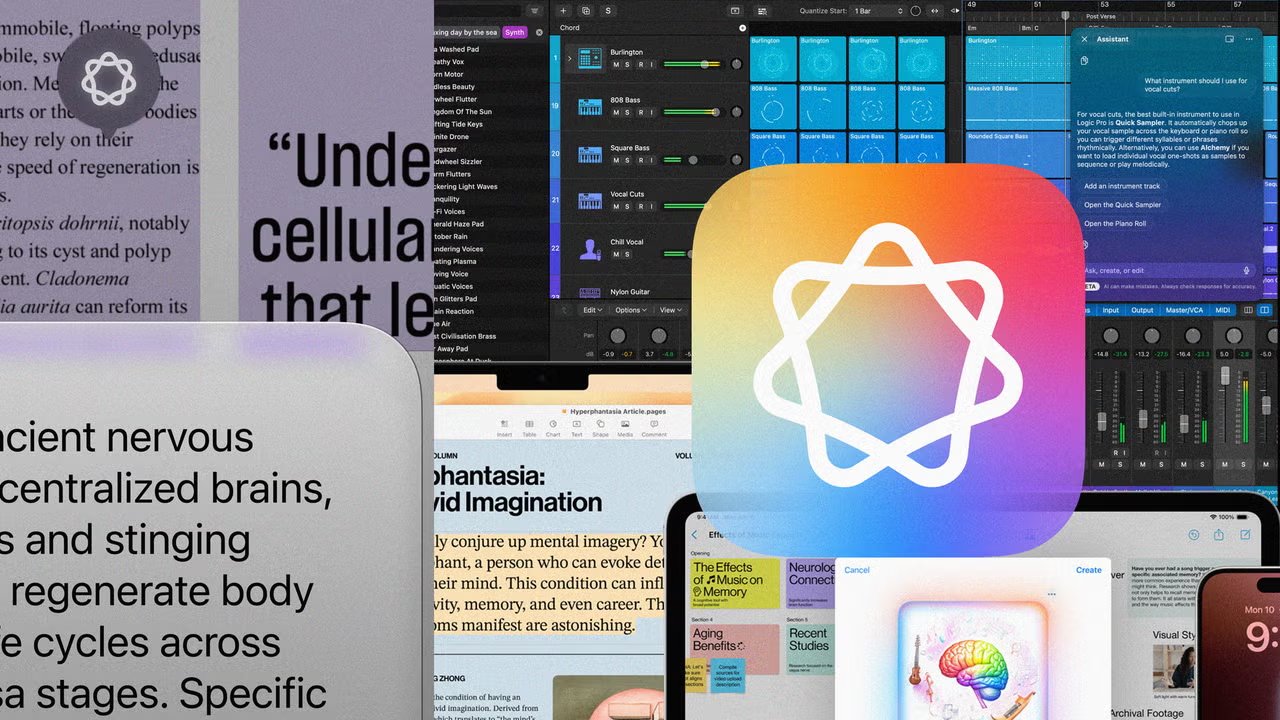
The newest and most capable entry, dubbed "intelligent assistant," was introduced last month and rolled out across the Creator Studio suite, embedding generative capabilities directly into Logic Pro, Pages, Numbers, and Keynote. Rather than drawing power from Apple Intelligence or Siri AI, the tool relies on a hybrid framework combining Apple Foundation Models with high-performance frontier models supplied by OpenAI and Google.
"The changes happen like magic—all very impressive stuff," Fast Company observed regarding the assistant's workflow prompts, including instructions to "make this piano track sound like it was recorded in a concert hall" or "fix the formula errors in this spreadsheet."
Hardware Segmentation and Emerging Subscription Economics
The functional divide between local processing and cloud delivery has introduced strict silicon gating across Apple’s hardware catalogue. While any Mac featuring an Apple Silicon processor can support entry-level Apple Intelligence operations, advanced utilities such as custom Siri Voices and advanced dictation mandate an M3 chip with 12 gigabytes of unified memory. Across the iPhone line, base Apple Intelligence operates on iPhone 15 Pro hardware and subsequent iterations, but advanced capabilities remain gated behind the iPhone 17 Pro. Similarly, wearable support for Audio Intelligence remains isolated to the Apple Watch Series 12 and Apple Watch Series 4.
Economic pressures tied to compute expenses are driving an unprecedented shift in Apple's monetization playbook. Although Siri AI and Apple Intelligence currently operate free of charge, Fast Company noted that Apple plans to enforce daily usage limits beginning in December with the release of version 27.3 across its operating systems. Once users exhaust daily allocations, cloud-dependent AI operations will be halted unless users upgrade their digital storage footprint.
To expand processing volume, Apple is tying artificial intelligence allowances directly to higher-tier iCloud Plus subscriptions. While the baseline 50-gigabyte tier at 99 cents per month yields no additional capacity, premium tiers scale incrementally: the $2.99-per-month 200-gigabyte package doubles daily limits, the $9.99 2-terabyte tier delivers a fivefold boost, the $29.99 6-terabyte plan provides a tenfold expansion, and the $59.99 12-terabyte tier increases limits by twentyfold.
Access to the flagship intelligent assistant in productivity and creative software requires a completely separate financial commitment. The feature is bundled exclusively inside the Creator Studio suite, priced at $12.99 per month or $129 per year. Consequently, enterprise professionals and content creators seeking unfettered utility across Apple’s complete artificial intelligence portfolio face cumulative subscription overhead requiring dual recurring fees.
Strategic Milestones and Market Implications
The bifurcation of Apple’s artificial intelligence portfolio signals a broader realignment across consumer technology, where the high operational costs of cloud compute collide with consumer expectations of seamless hardware-software integration. By pairing internal foundation models with external systems developed by OpenAI and Google for its premier creative tools, Apple acknowledges the lead established by market incumbents while preserving device-level ecosystem lock-in.
The rollout of operating system versions 27.3 in December will represent an essential proving ground for this hybrid commercial structure. Investors and enterprise watchers will closely monitor whether everyday consumers tolerate daily compute quotas and two-tier subscription demands, or whether user friction triggers pushback against Apple’s increasingly fragmented ecosystem.


