5G Non-Terrestrial Networks Lay Technical Blueprint for 6G Systems
Technical advances in 5G satellite integration from 3GPP Release 15 to 19 establish physical and protocol foundations for unified, AI-driven 6G networks.
EXECUTIVE BRIEF // KEY TAKEAWAYS
Technical advances in 5G satellite integration from 3GPP Release 15 to 19 establish physical and protocol foundations for unified, AI-driven 6G networks.
NEW YORK — The technical evolution bridging terrestrial cellular infrastructure with orbital satellite platforms has advanced into a defining phase as global standards bodies formalize Non-Terrestrial Network (NTN) specifications across 3GPP Release 15 through Release 19, according to an engineering analysis published by IEEE Spectrum in collaboration with Wiley. The shift from siloed proprietary satellite communications toward standardized 5G New Radio Non-Terrestrial Networks (NR-NTN) establishes the core operational framework required to build unified, multi-dimensional sixth-generation (6G) wireless systems.
For enterprise telecommunications operators, aerospace developers, and international logistics providers, the maturation of NR-NTN standards addresses persistent geographic limitations that leave remote interiors, international waters, and disaster zones detached from high-speed digital infrastructure. By integrating spaceborne payloads directly into standardized commercial network architectures, the technology transforms orbital transceivers into native network nodes, opening new avenues for global industrial monitoring, mission-critical communications, and AI-enabled edge orchestration across previously disconnected territory.
Standardization Trajectory and Payload Architectural Trade-offs
The progression of 3GPP specifications across Releases 15, 16, 17, 18, and 19 has progressively codified how terrestrial 5G protocols accommodate non-terrestrial channel dynamics. According to the whitepaper, titled “5G NTN Takes Flight: A Deep Dive into NR-NTN Technology and Testing Aspects,” a central engineering decision centers on the choice between transparent and regenerative payload architectures aboard satellite platforms, each presenting distinct implications for network performance and capital deployment.
“How transparent and regenerative satellite payload architectures differ, and what each choice means for round trip time, link budget, and hardware complexity,” the IEEE Spectrum source documentation states, remains a foundational design question governing orbital network topology.
In a transparent or “bent-pipe” architecture, the orbital platform functions as a frequency converter and radio-frequency amplifier, repeating signals between ground stations and user terminals without baseband demodulation. While this model minimizes payload weight, power consumption, and hardware complexity aboard satellites, it introduces higher end-to-end round-trip latency and compounds link-budget constraints. Conversely, regenerative payloads implement full or partial base station processing directly on the spacecraft, enabling on-board routing and signal regeneration. This configuration significantly reduces round-trip time and optimizes link margins, though at the expense of higher satellite mass, thermal constraints, and increased hardware and computational overhead.
Physical Layer Impediments: Doppler Shifts, Timing, and Mobility
Operating cellular protocols over extreme physical distances introduces severe physical layer disruptions that do not manifest in standard terrestrial cellular deployments. Low Earth Orbit (LEO) satellites travel at orbital velocities exceeding 7.5 kilometers per second, generating substantial Doppler shifts and dynamic propagation delays that challenge basic network synchronization. The whitepaper details how engineering teams must recalibrate timing advance calculations and re-engineer Hybrid Automatic Repeat Request (HARQ) mechanisms to account for long signal transit times that would otherwise cause conventional terrestrial protocols to time out and degrade data throughput.
Mobility management across non-terrestrial networks introduces parallel architectural complexity. Network engineers must configure robust cell selection routines, conditional handovers, and feeder link switchovers as high-speed orbital spot beams sweep rapidly across the Earth’s surface. Seamless service continuity requires precise coordination not only between shifting satellite cells and ground-based gateway feeder links, but also between non-terrestrial and terrestrial cellular layers, ensuring that mobile devices traverse heterogeneous radio environments without dropped connections or session renegotiations.
To de-risk these deployments, the report highlights the critical role of rigorous verification methodologies across radio frequency (RF), protocol, and over-the-air (OTA) testing domains. Validating user equipment, satellite transceivers, and base stations requires emulating realistic atmospheric fading, variable Doppler profiles, and complex propagation channels under laboratory conditions before hardware enters orbit.
The Evolution Toward Unified, Multi-Dimensional 6G Networks
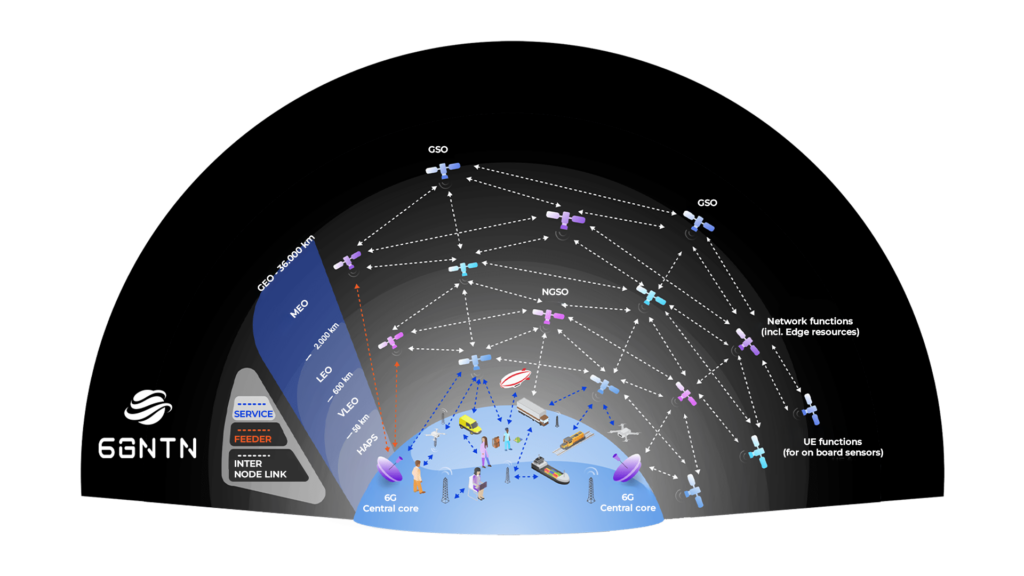
Beyond extending 5G coverage, the ongoing refinement of NR-NTN standards serves as an incubator for next-generation telecommunications paradigms. As the industry advances from Release 19 into preparatory 6G standardization, non-terrestrial communications are transitioning from supplementary coverage layers into fully unified multi-dimensional networks that operate across diverse spectrum bands, altitudes, and orbital planes.
The engineering documentation outlines an operational roadmap where terrestrial cellular cells, high-altitude platform systems (HAPS), and both geostationary and low-Earth satellite constellations converge into a cohesive network fabric. This unified 6G topology is designed to integrate advanced capabilities beyond simple data transport, incorporating integrated sensing, precise planetary positioning, and distributed artificial intelligence to autonomously optimize radio resource allocation, predict handover requirements, and maintain resilience across dynamic aerospace and terrestrial environments.


